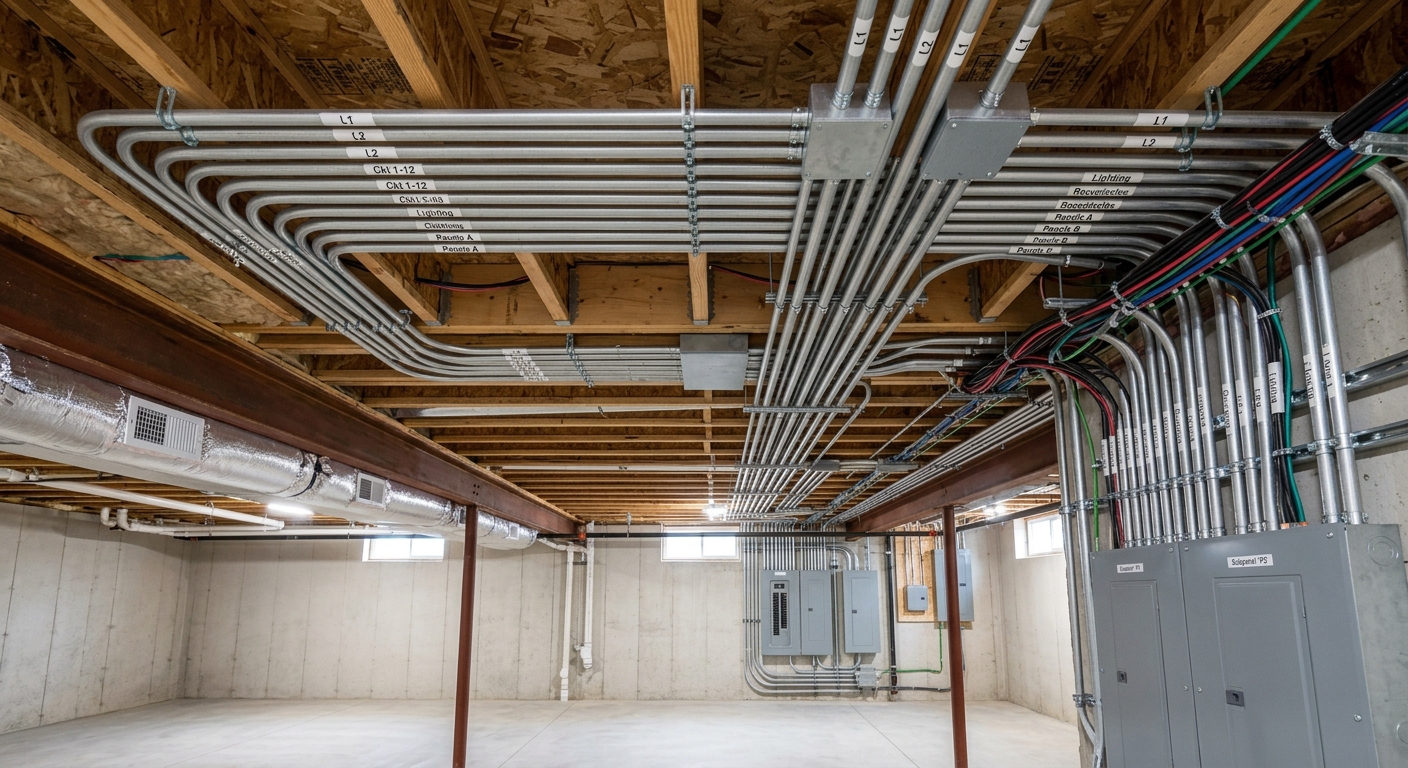
Electrical services and costs in Colwood
Electrical services in Colwood often start with safety and capacity questions, because many homes here were built long before modern load requirements. In fact, about 42.2% of dwellings in the area were built before 1981, which means you’ll frequently see older panels, dated wiring methods, and limited room for today’s demands. Another common driver is that Colwood households increasingly need room for heat pumps, electric baseboard, and other all-electric upgrades—especially as 5,455 homeowner households (73.5%) carry the majority of ownership in the community (Statistics Canada, 2021 Census).
On Vancouver Island and the Coast, the climate and the housing mix shape pricing in two ways. First, coastal weather and frequent moisture exposure don’t “cause” poor wiring by themselves, but they make connection quality, grounding, and weatherproofing more critical—so inspectors and electricians pay extra attention to detailing. Second, the market is busy: panel upgrades, knob-and-tube removals, and 100A-to-200A service upgrades are common in places like the Colwood suburbs near Metchosin Road and West Shore neighbourhoods, where older housing stock meets increasing EV and heat-pump adoption.
That’s why quotes can be surprisingly different for homes that look similar at first glance. A simple lighting update may stay in the lower band, but adding circuits, correcting wiring issues, or upgrading service capacity typically pushes projects toward the mid–high four figures. Use the comparison table below to benchmark your next step.
| Service |
Why It's Needed |
Permit Required |
Price Range |
| Panel upgrade — 100A to 200A service |
Adds capacity for heat pumps, EV charging, induction cooking, and future expansion; improves safety margins on older services. |
Yes (permit + inspection; utility coordination) |
$3,500–$9,000 |
| EV charger installation (Level 2, 40–50A) |
Supports daily charging and reduces reliance on slower outlets; usually requires a dedicated breaker/cabling and sometimes service work. |
Yes (permit + inspection) |
$1,200–$3,000 |
| Knob-and-tube wiring removal and replacement |
Modern safety and insulation concerns; insurers often require remediation before accepting or renewing coverage. |
Yes (rewiring scope generally requires permits) |
$8,000–$25,000 |
| Aluminum wiring remediation (CO/ALR connectors) |
Licensed connections reduce risk from oxidation and overheating; may include partial fixes or upgrades to compliant termination methods. |
Yes (typically part of a permitted remediation/alteration) |
$6,500–$18,000 |
| New dedicated circuit (HVAC, appliance, hot tub) |
Prevents nuisance trips and overheating by sizing conductors/breakers to the load; helps when panels are near capacity. |
Yes (major circuit additions generally require a permit) |
$1,000–$4,500 |
| Whole-home rewire (older home, full replacement) |
Addresses widespread wiring failures or mixed wiring types; improves overall safety and code compliance for modern devices. |
Yes (full rewiring requires permits + inspection) |
$12,000–$30,000 |
Prices are estimates only and vary by project scope, site access and material selection.
What affects the price of electrical work in Colwood
For the same “type” of job, electrical quotes across Vancouver Island and Coast and the broader British Columbia market can vary by 30–50%. The biggest reason isn’t the electrician’s hourly rate—it’s what the electrician discovers during load assessment, opening walls, and verifying existing wiring and panel condition. In Colwood, the dominant cost driver is often the age of the housing stock. Homes built before 1950 may include knob-and-tube wiring, which can trigger insurance refusals or require remediation before coverage continues. Meanwhile, many 1960s–70s houses have 60A or 100A panels that struggle with today’s combination loads (EV chargers, heat pumps, electric ranges) and may require a load calculation and service upgrade. Aluminum wiring is also common in homes built roughly in the 1965–1976 window; remediation needs licensed connectors such as CO/ALR or, in some cases, complete replacement.
EV adoption is adding another pressure point. Level 2 chargers (commonly 40A or 50A) generate a surge in permit applications, and if your service is close to its limit, the job can move from “charger-only” into “service upgrade first.” For many Vancouver Island homes, a 100A-to-200A upgrade can sit in the $3,500–$9,000 range once you account for materials, permits, and coordination with BC Hydro. By contrast, a smaller dedicated-circuit or outlet expansion project might land closer to the $300–$2,500 lighting/fixture style band—unless the panel is already constrained.
Concrete examples in Colwood: (1) Homes with tight crawlspaces or difficult attic access often increase labour time for rewiring and conductor runs, pushing you toward the higher end of wiring work. (2) Moisture-prone areas near the coast can require additional weatherproofing and careful terminations, which raises material and inspection time. (3) If your panel is older or overloaded, a load calculation may confirm that a simple “add one breaker” won’t work safely—shifting the budget from minor upgrades into a full service upgrade.
| Price Factor |
Why It Matters |
Cost Impact |
| Panel size upgrade — 100A to 200A is the standard minimum today |
More capacity reduces overheating risk and supports modern loads without constant tripping. |
Often adds the largest cost step, frequently within the $3,500–$9,000 band for typical service work |
| Wiring type — copper vs. aluminum remediation vs. K&T removal |
Aluminum and knob-and-tube require specific compliant methods, connectors, or full replacement. |
Can move a project from a few thousand dollars to high five/low six figures depending on scope (e.g., wiring bands $8,000–$25,000 and beyond) |
| Number of new circuits — each adds material and labour time |
Each circuit needs proper conductor sizing, breaker(s), terminations, and testing. |
More circuits can add several hundred to a few thousand per circuit |
| Permit + ESA/TSBC inspection fee — mandatory for all major work |
Major alterations and new circuits must be permitted and inspected. |
Typically increases totals; also can add scheduling time |
| Labour rate for licensed electricians — journeyman rates in Vancouver Island & Coast |
Travelling, complexity, and jobsite conditions drive labour hours. |
Labour hours are a major portion; uneven access can increase quotes by 10–30% |
| EV charger amperage — 40A vs. 50A circuit affects cable and breaker cost |
Higher amperage typically requires heavier cable and specific breaker/components. |
May add a few hundred to about a thousand depending on routing and panel capacity |
| Emergency or after-hours premium |
Urgent dispatch often costs more due to scheduling and time constraints. |
Often adds a noticeable premium compared with standard weekday work |
| Load calculation required for service upgrade |
Ensures the new service size and breaker configuration match reality. |
May not add huge material cost, but can change whether you need 150A/200A and prevent rework |
Permits & regulations in British Columbia
In British Columbia, electrical work beyond changing a light bulb must be done by a licensed electrician. Most homeowners can’t legally rewire circuits, modify panels, add wiring, or install new breakers without a contractor licence holding the work under permit. That includes panel upgrades, new circuits (including EV charger circuits), rewiring, and any service upgrade. In practice, inspectors will not pass work that wasn’t completed under a proper permit.
Permitted electrical work must pass inspection by the provincial electrical safety authority, which in BC is handled through Technical Safety BC. While the exact administrative steps can vary, the overall requirement is consistent: the electrician submits the permit, the work is verified to code, and the province inspects before energization/approval milestones are completed. DIY electrical is generally prohibited for most tasks; narrow exceptions (such as certain low-voltage or very limited work) still have conditions and can require permits depending on what you touch.
To verify a contractor in Colwood, start with the electrician’s licence: confirm it through the provincial registry or licence verification tool available under Technical Safety BC. Next, ask for a certificate of insurance showing liability coverage (and request the COI expiry date). Finally, confirm coverage with documentation—typically via clearance letter or proof of coverage for worker compensation. If anything is missing or the contractor won’t provide paperwork up front, treat it as a red flag before you book work.
When your Colwood home needs an electrical upgrade
In Colwood, electrical problems aren’t just “annoying”—some are safety-critical, especially in older homes where wiring methods and panel capacity pre-date modern loads. Start with the warning signs that matter most. (1) Breakers that trip regularly can mean an overloaded panel, a failing breaker, or circuits that aren’t correctly sized for your appliances. If it’s frequent, it needs urgent attention because it can indicate overheating or loose connections.
(2) Knob-and-tube wiring present is a major concern. The issue isn’t only age; old insulation can contact surfaces and degrade, creating higher fire risk, and insurers often refuse coverage or require remediation. (3) A 60A or 100A panel can become inadequate as you add an EV charger, heat pump, and electric stove—running them together can push your service close to limits. In these cases, a 200A upgrade is usually the standard solution.
(4) Aluminum wiring in older homes (often pre-1976 construction) may not be immediately dangerous if properly installed and maintained, but it does require licensed remediation—typically CO/ALR connector work—because connections can oxidize over time. (5) Insufficient outlets (extension cords everywhere) is a code and safety issue; it can also overload circuits and lead to nuisance trips. Finally, (6) no AFCI/GFCI protection where required can surface during home sales or inspections, but you shouldn’t wait for a transaction to fix it.
Where price differences are justified: if your breaker trips only after using one specific appliance, adding a dedicated circuit might cost within the smaller bands. But if load calculations show the panel is near capacity, choosing “one more outlet” instead of addressing service capacity can repeat the problem—so the higher service upgrade cost can be the more economical long-term fix.
| Warning Sign |
What It Means |
Recommended Action |
Urgency |
Price Band |
| Breakers trip frequently |
Likely overload, wiring problem, or breaker/connection issues due to undersized circuits. |
Book an inspection and load check; repair loose/overloaded circuits first. |
Immediate to within days |
$1,000–$4,500 |
| Knob-and-tube wiring present |
Older wiring method with degraded insulation risk and modern safety/insurance concerns. |
Plan knob-and-tube removal and compliant rewire or targeted replacement where feasible. |
High urgency (plan remediation ASAP) |
$8,000–$25,000 |
| 60A or 100A panel (inadequate load capacity) |
Service may be near limits with EV, heat pumps, and other modern loads. |
Do a load calculation and upgrade service to meet demand. |
High urgency if adding new loads |
$3,500–$9,000 |
| Aluminum wiring (pre-1976 construction) |
Connections may overheat if not installed/terminated with approved methods. |
Have it assessed and remediate with CO/ALR connectors or replacement where needed. |
Planned (but do not ignore) |
$6,500–$18,000 |
| Insufficient outlets — extension cords everywhere |
Temporary wiring habits increase shock and overheating risk. |
Add outlets and, if needed, add circuits so you can remove extension cords. |
Planned (fix before a failure) |
$300–$2,500 |
| No AFCI or GFCI protection where required |
Can fail modern safety expectations and may block sale/insurance underwriting. |
Add required protection devices and correct wiring to code. |
Planned (address before sale) |
$800–$3,000 |
How to choose a electrical work contractor in Colwood
Choosing a licensed contractor matters in Colwood because service upgrades, rewiring, and EV charger installs all require permits and inspection under British Columbia rules. Start by verifying the electrician’s licence with the provincial system used in BC (Technical Safety BC). Ask for their certificate of insurance (liability coverage) and confirm they carry worker compensation coverage—typically documented through proof of coverage or a clearance letter. Don’t rely on “we have coverage” without paperwork; request copies before work begins.
Next, get 2–3 itemised written quotes that break out labour and materials, not just a single total. A good quote clearly lists what’s included (for example: panel components, breakers, permits, trenching/conduit if needed, wire/cable type, testing, and disposal). Confirm whether the quote includes permit pull and whether the electrician will coordinate with BC Hydro if service work requires it. Also ask whether any work is excluded (drywall repair, inaccessible runs, attic/crawlspace conditions, or additional circuits).
For warranty, ask for the workmanship warranty length and whether the manufacturer warranty on parts is provided and transferable to you. On payment schedule, never pay more than about 10–15% upfront, and hold back a portion until the job is complete and inspected. Finally, require a start date and estimated completion timeline in writing so weather disruptions and material lead times don’t become surprises.
- Licence number and verification method provided before booking
- Liability insurance certificate with coverage limits
- Worker compensation proof/clearance documentation
- Permit pull included (or clearly stated otherwise)
- Inspection/testing included in scope
- Itemised labour and materials (no “lump sum only” quotes)
- Clear assumptions about attic/crawlspace access
- Conduit/wire type and breaker sizing spelled out
- Disposal/recycling of removed materials specified
- Workmanship warranty details in writing
- Payment schedule with small deposit and a holdback
- Estimated schedule and what triggers change orders
Red flags in Colwood: they won’t show licence/insurance documents, they ask for a large upfront payment, they avoid itemising labour/materials, they say they can do permitted service work without permits, or they pressure you to accept an “estimated” scope without a load calculation or a site inspection.
Frequently asked questions — electrical work in Colwood
What is knob-and-tube wiring and should I replace it?
Knob-and-tube wiring is an older wiring method where conductors run through ceramic knobs and tubes. In Colwood and across British Columbia, it’s often found in homes built before modern safety requirements, and it can be an insurance and safety concern because insulation and installation details may no longer meet today’s standards. Many homeowners choose replacement because it’s not just “old wiring”—it can create higher fire risk under certain conditions, and it may fail compliance for added circuits. If you’re planning other upgrades (like a service upgrade or EV charger), it’s usually more cost-effective to address knob-and-tube during the same access work. Depending on extent, knob-and-tube removal often falls in the $8,000–$25,000 range for rewiring scope, so get a proper assessment and budget for the largest likely sections.
Is aluminum wiring safe in older Colwood homes?
Aluminum wiring can be safe when it’s installed and terminated correctly with approved methods, but older installations can develop connection issues over time. In Colwood, many homes with aluminum wiring were built before stricter modern termination requirements, and the main problem is often at connectors and devices rather than the wire itself. A licensed electrician should inspect junctions and terminations, then recommend remediation—commonly using CO/ALR connectors or replacement of affected components. If the wiring is in good condition and properly connected, you may not need full replacement; if it’s damaged or improperly terminated, partial remediation or full replacement may be required. Budget depends on scope; some remediation jobs can start in the mid–thousands, while more extensive work can rise toward wiring replacement bands.
Do I need a permit for electrical work in British Columbia?
In British Columbia, permits are required for most electrical work beyond simple fixture changes. In Colwood, that typically includes panel upgrades, adding or replacing breakers, running new circuits, rewiring portions of a home, and installing EV chargers. The reason is that permitted work must be inspected and verified to the electrical code before it’s approved for safe operation. DIY is restricted: homeowners generally shouldn’t attempt panel or wiring changes, and work that impacts safety-critical components usually needs a licensed electrician. Your contractor should pull the permit, schedule required inspections through the provincial system (Technical Safety BC), and provide documentation after completion. If you’re quoted a “no permit” approach for service or wiring work, it’s a major concern—ask what portion, if any, is actually permit-exempt.
What are signs of an overloaded electrical panel?
Overload symptoms often show up as frequent breaker trips, dimming lights when major appliances start, or breakers that feel unusually warm. In Colwood, these issues are more common when a home has older panel capacity (like 60A or 100A), then adds modern loads such as heat pumps, EV charging, electric ranges, or hot tubs. Another sign is that “everything needs a separate workaround,” like extension cords or constant use of power bars. The best confirmation is a load calculation and inspection—especially if you plan to install a Level 2 charger. If your panel needs upgrades, you may be looking at a 100A-to-200A service upgrade commonly priced within the $3,500–$9,000 band, depending on materials, permit scope, and utility coordination. A good electrician will explain why a new circuit alone isn’t enough.
Can I do my own electrical work in British Columbia?
In British Columbia, DIY electrical is limited. While some small tasks may be permitted in narrowly defined circumstances, most safety-critical work—especially anything involving wiring, panels, breakers, or new circuits—must be done by a licensed electrician under permit and inspection. For Colwood homeowners, that means tasks like installing a new EV charger circuit, adding a dedicated breaker, upgrading a service, or rewiring portions of a home generally should not be DIY. If you’re considering a minor change (like a replacement luminaire), confirm whether it’s within your permitted scope and whether any wiring modifications would push it into “permit-required” territory. When in doubt, hire a licensed electrician early; attempting DIY and then having it re-done under inspection can increase total cost more than the original labour savings.
How long does a rewiring job take?
Rewiring timelines in Colwood vary a lot based on house size, access (attic/crawlspace/basement), the number of circuits, and whether the job is a full rewire or targeted replacement. A partial remediation of aluminum terminations may take a day or two, while knob-and-tube removal and whole-home rewiring typically takes longer—often several days to a few weeks. The reason is that licensed electricians must open walls where needed, run new cable to match code, label and test circuits, and coordinate inspection steps required by Technical Safety BC. If your home is older (and many in the community are), expect more time for detective work, fixing mismatched wiring paths, and ensuring connections are compliant. If you’re also planning a panel or service upgrade, your electrician may sequence the work so the new wiring and service install align efficiently—this can prevent rework and reduce overall disruption.