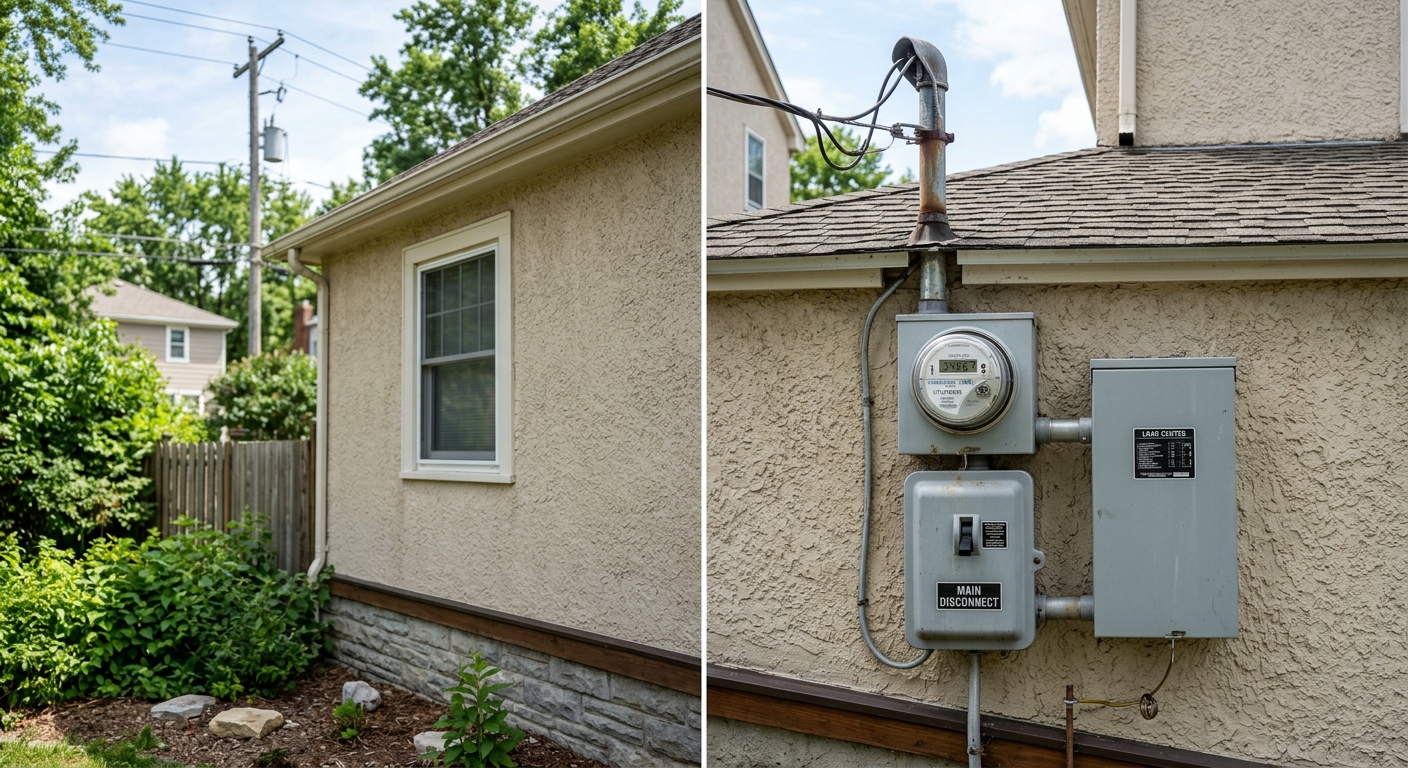
Electrical services and costs in Delbrook
In Delbrook, electrical work costs reflect both the age of the housing stock and how busy the Lower Mainland–Southwest trades are. With a total population of 2,497 (Statistics Canada, 2021 Census), Delbrook is small enough that contractor capacity can feel tight at peak permit seasons, yet the surrounding Burnaby/Vancouver demand influences day rates, scheduling, and inspection availability. Just as importantly, many homes around Delbrook are older—pre-renovation wiring and dated service sizes are common—so it’s not unusual for projects to start with identifying hazards like knob-and-tube or aluminum branch circuits, then move into a capacity upgrade to support today’s loads.
Lower Mainland–Southwest markets also see cost pressure from how houses were originally built for different heating patterns. Today’s homes often add electric baseboard or electric furnace elements, and the growth in EV ownership is pushing more Level 2 charger installations. Where that coincides with a 60A or 100A service, a modern 200A upgrade is often the safest, code-compliant path—especially when you’re also adding heat-pump circuits or induction stove capacity. If service equipment must be coordinated, BC Hydro scheduling and required civil work can add time and cost beyond typical “electrical-only” projects.
In Delbrook—particularly the older residential pockets near the Delbrook community area—panel upgrades and wiring remediation are especially in demand because many older homes are being updated for insulation, heating efficiency, and vehicle charging. The table below compares typical service categories you’ll see in homeowner quotes, with permit requirements and realistic price ranges as the first step of your comparison.
| Service |
Why It's Needed |
Permit Required |
Price Range |
| Panel upgrade — 100A to 200A service |
Modern load needs (EV charging, cooking appliances, heat pumps/electric heat) require more capacity and safer fault protection. |
Yes (service equipment change/service upgrade) |
$1,800–$4,500 |
| EV charger installation (Level 2, 40–50A) |
Provides faster home charging and usually requires dedicated circuits and sometimes a capacity check or panel/service upgrade. |
Yes (new dedicated circuit/EV branch circuit) |
$900–$2,500 |
| Knob-and-tube wiring removal and replacement |
K&T systems have brittle insulation and poor modern fault-current compatibility; removal reduces fire risk and insurance friction. |
Yes (rewiring/major alterations) |
$8,000–$20,000 |
| Aluminum wiring remediation (CO/ALR connectors) |
Aluminum branch wiring (often seen in 1965–1976 homes) requires licensed remediation using approved connectors to reduce overheating risk. |
Yes (alterations to wiring/connections) |
$8,000–$20,000 |
| New dedicated circuit (HVAC, appliance, hot tub) |
Adds properly sized wiring and protection for high-demand equipment so outlets and existing circuits aren’t overstressed. |
Yes (new circuit) |
$900–$2,500 |
| Whole-home rewire (older home, full replacement) |
When multiple hazards exist (K&T plus undersized circuits, obsolete devices, mixed wiring types), full replacement restores system reliability. |
Yes (major rewiring) |
$8,000–$20,000 |
Prices are estimates only and vary by project scope, site access and material selection.
What affects the price of electrical work in Delbrook
In the Lower Mainland–Southwest, quotes for the same electrical work can differ by 30–50% between contractors because the “hidden scope” is often different: how much wiring is actually unsafe, whether the panel can be expanded, how long walls/floors must be opened, and how many circuits must be corrected to pass inspection. In British Columbia, permits and inspections are mandatory for major electrical changes, so two similar jobs can still land at different totals depending on how much is bundled into the permit submission and whether the panel/service must be upgraded for capacity and fault-current compliance.
Housing age is the dominant cost driver. In older Delbrook homes, knob-and-tube wiring often requires removal and full circuit replacement rather than simple spot repairs. Homes from the 1960s to 1970s frequently have 60A or 100A panels that are inadequate for today’s load patterns—especially when you add EV charging and modern cooking/conditioning loads. Aluminum wiring is another factor: branch circuits installed with aluminum conductors (commonly from about 1965–1976) typically need licensed remediation with approved CO/ALR connectors, or in some cases full replacement. That’s where you’ll see wiring categories expand into the $8,000–$20,000 band, even if the homeowner initially asked only for “a new circuit.”
Local conditions can raise or lower cost quickly. Tight lot access near Delbrook can increase mobilization time and material staging, while easier crawlspace/basement access can reduce opening-and-restoration costs. Also, EV adoption is driving more Level 2 permit applications, and EV charger installs are often priced around the $900–$2,500 band—unless the panel/service upgrade pushes the project into the $1,800–$4,500 panel/service range. In homes with 60A/100A service, that jump is usually justified because the charger and everyday loads can’t be safely supported without modern protection.
| Price Factor |
Why It Matters |
Cost Impact |
| Panel size upgrade — 100A to 200A is the standard minimum today |
More capacity and modern breakers reduce overloading and improve compliance for today’s devices. |
$1,800–$4,500 typical added scope |
| Wiring type — copper vs. aluminum remediation vs. K&T removal |
Aluminum and knob-and-tube often require approved remediation or complete replacement, not “patches.” |
$8,000–$20,000 in many full-scope homes |
| Number of new circuits — each adds material and labour time |
Each circuit requires planning, cable/breaker costs, routing, and inspection sign-off. |
Often scales toward $900–$2,500 per meaningful circuit |
| Permit + ESA/TSBC inspection fee — mandatory for all major work |
Permits and inspections must be completed; they protect safety and are required for insurance/resale. |
Typically included in pricing but can add hundreds depending on job class |
| Labour rate for licensed electricians — journeyman rates in Lower Mainland–Southwest |
Higher urban labour demand affects time-based costs and job scheduling. |
Can move totals by 10–25% even when materials are similar |
| EV charger amperage — 40A vs. 50A circuit affects cable and breaker cost |
Higher-amperage circuits require appropriately sized wiring components and breakers. |
May increase cost by a few hundred dollars |
| Emergency or after-hours premium |
Priority response increases staffing, scheduling complexity, and sometimes temporary measures. |
Often adds 15–30% to labour |
| Load calculation required for service upgrade |
Proper sizing requires a load calculation so the upgraded service can handle modern demand. |
Usually adds a small fixed amount but can prevent costly under-sizing |
Permits & regulations in British Columbia
In British Columbia, ALL electrical work beyond changing a light bulb must be done by a licensed electrician, and most homeowner “do-it-yourself” electrical tasks still require professional involvement. Permits are required for panel upgrades, new circuits (including EV charger circuits), rewiring projects, and any service equipment changes. Permitted work must pass inspection by the province’s electrical safety authority system—Technical Safety BC—under the BC Electrical Code and the Safety Standards Act framework. Practically speaking, this means that even if you can safely run conduit or pull low-voltage cable, the moment you’re altering power circuits, wiring methods, or service equipment, you’re in permit territory.
What typically does not require a permit: replacing a like-for-like light fixture where the existing wiring connection method is unchanged and no circuit alterations occur, or swapping a receptacle cover/faceplate only. What does require a permit: adding a new breaker/circuit, relocating outlets, upgrading a panel, installing an EV Level 2 charger circuit, and any knob-and-tube/aluminum remediation that involves changes to wiring connections.
To verify a contractor in Delbrook, start with the electrician’s licence using the provincial registry online (confirm the business and worker are licensed for the work described). Then ask for a certificate of insurance showing liability coverage and—where applicable—labour coverage arrangements (WSBC/WCB registration depends on employer structure). Before work begins, request a clearance/coverage letter if they are carrying the coverage through a registered system, and keep copies with your quote and permit documents.
When your Delbrook home needs an electrical upgrade
Electrical upgrades in Delbrook are often triggered by safety and reliability issues, not just convenience. Here are the signs that you should treat as safety-critical: (1) Breakers that trip regularly—this commonly means an overloaded panel, undersized circuits, or wiring problems that heat up under load. (2) Knob-and-tube wiring—this is less about “age” and more about insulation contact and modern fault performance; insurance issues and inspection failures can follow if it’s left in service. (3) A 60A or 100A panel—today’s households often run electric baseboard or electric furnace elements, plus heat pumps, modern cooking, and Level 2 EV charging. When you try to add those loads without capacity, the safest standard solution is often moving toward a 200A service upgrade. (4) Aluminum wiring from pre-1976 construction—this isn’t automatically an emergency, but it requires licensed remediation because loose/oxidized connections can overheat. (5) Insufficient outlets—when you see extension cords everywhere, you’re likely masking a circuit loading problem and risking nuisance tripping and overheating. (6) No AFCI or GFCI protection where required—this becomes a compliance issue and can surface during home sale or insurance underwriting.
Immediate action is warranted for tripping with burning smell, visible scorching, flickering lights that persist, or signs of overheating at outlets/breakers. Planned upgrades are common when you have K&T present, aluminum branch circuits needing CO/ALR remediation, or a panel/service that can’t support the EV/heat/modern appliance load profile. For example, if your panel upgrade is in the $1,800–$4,500 range and it prevents an EV charger install from needing repeated costly rerouting or unsafe loading, that difference is usually justified. Trying to “work around” an undersized service often turns a simpler job into wiring-expansion costs that quickly climb into the $8,000–$20,000 band.
| Warning Sign |
What It Means |
Recommended Action |
Urgency |
Price Band |
| Breakers trip frequently |
Overload, undersized circuit, damaged wiring, or inadequate protection for connected loads. |
Inspection + load check; add circuits or upgrade protection; investigate hotspots. |
Immediate to near-immediate |
$900–$2,500 (often escalates if wiring/panel issues are found) |
| Knob-and-tube wiring present |
Obsolete wiring method with higher risk of insulation failure and poor compatibility with modern fault conditions. |
Plan K&T removal/replacement; rewire affected circuits to code. |
Planned upgrade (schedule promptly) |
$8,000–$20,000 |
| 60A or 100A panel (inadequate load capacity) |
Service undersized for today’s appliance, heating, and EV demand. |
Load calculation and panel/service upgrade (commonly toward 200A). |
Planned upgrade (before EV/major new loads) |
$1,800–$4,500 |
| Aluminum wiring (pre-1976 construction) |
Connections can overheat if not properly remediated; CO/ALR requirements often apply. |
Licensed remediation with approved connectors or targeted replacement. |
Planned upgrade (not a DIY) |
$8,000–$20,000 (varies by quantity and accessibility) |
| Insufficient outlets — extension cords everywhere |
Likely circuit overload and increased risk of overheating at overused connectors. |
Add grounded outlets and new circuits where needed; reduce extension dependence. |
Planned upgrade |
$900–$2,500 |
| No AFCI or GFCI protection where required |
Higher risk of undetected arc faults and shock hazards; can affect compliance at resale. |
Add/upgrade protection devices as required by current standards. |
Planned upgrade (address before resale/renovations) |
$200–$800 for limited corrections; more if panel work is needed |
How to choose a electrical work contractor in Delbrook
Choosing the right electrician matters in Delbrook because the wrong approach usually shows up at inspection time—or worse, later as overheating or nuisance tripping. Start by verifying British Columbia licensing for both the company and the individual who will be doing the work. Check the BC licence registry online, and confirm the scope on the quote matches the licensed work they claim to do. Next, request liability insurance documentation (certificate of insurance). Finally, confirm coverage arrangements relevant to workplace injuries through the proper BC channels (often handled via WSBC/WCB registration for the employer). If they’re vague about coverage, get it in writing before any walls are opened.
Then request 2–3 itemised written quotes, not just a lump sum. You want a materials/labour breakdown (panel equipment, breakers, cable type, conduit, chargers/transformers, and any restoration work) and a clear explanation of what’s included for permit pull and inspections. Ask whether disposal/dump fees are included (especially for K&T or panel-removal waste). Also confirm the warranty: workmanship warranty length (how many months/years) and the product/manufacturer warranty coverage, and whether the warranty transfers to you if you sell the home. For payment, keep upfront deposits to about 10–15% and hold back a portion until the job is complete and inspected. Get a start date and estimated completion timeline in writing, since scheduling trades and inspections in the Lower Mainland–Southwest can affect the overall project duration.
- Licence verification for BC (company and electrician), aligned with the permit scope.
- Certificate of liability insurance provided before work starts.
- Proof of workplace coverage status via the proper BC channels for the employer.
- Written permit plan: who pulls the permit and how inspection timing is handled.
- Itemised quote showing labour hours, materials, and restoration/disposal.
- Clear exclusions (for example: drywall replacement, cable routing through inaccessible spaces).
- Load calculation included for service upgrades (not just “replace panel”).
- EV charger quote lists the exact breaker amperage and cable sizing assumptions.
- Confirmation of approved methods for aluminum remediation (CO/ALR) or K&T removal scope.
- Workmanship warranty in writing; product warranty terms stated clearly.
- Payment schedule with 10–15% maximum upfront and a holdback until completion.
- Start date, inspection day expectations, and realistic completion estimate in writing.
Red flags I commonly see with electrical contractors in Delbrook include: promises to skip the permit (“it’s just a small circuit”), refusal to show licence/insurance documents, only quoting a lump sum without a scope breakdown, vague warranties (“we’ll try our best”), and pressure to take a large upfront deposit before inspection paperwork is arranged.
Frequently asked questions — electrical work in Delbrook
What are signs of an overloaded electrical panel?
In Delbrook and across the Lower Mainland–Southwest, an overloaded panel often shows up as breakers tripping under normal use, persistent dimming/flickering when multiple appliances run, or repeated warm/hum-like sounds around breakers or the panel area. If you notice nuisance trips specifically when you use electric baseboard/electric heat along with the kitchen or laundry, that can indicate capacity limits or circuits sharing overload characteristics. Another sign is frequent requests to “add just one more circuit” because outlets and breaker spaces keep filling up. A safe next step is a load check and, if needed, a service upgrade. Panel upgrades often fall around $1,800–$4,500 depending on whether you’re moving from 100A to 200A and what panelwork is required for code compliance.
Can I do my own electrical work in British Columbia?
In British Columbia, DIY electrical beyond very limited tasks is not permitted. Most work that alters a circuit or changes wiring—like adding outlets, installing a new breaker, running wiring for an EV charger, replacing wiring methods, rewiring sections, or upgrading a panel—must be done by a licensed electrician and must be permitted and inspected. Changing a light bulb or a simple like-for-like fixture in some circumstances is typically the limit of homeowner activity, but once you’re modifying connections, conductors, or protection devices, you’re in licensed/permit territory. If you’re doing renovations in Delbrook, it’s common to coordinate drywall schedules with the electrician so the work can be inspected properly before walls are closed. For anything major, budget for the permit process; it’s a normal cost of $1,800–$4,500 panel/service and $8,000–$20,000 rewiring scopes.
How long does a rewiring job take?
The timeline for a rewiring job in Delbrook depends on how much of the home is affected (for example, knob-and-tube only in certain areas versus a full whole-home rewire) and how accessible the wiring paths are. In older Lower Mainland–Southwest homes with difficult routing—multiple levels, stapled-in wiring in tight cavities, or mixed wiring types—rewiring can extend due to careful discovery, routing, and verifying each circuit for code compliance and inspection readiness. As a practical expectation, partial rewires can take days to a couple of weeks, while full replacements often take longer due to the breadth of circuit testing, labeling, and coordination with drywall restoration. If your project involves service changes as part of the same permit, that can add scheduling time around inspection steps. Your electrician should provide a written start and completion estimate based on the exact scope and access conditions.
Why do my breakers keep tripping?
Breakers tripping can happen for several reasons, and the “fix” depends on what’s actually causing the trip. In many Delbrook homes, tripping is triggered by overloaded circuits—like running electric heating elements while also using kitchen appliances—or by wiring problems such as damaged insulation, loose connections, or issues that show up under sustained load. If the home has aluminum wiring, certain connection problems can cause heating and instability that lead to trips. If knob-and-tube circuits are involved, age-related insulation contact issues can contribute. The correct response is not to just replace the breaker with a higher amperage. Instead, have the electrician investigate with inspection and load/connection checks. Depending on what’s found, costs range from adding a dedicated circuit (commonly near $900–$2,500) to a panel/service upgrade when capacity is truly the issue (often $1,800–$4,500 for 100A to 200A).
How do I compare electrical quotes?
When comparing quotes in Delbrook, start by making sure they’re quoting the same scope. Ask each contractor for an itemised breakdown (labour hours, materials/cable type, breaker and panel equipment, and whether permit fees and inspections are included). Confirm who pulls the permit and whether they’re coordinating inspection timing—this is especially important for service upgrades and EV circuits. Look for clarity on exclusions like drywall restoration, disposal, and additional exploratory opening if unsafe wiring is discovered. Also compare the approach to hazards: reputable contractors specify whether aluminum wiring will be remediated using approved CO/ALR methods versus being replaced, and whether knob-and-tube will be removed by circuit rather than patched. Finally, compare warranty and the payment schedule—avoid quotes that demand large upfront deposits or don’t provide a written timeline. A good quote will explain why the price is higher or lower, not just state a total.
How long does a panel upgrade take in Delbrook?
A panel upgrade in Delbrook typically takes a short, focused window of active work once the electrician has confirmed parts and inspected accessibility, but the overall project timeline includes permitting and inspection steps. The actual swap from an older service (like 100A) to a modern 200A setup is often completed in about a day of on-site labour for many standard homes; however, the schedule can stretch if there are wiring deficiencies to correct, if panel locations are constrained, or if additional circuits must be reworked for code compliance. Because British Columbia requires permits and inspections for service equipment changes, plan time for permit submission and the inspection appointment availability in the Lower Mainland–Southwest. Your contractor should provide a written start date and inspection timeline estimate. Pricing for panel upgrades commonly lands around $1,800–$4,500, varying with whether it’s a straightforward changeover or a bigger service coordination scope.