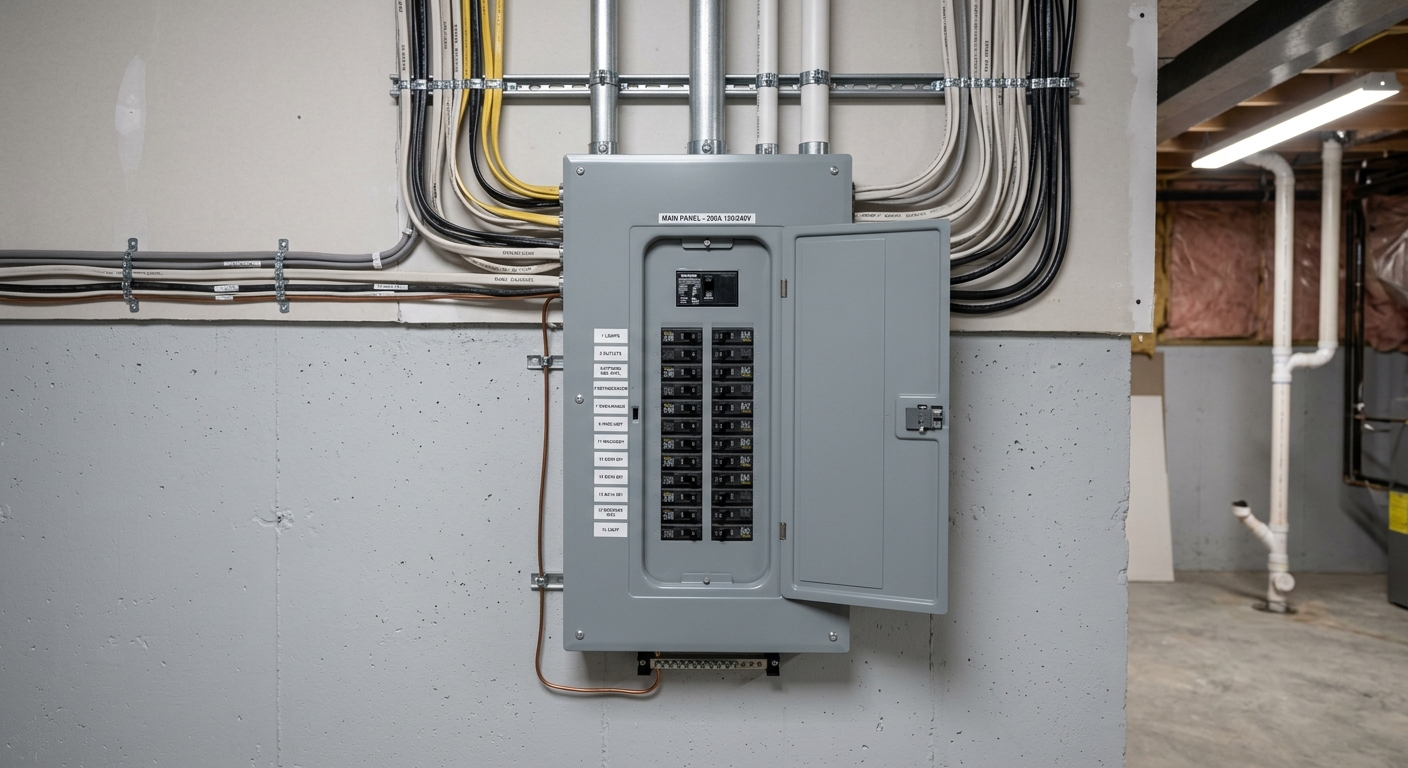
Electrical services and costs in Marpole South
Electrical services in Marpole South, British Columbia are shaped by both older housing stock and the pace of modern electrification. With a population of 7,150 (Statistics Canada, 2021 Census), the area doesn’t feel “rural,” but many nearby Richmond/Vancouver-area neighbourhoods still contain older pre-1960s and 1960s–1970s homes where electrical systems often lag behind current daily loads. In practical terms, Marpole South homeowners commonly run into two cost drivers: replacing obsolete wiring methods (especially knob-and-tube) and updating undersized services (often 60–100A) to safely support today’s household demand.
Lower Mainland–Southwest pricing reflects dense neighbourhood access, tighter electrical chases in older walls, and frequent coordination with BC Hydro when a service change or mast upgrade is needed. Labour and scheduling constraints can also be felt more strongly here than in less urban regions, particularly for projects that require load calculations, permit-ready drawings, and staged inspections. Climate and lifestyle also matter: many homes rely heavily on electric heat (baseboard or furnace), and EV adoption is pushing more Level 2 charger installs that can trigger panel or full service upgrades to maintain capacity and fault-current compliance.
Contractors are especially in demand around Marpole and the nearby business/residential corridors, where older duplexes and renovated character homes often require both capacity upgrades and wiring remediation.
Below is a realistic set of “most common” electrical service options so you can compare quotes before you meet an electrician.
| Service |
Why It's Needed |
Permit Required |
Price Range |
| Panel upgrade — 100A to 200A service |
Modern loads (EV charging, electric heat, cooking, heat pumps) can exceed older panel/service capacity and fail code safety expectations without updated overcurrent protection and wiring. |
Yes (panel/service change and related work must be permitted and inspected) |
$1,800 – $4,500 |
| EV charger installation (Level 2, 40–50A) |
Adds a dedicated, protected circuit to safely support daily charging; may require service capacity verification and sometimes a concurrent panel upgrade. |
Yes (new circuit and charger connection) |
$900 – $2,500 |
| Knob-and-tube wiring removal and replacement |
K&T wiring uses aged insulation and wiring methods that increase risk and insurance issues; remediation typically includes rewiring affected circuits for reliability and safety. |
Yes (rewiring and any related terminations/branch changes) |
$8,000 – $20,000 |
| Aluminum wiring remediation (CO/ALR connectors) |
Aluminum branch circuits (common in some 1965–1976 builds) often require approved connectors/terminations to address long-term connection performance. |
Yes (connector/termination changes on branch circuits) |
$2,000 – $7,500 |
| New dedicated circuit (HVAC, appliance, hot tub) |
Dedicated protection reduces nuisance trips and supports high-wattage loads with correct cable sizing and breaker rating. |
Yes (new circuit work) |
$900 – $2,800 |
| Whole-home rewire (older home, full replacement) |
When multiple circuits are outdated or unsafe, a full rewire provides uniform code compliance, modern protection, and safer long-term operation. |
Yes (full rewiring is permitted and inspected) |
$8,000 – $20,000 |
Prices are estimates only and vary by project scope, site access and material selection.
What affects the price of electrical work in Marpole South
In Marpole South and across the Lower Mainland–Southwest, two quotes for the same end result can differ by 30–50% because the “invisible work” varies: how much wall/ceiling access is required, whether existing wiring methods can be safely retained, how many circuits must be rebalanced, and how early permit and utility scheduling are confirmed. British Columbia projects are also shaped by inspection stages and permit documentation, which can add time even when the electrical components themselves are similar. For homeowners, that’s why you’ll often see a panel/service range of $1,800 – $4,500 swing upward when a 60–100A service is not only swapped but also requires extensive rewiring and load-calc evidence.
Housing age is the dominant cost driver here. Homes built before 1950 can have knob-and-tube wiring; insurance concerns and safety remediation mean the job often becomes a full circuit replacement rather than a “repair.” Meanwhile, many 1960s–70s builds were wired for lower demand and may have 60A or 100A panels that can’t comfortably handle today’s loads—especially electric heat plus a Level 2 EV charger and modern high-watt kitchen appliances. Aluminum wiring, common in some homes from roughly 1965–1976, typically requires licensed remediation with approved CO/ALR connectors or full replacement, and that labour adds up quickly. EV adoption in the Lower Mainland–Southwest has increased Level 2 charger permit applications, which can push projects toward service-capacity checks and sometimes a concurrent upgrade to a 200A standard.
Concrete local examples that change price in Marpole South: (1) tight-lot access and long cable runs can increase labour and cable cost even when the panel is “nearby”; (2) unfinished basements or accessible ceilings lower drywall/framing disruption and reduce rework; (3) if BC Hydro coordination delays the service change window, your electrician may need to stage work, which can affect scheduling.
| Price Factor |
Why It Matters |
Cost Impact |
| Panel size upgrade — 100A to 200A is the standard minimum today |
Modern protection and conductor sizing depend on available service capacity and calculated load. |
Often shifts the project into the $1,800 – $4,500 band, higher if extensive rework is needed. |
| Wiring type — copper vs. aluminum remediation vs. K&T removal |
Aluminum terminations need approved connectors and sometimes full circuit replacement; K&T removal typically means rewiring. |
Aluminum remediation may add thousands; K&T removal can expand the job toward the $8,000 – $20,000 band. |
| Number of new circuits — each adds material and labour time |
Each circuit requires proper cable sizing, breakers, routing, and documentation for inspection. |
Can add incremental costs quickly; additional circuits can push a partial upgrade toward a whole-home approach. |
| Permit + ESA/TSBC inspection fee — mandatory for all major work |
Major service and wiring changes must be permitted, inspected, and documented. |
Adds fixed administrative and inspection cost to nearly every larger job. |
| Labour rate for licensed electricians — journeyman rates in {region} |
Labour time increases with access complexity, older wiring, and the need for careful staging. |
Differences in crew size and site hours are a common source of the 30–50% quote spread. |
| EV charger amperage — 40A vs. 50A circuit affects cable and breaker cost |
Higher amperage circuits require larger cable/breaker components and may impact service capacity decisions. |
Often changes the EV job’s price within the $900 – $2,500 range. |
| Emergency or after-hours premium |
Urgent callouts reduce scheduling flexibility and may require expedited inspections and parts sourcing. |
Can add a noticeable premium on top of the base scope. |
| Load calculation required for service upgrade |
Service changes require proper load calculation to show the system supports modern demand safely. |
Adds professional time; if the calculation reveals shortfalls, it can justify broader rewiring. |
Permits & regulations in British Columbia
In British Columbia, ALL electrical work beyond changing a light bulb must be done by a licensed electrician, and permits are required for common “service-critical” tasks. Panel upgrades, service equipment changes, adding new circuits (including Level 2 EV charger circuits), rewiring, and any major alteration to branch circuits generally require a permit and inspection. This is tied to the BC Electrical Code and enforced through electrical safety oversight by Technical Safety BC (commonly referred to as the provincial electrical safety authority in practice). DIY electrical is restricted for most work—small in-scope exceptions for very basic items are narrow, and you should assume that any wiring, breaker work, or panel/service interaction requires a licensed contractor and permitting.
Step-by-step, a homeowner in Marpole South can verify a contractor’s legitimacy and coverage before work starts:
- Check the licence status with the provincial online registry for the electrician or business (confirm it’s active and matches the job).
- Ask for a current certificate of insurance and confirm liability coverage is appropriate for residential electrical work.
- Confirm WSIB/WCB coverage if the contractor is required to carry it under their employment/operations structure; get it documented rather than verbal.
- Ensure the permit is clearly included in the scope (and that the electrician plans the inspection stages).
- Request the quote’s scope in writing so you can see what is included/excluded (cable runs, disposal, drywall reinstatement, and material allowances).
Clear documentation protects you at inspection time and later if you sell or insure the home.
When your Marpole South home needs an electrical upgrade
Your Marpole South electrical system doesn’t need to “look modern” to function—but certain warning signs are safety-critical, not cosmetic. First, breakers that trip regularly—especially with normal use—often point to overloaded circuits, aging connections, or undersized wiring for current loads. Second, knob-and-tube wiring is a major concern because insulation contact and deterioration can create failure modes; the risk is not only “age,” but also how easily connections become problematic behind finished walls.
Third, if you have a 60A or 100A service, it may be inadequate for a modern home running an EV charger, heat pump or electric furnace load, plus typical kitchen and laundry demand. In the Lower Mainland–Southwest, electric heat use in many homes makes this problem show up earlier in the year—especially during colder snaps—so capacity planning matters. A 200A upgrade is the common, code-aligned solution when load calculations show the service can’t meet demand safely.
Fourth, aluminum wiring in pre-1976 construction typically isn’t an “instant emergency,” but it does require licensed remediation, such as correct CO/ALR connector terminations or rewiring where connectors aren’t viable. Finally, insufficient outlets or missing AFCI/GFCI protection can be a code-compliance issue that becomes visible during resale inspections or when a buyer’s home inspector flags protection requirements. Planned upgrades are usually the right path when safety devices are missing or circuit capacity is tight; immediate action is important when you notice repeated tripping, burning smells, heat at outlets/switches, or persistent nuisance faults.
Example: if a Level 2 EV charger quote looks cheaper but your electrician’s load calculation shows the existing 100A service won’t support the combined load, the “charger-only” option may end up being false economy. Spending toward the $1,800 – $4,500 panel/service range can prevent repeated callouts and future rewiring, which can be far more expensive than doing the upgrade once.
| Warning Sign |
What It Means |
Recommended Action |
Urgency |
Price Band |
| Breakers trip frequently |
Possible overload, failing breaker/connections, or wiring not suited to current load patterns. |
Schedule a diagnostic and load check; correct circuit sizing and protection. |
Immediate to planned (depending on frequency and any heat/burning odours) |
$900 – $2,800 |
| Knob-and-tube wiring present |
Aged wiring method with insulation/connection concerns that can affect safety and insurance. |
Plan K&T removal and circuit replacement to modern wiring standards. |
Planned soon (priority depends on condition) |
$8,000 – $20,000 |
| 60A or 100A panel (inadequate load capacity) |
Not enough available capacity for modern demand (EV charging, electric heat, induction, heat pumps). |
Request a load calculation and upgrade toward 200A if needed. |
Planned soon |
$1,800 – $4,500 |
| Aluminum wiring (pre-1976 construction) |
Connection performance can degrade over time; requires remediation rather than “do nothing.” |
Licensed CO/ALR connector remediation or selective/full replacement depending on condition. |
Planned |
$2,000 – $7,500 |
| Insufficient outlets — extension cords everywhere |
Overreliance on temporary power increases overheating risk and often indicates missing circuits. |
Add dedicated circuits/outlets and tidy the load distribution. |
Planned |
$900 – $2,800 |
| No AFCI or GFCI protection where required |
Missing modern protection can increase shock and arc-fault risk; it can also surface at resale. |
Upgrade receptacles/breakers as required and confirm code-compliant protection. |
Planned (can be urgent for safety-critical rooms) |
$200 – $800 |
How to choose a electrical work contractor in Marpole South
Choosing the right electrical contractor in Marpole South starts with proof—not promises. First, verify British Columbia licensing: confirm the electrician’s licence is active and that the business conducting the work is properly registered. Next, request liability insurance and keep it on file (certificate of insurance with policy details). For coverage consistency, confirm WSIB/WCB status where applicable and ensure you receive documentation rather than relying on a verbal claim.
Then get 2–3 itemised written quotes. A good electrical quote should separate labour and materials, show how many hours/crew-days are expected, and list assumptions about access and removals (for example, ceiling openings, drywall reinstatement, and wiring path access). Make sure the scope clearly states whether permits are included, whether inspections are covered, and whether disposal/recycling of old panels and wiring is part of the cost. Watch for vague line items like “electrical work” with no quantities—those tend to be where cost overruns start.
Warranty matters: ask for the workmanship warranty length and whether it’s transferable, and also confirm manufacturer product warranty terms (especially for EV chargers, breakers, and any panel components). For payment, never pay more than about 10–15% upfront; use a progress draw schedule and hold back until the job is complete and inspected. Finally, insist on a written timeline with a start date and estimated completion window.
- Licence verification: confirm the active BC licence before booking a permit
- Certificate of insurance provided in advance of site work
- Proof of WSIB/WCB coverage where applicable
- Itemised quote with labour and materials separated
- Explicit permit + inspection responsibility in the scope
- Written load calculation plan if service upgrade is proposed
- Clear cable routing assumptions and access requirements
- Disclosure of what’s excluded (drywall patching, soffit work, disposal)
- Product list with model numbers for panel/chargers/breakers
- Workmanship warranty terms in writing (duration + what it covers)
- Payment schedule with a small deposit and holdback
- Start and completion dates in writing, with inspection scheduling included
Red flags to watch for: “no permit required” claims for panel/service or EV circuits; a contractor who can’t explain the load calculation approach; quotes that omit whether BC Hydro coordination is needed; generic warranties that don’t specify workmanship coverage; and refusal to provide licence/insurance documentation in writing.
Frequently asked questions — electrical work in Marpole South
How long does a panel upgrade take in Marpole South?
In Marpole South, a typical 100A-to-200A panel upgrade often takes about a day of active on-site electrical work, but the overall timeline is frequently longer because of permitting and inspection scheduling. If your job needs extensive wiring updates in the existing panel area, longer cable runs, or corrective work to address older wiring methods, expect additional time for rough-in and terminations. If BC Hydro coordination is required for the service change/mast timing, the date you can energize the updated equipment may shift, which is a common reason panel projects feel “spread out.” Costs usually track these steps: many upgrades land in the $1,800 – $4,500 band when no major rewiring expansion is required.
What is a GFCI outlet and where is it required in British Columbia?
A GFCI (Ground-Fault Circuit Interrupter) outlet is designed to reduce shock risk by monitoring current imbalance and quickly shutting power off when it detects a ground fault. In British Columbia, GFCI protection is required for specific locations under the BC Electrical Code—commonly where there’s increased shock risk such as near sinks, in garages, outdoors, basements in certain situations, and other areas with wet/damp conditions. Because the exact coverage depends on the circuit type and room conditions, the best approach is to have your electrician review your existing receptacles and proposed circuit changes. If you’re updating outlets for resale or after adding new circuits, ensuring the correct GFCI protection is installed helps you avoid costly “redo” work later.
How do I know if my Marpole South home has aluminum wiring?
You can sometimes identify aluminum wiring by looking for marking on the cable jacket or terminals, or by checking where the conductors land in receptacles and junction points. In many older Marpole South homes, especially those built around the mid-1960s to mid-1970s era, aluminum conductors were used in some branch circuits. The definitive way is usually for a licensed electrician to inspect the conductors at accessible devices and panel/breaker terminations and confirm the conductor material and condition. If aluminum is present, it doesn’t always mean the house is unsafe right away, but it does mean you should plan licensed remediation using approved CO/ALR connectors or replacement where needed—work that often falls outside simple “outlet swap” pricing.
What is the cost of rewiring a house in Marpole South?
Full-house rewiring in Marpole South commonly falls into the $8,000 – $20,000 range, but the actual number depends heavily on how much existing wiring can’t be reused (for example, knob-and-tube presence, aluminum remediation scope, and accessibility through ceilings/basements). Homes that need extensive opening of finished walls, relocation of outlets, or replacement of many circuits generally cost more, and inspection/permitting time can add cost as well. If you’re only replacing a few high-risk circuits rather than rewiring the entire home, your cost is often closer to dedicated circuit or partial remediation bands instead. A good quote will spell out the number of circuits and the wiring method being installed.
What electrical upgrades are required when selling a home in British Columbia?
British Columbia doesn’t require you to “modernize everything” just because you’re selling, but upgrades are often required in practice when electrical systems are unsafe, non-compliant, or missing protection expected under current standards. Common items that get flagged include missing GFCI/AFCI protection in certain locations, unsafe or obsolete wiring methods (like knob-and-tube), and capacity issues revealed by inspection or by the buyer’s due diligence—especially in homes with older 60–100A services that can’t support modern loads. If your insurer or inspector raises issues around knob-and-tube or aluminum, addressing them before listing can reduce negotiation risk. Many capacity-related upgrades target a service update toward the $1,800 – $4,500 range, while comprehensive rewiring can move toward the $8,000 – $20,000 band.
What is a load calculation and why does my electrician need one?
A load calculation is a structured method to estimate how much electrical demand your home can draw based on connected appliances, heating type, lighting, outlets, and planned additions like a Level 2 EV charger. In Marpole South, this matters because many homes have older 60A or 100A services, and the Lower Mainland–Southwest lifestyle changes—electric heat usage, EV charging, and modern kitchens—can push demand beyond what older panels can safely handle. When upgrading a service or adding substantial loads, a load calculation helps confirm breaker sizing, conductor sizing, and whether you should upgrade to a 200A standard. It also supports your permit/inspection documentation so the electrical work is approved for safe operation, not just “installed.”