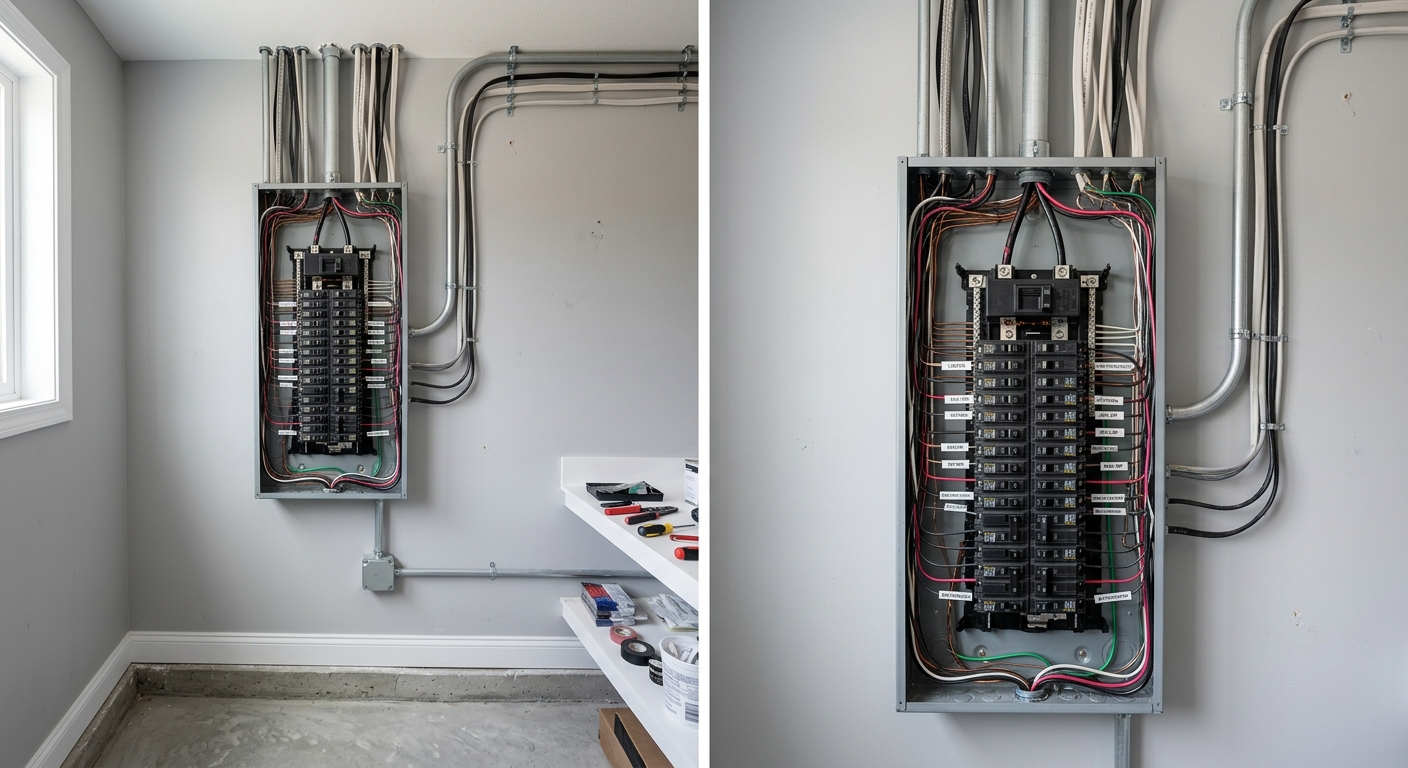
Electrical services and costs in Nanaimo
Nanaimo homeowners often run into electrical upgrades sooner than they expect, especially in older neighbourhoods built around 39.1% of homes before 1981. With that age of housing stock, panel changes, knob-and-tube removal, and aluminum wiring remediation are common safety and capacity projects. Across Vancouver Island and the Coast, many properties also have higher electrical heating and load growth—think heat pumps, electric ranges, and an increasing number of Level 2 EV chargers—so replacing undersized older equipment is frequently part of “getting ready for the next purchase.” In 2021, Nanaimo’s population was 99,863 and homeowner households made up 66.7% of all households, which supports steady demand for service work and full rewires.
Cost is shaped by how weather and logistics affect electrical installs. On Vancouver Island, contractors plan around rain, coastal wind, and schedule constraints, and that can increase labour time for exterior meter/service work or longer cable routes when panels need relocating. Permitting and utility coordination also influence turnaround and price: most major work must be done by a licensed electrician, inspected, and then coordinated for BC Hydro reconnection or modifications—adding steps compared with simple “swap and go” jobs. In areas like North Nanaimo (and nearby older subdivisions), trades demand is especially strong because many homes date back to the post-war era.
Below is a practical comparison of typical electrical services and what usually triggers them, so you can sanity-check your quote before you compare contractors.
| Service |
Why It's Needed |
Permit Required |
Price Range |
| Panel upgrade — 100A to 200A service |
Insufficient capacity for heat pumps, electric appliances, and EV charging; improves safety and reduces nuisance trips |
Yes (permit + inspection) |
$3,500–$9,000 |
| EV charger installation (Level 2, 40–50A) |
Supports higher charging speeds; adds a dedicated circuit/breaker for a safe, code-compliant installation |
Yes (permit + inspection) |
$1,200–$3,000 |
| Knob-and-tube wiring removal and replacement |
Old insulation practices can degrade; replacement is often required for safety, insurance expectations, and modern loads |
Yes (permit + inspection) |
$8,000–$25,000 |
| Aluminum wiring remediation (CO/ALR connectors) |
Connector remediation or splicing upgrades reduce overheating risk; keeps older wiring usable where replacement isn’t practical |
Yes (permit + inspection) |
$8,000–$25,000 |
| New dedicated circuit (HVAC, appliance, hot tub) |
Prevents overloaded circuits and supports equipment startup; improves code compliance and troubleshooting |
Usually yes (for new/major circuits) |
$300–$2,500 |
| Whole-home rewire (older home, full replacement) |
Full modernization of wiring, grounding, and protection devices to match today’s requirements and loads |
Yes (permit + inspection) |
$8,000–$25,000 |
Prices are estimates only and vary by project scope, site access and material selection.
What affects the price of electrical work in Nanaimo
On Vancouver Island and the Coast, it’s not unusual to see the same electrical scope land 30–50% apart between quotes, even when the contractor is licensed and experienced. The biggest drivers are hidden site conditions, how much of the existing system needs to be brought up to today’s requirements, and whether the job includes service coordination and load calculations. Housing age is the dominant cost driver here: homes built long ago may still have knob-and-tube wiring, and many insurance providers increasingly scrutinize it. Meanwhile, homes from the 1960s–70s commonly have 60A or 100A service panels that simply can’t support today’s combined load—especially as EV adoption increases and heat-pump installations and electric cooking become more common. Aluminum wiring is also a factor in this vintage; it can be safe when properly remediated, but connector work (CO/ALR-approved methods) requires licensed labour and approved components—or full replacement if it’s too deteriorated.
Local conditions raise or lower costs in very practical ways. For example, an attic or crawlspace rewiring in a tight North Nanaimo layout can add labour because cable routing is slower and more invasive. Conversely, upgrading a panel in a straightforward, accessible mechanical room with clear pathways can keep a 100A-to-200A service closer to the low end of the $3,500–$9,000 band. If your home already has adequate capacity and you’re only adding a dedicated circuit for a hot tub, the job may stay nearer the $300–$2,500 range for that component. On the other hand, adding a 50A Level 2 charger to a borderline service can require a larger panel/service plan, and that’s when quotes move quickly.
| Price Factor |
Why It Matters |
Cost Impact |
| Panel size upgrade — 100A to 200A is the standard minimum today |
Modern loads (heat pumps, EVs, electric cooking) exceed older panel capacity |
Often shifts the project into the $3,500–$9,000 range |
| Wiring type — copper vs. aluminum remediation vs. K&T removal |
Different materials and approved methods; older wiring is slower to assess and make safe |
Can swing work from partial remediation to full rewiring within $8,000–$25,000 |
| Number of new circuits — each adds material and labour time |
Each circuit needs cable, breakers, terminations, and testing |
Typically adds incremental cost within the $300–$2,500 per-circuit band |
| Permit + ESA/TSBC inspection fee — mandatory for all major work |
Permits and inspection are required before re-energizing major changes |
Raises the floor of the quote and adds administrative time |
| Labour rate for licensed electricians — journeyman rates in {region} |
Licensed work is labour-intensive and includes diagnosis, testing, and compliance |
Higher labour hours can move you toward the top end of a band |
| EV charger amperage — 40A vs. 50A circuit affects cable and breaker cost |
Higher amperage often means larger conductors and breaker components |
Usually within the $1,200–$3,000 EV installation band |
| Emergency or after-hours premium |
Scheduling and call-out time cost extra; work may require re-inspection and testing |
Can add a noticeable premium compared with standard daytime scheduling |
| Load calculation required for service upgrade |
Determines the correct service size and prevents future undersizing |
May add engineering/diagnostic time but prevents rework |
Permits & regulations in British Columbia
In British Columbia, ALL electrical work beyond changing a light bulb must be completed by a licensed electrician. That includes panel upgrades, new circuits, rewiring, service upgrades, and EV charger installations—because these tasks change the electrical system and must be verified for safety. Permits are typically required for major work such as adding outlets where the circuit is new or significantly modified, installing dedicated HVAC/appliance circuits, removing and replacing knob-and-tube wiring, remediating aluminum wiring with approved methods, and upgrading a home’s service rating. Permitted work must pass inspection by the provincial electrical safety regulator (Technical Safety BC).
For homeowner scope, the practical exceptions are narrow and usually limited to activities that don’t alter wiring or overcurrent protection. If you’re unsure, treat anything involving running cable, changing breakers, connecting to a panel, altering the service/meter base, or touching grounding as “not DIY.”
Step-by-step in Nanaimo: (1) ask the contractor for their licence details and verify the electrician on the provincial registry; (2) request a current certificate of insurance and confirm liability coverage; (3) confirm workers’ compensation coverage (WSBC/WCB) for their employees; (4) ask who pulls the permit and when—your permit number should be on the job documents; (5) ensure you receive the inspection/clearance documentation after the work is complete. If a contractor can’t provide licence/insurance/coverage proof, that’s a serious red flag.
When your Nanaimo home needs an electrical upgrade
Nanaimo homes can look fine electrically until safety-critical issues start showing up. Breakers that trip regularly are often the first warning sign: it can mean an overloaded panel, undersized or aging circuits, or loose connections. If that happens repeatedly—especially when running heat pumps, microwaves, or EV charging—plan for diagnosis soon, not later.
Knob-and-tube wiring needs special attention. The concern isn’t just the age; it’s the state of insulation and contact reliability, which can increase risk of overheating and fire. If knob-and-tube is present, treat it as a safety priority and plan replacement, particularly if you’re also making renovations or adding a new load. Homes with 60A or 100A service are also a common mismatch for modern Vancouver Island living. It’s typical to have an EV charger, heat pump, electric stove, and other household loads running at once, and that can push older panels beyond what they were designed for—making a 200A upgrade the standard solution.
Aluminum wiring (often seen in pre-1976 construction) is not automatically “immediate danger” if it has been properly maintained, but it does require licensed remediation for connectors/splices where appropriate. Lastly, insufficient outlets and missing AFCI/GFCI protection can become urgent during home sales or inspections; code compliance issues often surface when you least want them to.
In coastal conditions, weatherproofing and exterior routing can add labour, so don’t assume a panel or circuit add-on will stay “small.” For example, adding only a single circuit might land in the $300–$2,500 band, but if your existing service can’t support a new heat-pump or EV load, the project can quickly move into the $3,500–$9,000 panel/service range—where the extra cost is justified to prevent repeated upgrades and nuisance shutdowns.
| Warning Sign |
What It Means |
Recommended Action |
Urgency |
Price Band |
| Breakers trip frequently |
Possible overload, failing components, loose connections, or undersized circuits |
Schedule an electrical inspection and load evaluation; consider panel/circuit upgrades if confirmed |
Immediate (for repeated trips) |
$300–$9,000 |
| Knob-and-tube wiring present |
Older wiring practices with degrading insulation/termination risk |
Plan removal and replacement; prioritize areas that see frequent use or renovation |
Safety priority |
$8,000–$25,000 |
| 60A or 100A panel (inadequate load capacity) |
Capacity may be insufficient for modern combined loads (heat pumps + EV + appliances) |
Request a load calculation and discuss 200A service upgrade |
Planned upgrade (before adding new major loads) |
$3,500–$9,000 |
| Aluminum wiring (pre-1976 construction) |
Connector/splice risks if not properly remediated |
Have aluminum wiring assessed; perform CO/ALR-approved remediation or replacement as needed |
Planned upgrade (unless there are signs of overheating) |
$8,000–$25,000 |
| Insufficient outlets — extension cords everywhere |
Overreliance on temporary power; higher chance of overload and damaged cords |
Add properly rated circuits/outlets and reduce cord usage |
Address soon |
$300–$2,500 |
| No AFCI or GFCI protection where required |
Increased risk from arc faults and shock hazards; can fail inspection |
Upgrade protection devices and update affected circuits to meet requirements |
Planned upgrade (or urgent before sale) |
$300–$2,500 |
How to choose a electrical work contractor in Nanaimo
Start by verifying the contractor’s British Columbia credentials. Ask for their electrician licence information and confirm it using the provincial online registry (so you can match the company/individual to the right licence). Request a certificate of liability insurance and check that it’s current and includes electrical work. Also confirm workers’ compensation coverage (WSBC/WCB) for their employees—if someone is injured on your property and they’re not covered, the financial risk can land on you.
Next, get 2–3 itemised written quotes. You want a breakdown that shows labour hours, materials, and allowance items, not just one “all-in” number. Make sure each quote lists whether the permit pull is included, who pays for inspection coordination, and whether disposal/patching is covered. For service upgrades or rewires, ask for the test and documentation plan (grounding/bonding verification, panel testing, and final inspection expectations).
For warranty, ask how long the workmanship warranty lasts and whether it transfers if you sell. Product warranties are different from workmanship—confirm both. Payment schedules should be controlled: never pay more than 10–15% upfront, and use a holdback until the job is complete and you’ve received inspection sign-off.
Finally, get a start date and completion estimate in writing. In Nanaimo, permitting and scheduling can affect timelines, so a clear plan helps you avoid cost overruns.
- Licence details verified via provincial registry before work starts.
- Current certificate of liability insurance provided for your records.
- WSBC/WCB coverage confirmed (ask for proof).
- Quotes are itemised (labour + materials), with allowances clearly listed.
- Permit pull included or explicitly excluded (and who handles it).
- Inspection/testing steps described (not just “we’ll book it”).
- Scope exclusions stated (ceiling/floor patching, drywall access, disposal, cabinet moves).
- Service coordination with BC Hydro mentioned where required.
- Workmanship warranty term documented in writing.
- Payment schedule capped at 10–15% upfront, with holdback on completion.
- Start date and estimated completion time in writing.
- Clear communication on change orders (what triggers them and how they’re priced).
Red flags to watch for in Nanaimo: contractors who won’t provide licence/insurance/coverage proof; quoting without an inspection of the existing panel/wiring; vague scopes that don’t address permits/inspection responsibility; unusually low bids that omit materials or testing; and pressure to pay a large deposit before permits are confirmed.
Frequently asked questions — electrical work in Nanaimo
What is knob-and-tube wiring and should I replace it?
Knob-and-tube wiring is an older wiring method commonly found in homes built before modern electrical standards—so it’s still encountered in parts of Nanaimo where older housing stock exists. The main issue isn’t just “it’s old”; insulation and terminations can degrade, and the system may not meet how modern households use power (heat pumps, EV chargers, and more kitchen/laundry loads). In most cases, the safest approach is to plan replacement of knob-and-tube rather than patching it. If you’re adding circuits or upgrading to 200A, you’ll likely need to remove problematic sections anyway to make the system safe and inspection-ready under BC requirements.
Is aluminum wiring safe in older Nanaimo homes?
Aluminum wiring can be safe when it has been installed and maintained correctly, and when joints and terminations are remediated using approved methods. In Nanaimo and across Vancouver Island and the Coast, aluminum wiring is often associated with homes built in the 1965–1976 era, so it comes up during service upgrades and insurance reviews. The key is assessment: licensed electricians look for signs of overheating, poor terminations, and identify where CO/ALR-approved connectors or full replacement is required. If remediation is needed, many homeowners spend in the broader wiring/remediation band (for example, $8,000–$25,000 depending on how much wiring needs attention). Don’t treat it as “automatically dangerous,” but do plan a proper evaluation.
Do I need a permit for electrical work in British Columbia?
Yes—most electrical work beyond basic bulb replacement requires a permit in British Columbia. This includes panel upgrades, new circuits, rewiring, service changes, and EV charger installations. Once the permitted work is done, it must pass inspection by the provincial electrical safety regulator (Technical Safety BC). Homeowners should assume that if the job involves opening walls, changing breakers, running new cable, working in or around a panel, modifying a service, or installing an EV circuit, a permit will be required and inspections are mandatory. A licensed electrician should handle the permit process and provide you documentation after approval. If a contractor suggests you can bypass permits, that’s a major compliance and safety concern.
What are signs of an overloaded electrical panel?
Common signs include breakers that trip frequently, lights dimming when appliances start, or a pattern where trips happen when multiple loads run—like microwave + kettle + heat pump, or charging an EV. Overloading can also show up indirectly: you may find that the panel has many “double-duty” circuits, you’re using extension cords, or you can’t add new loads without repeated tripping. The remedy is diagnosis and often a capacity upgrade. In Nanaimo, many homes end up needing a service/panel upgrade—typically discussed as a 100A to 200A change—often priced in the $3,500–$9,000 band when materials, permits, and coordination are included. A proper load calculation helps confirm whether the panel is truly undersized.
Can I do my own electrical work in British Columbia?
For most electrical tasks in British Columbia, DIY is not permitted. Beyond simple bulb changes or other non-wiring, non-modifying tasks, electrical work must be done by a licensed electrician. That’s because permitted work must be inspected and verified for safety (Technical Safety BC). While there may be narrow homeowner-related allowances in some limited circumstances, they don’t usually apply to panel work, adding circuits, rewiring, EV charger installation, or anything involving service equipment. If you DIY the “easy part” and a licensed electrician has to finish or troubleshoot, the final bill can be higher and inspections can be delayed. The safer path is hiring a licensed electrician and confirming permits/inspection handling up front.
How long does a rewiring job take?
Whole-home rewiring timelines vary mainly with home layout, access (attic/crawlspace vs. open walls), and how much of the system needs removal and replacement. In Nanaimo, coastal conditions can slow exterior coordination and sometimes affect site access planning, especially when service equipment work is involved. As a rough expectation, partial rewiring or targeted section replacement can be completed in days, while a full rewire typically takes longer because it involves careful routing, testing, and inspection sign-off. Your contractor should provide a written schedule after assessing your existing wiring, panel condition, and any knob-and-tube or aluminum remediation needs. If a job is in the $8,000–$25,000 range, it usually indicates significant scope and should come with a realistic staging plan and permit timeline.