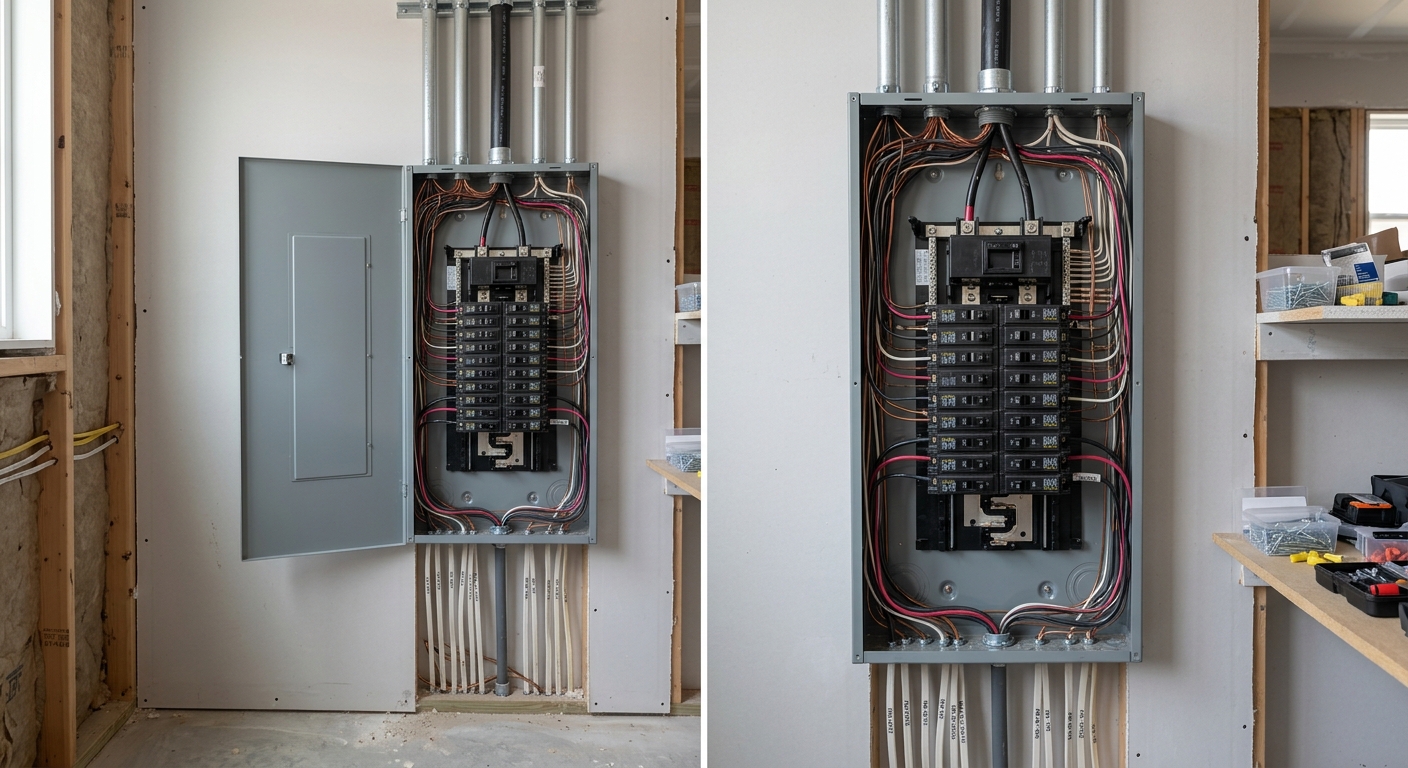
Electrical services and costs in Humbermede
In Humbermede, electrical service upgrades and rewiring projects are common because the housing stock is a mix of older properties and newer infill, and that directly affects what contractors need to replace or modernize. With a population of 15,545 people (Statistics Canada, 2021 Census), the Toronto economic region has steady demand for licensed electricians—so lead times can vary, especially during busy spring and summer renovation periods.
In practice, many Humbermede homes built before modern electrical standards are prime candidates for either panel upgrades or partial/complete wiring remediation. Homes from the pre-1980 era are often still found with knob-and-tube wiring or mid-century wiring with aluminum branch conductors—both of which can limit today’s appliance and EV loads unless remediated. At the same time, the GTA’s fast-paced market—dense older neighbourhoods alongside condo and infill growth—keeps electrical pricing sensitive to labour availability, material volatility, and how complex a site is (service location, access, and how much drywall or exterior work is required).
Climate also plays a role. Ontario winters are long and load-heavy for heating, while summer brings air conditioning and heat-pump cycling, which increases the odds that an older panel or undersized circuits show their limits sooner. In Humbermede areas with more mature housing pockets—particularly where basements have been finished or updated—contractors often see a higher concentration of service upgrades paired with new circuits.
Below is a practical comparison of the most common electrical services and typical price ranges so you can line up like-for-like scope before you request quotes.
| Service |
Why It's Needed |
Permit Required |
Price Range |
| Panel upgrade — 100A to 200A service |
Supports modern loads (EV charging, heat pumps, electric range) and reduces overheating risk on older gear |
Yes (major electrical work) |
$2,500–$6,000 |
| EV charger installation (Level 2, 40–50A) |
Creates a dedicated, code-compliant circuit and breaker for safe, efficient charging |
Yes (new dedicated circuit + charger connection) |
$900–$2,500 |
| Knob-and-tube wiring removal and replacement |
Modern insulation and contact risks; many insurers and buyers won’t accept K&T without removal |
Yes (rewiring/remediation) |
$3,000–$15,000 |
| Aluminum wiring remediation (CO/ALR connectors) |
Improves connection safety where aluminum branch wiring exists |
Yes (alterations to wiring/terminations) |
$1,500–$8,500 |
| New dedicated circuit (HVAC, appliance, hot tub) |
Prevents nuisance trips and supports high-draw equipment with proper breaker/cable sizing |
Yes (new circuit work) |
$700–$2,200 |
| Whole-home rewire (older home, full replacement) |
Brings the entire home up to current safety and connectivity expectations; often paired with service upgrades |
Yes (full rewiring) |
$8,000–$15,000+ |
Prices are estimates only and vary by project scope, site access and material selection.
What affects the price of electrical work in Humbermede
In the Toronto area, you can see quote-to-quote differences of roughly 30–50% for what sounds like the same job. That’s because contractors price not just the “electrical” portion, but also the hidden variables: how the wiring is routed (finished walls vs. open access), whether you’re dealing with knob-and-tube or aluminum terminations, and how much panel/service work is required to make everything safe and code-compliant. Labour rates also matter; licensed electricians in the region commonly bill around $90–$120 per hour, and that directly impacts any time-consuming troubleshooting and remediation.
The dominant cost driver is usually the age and condition of the housing stock. Pre-1950 homes may contain knob-and-tube wiring that insurers increasingly decline or require to be removed. Meanwhile, many homes built in the 1960s–70s have 60A or 100A panels that were fine for their time, but today’s loads (EV chargers, heat pumps, induction stoves, plus normal “always-on” electronics) can overwhelm them. Aluminum wiring is another big factor: if you’re dealing with aluminum branch conductors installed in the mid-century period (often 1965–1976), the work typically requires licensed remediation using approved connectors (CO/ALR) or, in more complex cases, replacement of affected runs.
EV adoption is also driving higher permit volumes and demand for dedicated circuits. Even when the charger cost looks straightforward, the electrical quote often changes based on whether you need a load calculation and whether your panel can safely add a 40–50A circuit. For example, a standard EV Level 2 install can sit in the $900–$2,500 band when the panel has spare capacity, but that same project can push higher if it triggers a 100A-to-200A service upgrade in the $2,500–$6,000 range. In Humbermede, projects can be cheaper when the service location is accessible and walls are already open; costs rise when you need exterior trenching, service relocation, or extensive remediation behind finished ceilings and drywall.
| Price Factor |
Why It Matters |
Cost Impact |
| Panel size upgrade — 100A to 200A is the standard minimum today |
Allows modern loads to run without nuisance trips or overheating on older equipment |
$2,500–$6,000 |
| Wiring type — copper vs. aluminum remediation vs. K&T removal |
Different risks and different labour to remediate (connectors vs. replacement) |
$1,500–$15,000 |
| Number of new circuits — each adds material and labour time |
More runs, more breakers, more testing and labelling |
$700–$2,200+ per circuit |
| Permit + ESA/TSBC inspection fee — mandatory for all major work |
Major changes require permitting and inspections before energizing |
$200–$500 |
| Labour rate for licensed electricians — journeyman rates in Humbermede region |
Hourly rates affect troubleshooting, access time, and finishing |
$90–$120/hour |
| EV charger amperage — 40A vs. 50A circuit affects cable and breaker cost |
Higher amperage can require heavier cable and specific breaker selection |
$900–$2,500 |
| Emergency or after-hours premium |
Scheduling urgency increases labour cost and contractor overhead |
+$300–$1,000 |
| Load calculation required for service upgrade |
May be needed to confirm safe panel capacity for EV, heat pumps, and electric heating |
$150–$500 |
Permits & regulations in Ontario
In Ontario, ALL electrical work beyond changing a light bulb must be completed by a licensed electrician. That includes panel upgrades, rewiring, new circuits (for example, an EV charger circuit), and service upgrades—anything that modifies the wiring system or connections. For Humbermede homeowners, the important point is that major work also requires a permit and must be inspected by the Electrical Safety Authority (ESA) (through the local building process).
Work that typically does not require a permit is limited to very minor changes that don’t involve wiring changes—examples often include replacing a light fixture with a like-for-like unit where the existing wiring box and connections remain untouched, or swapping a clearly serviceable plug-in device. As soon as you’re adding circuits, altering the panel, connecting hardwired equipment, or touching concealed wiring, treat it as “permit territory” and plan on an inspection.
To verify your contractor before work starts in Humbermede, do this in order: (1) confirm their Ontario licence number is valid using the provincial licence registry; (2) request a certificate of insurance showing liability coverage; (3) ask for WSIB/WCB clearance or coverage documentation (and confirm they’re up to date for contractor work). During quoting, also ask what permit they will pull and who handles the inspection scheduling. If a contractor can’t clearly explain the permit/inspection steps, that’s a warning sign.
When your Humbermede home needs an electrical upgrade
Electrical upgrades in Humbermede aren’t just about convenience—several common “symptoms” can indicate safety risks or code gaps that show up during Ontario winters and summer cooling. Start with these warning signs and sort them into immediate action versus planned upgrades.
(1) Breakers that trip frequently: this often means an overloaded panel, undersized circuits, or wiring issues. If tripping happens repeatedly—especially when running heating/AC plus other loads—stop using the affected circuits and arrange an electrician evaluation right away. (2) Knob-and-tube wiring present: the concern is not only age; worn insulation and contact issues can create overheating and reliability problems. If you have K&T, plan for removal and replacement, particularly if you’re approaching a sale or insurance review.
(3) 60A or 100A service: today’s homes frequently combine EV charging, heat pumps (and/or electric heating), and an electric stove. A 200A upgrade is commonly the standard solution for stable capacity and future-proofing. (4) Aluminum wiring (pre-1976 construction): it may function for years, but it needs licensed remediation and proper connectors (CO/ALR) or replacement where condition demands. (5) Insufficient outlets and extension cords everywhere: that’s a safety and nuisance-load issue—cord overheating risks increase during cold-weather use patterns. (6) No AFCI or GFCI protection where required: this is often exposed at home sale or inspection and is a compliance and shock-risk concern.
How to justify options with money: if you can stay within your existing capacity, a dedicated circuit or EV installation may fit a $900–$2,500 band. But if a load calculation shows you need a service upgrade, that’s when spending toward the $2,500–$6,000 panel/service range is typically justified because it reduces repeated tripping and supports modern equipment safely.
| Warning Sign |
What It Means |
Recommended Action |
Urgency |
Price Band |
| Breakers trip frequently |
Overloaded circuits, failing components, or incorrect breaker/cable sizing |
Troubleshoot load use, test wiring, then plan panel/circuit upgrades as needed |
Immediate (if repeated or sparks/odours) |
$700–$6,000 |
| Knob-and-tube wiring present |
Older insulated wiring with increased risk and often insurance/sale concerns |
Schedule K&T removal and rewiring (partial or whole-home based on condition) |
High priority (planned, but don’t delay) |
$3,000–$15,000 |
| 60A or 100A panel (inadequate load capacity) |
Can’t reliably support EVs, heat pumps, and modern kitchen loads |
Load calculation and service upgrade toward 200A where required |
High priority |
$2,500–$6,000 |
| Aluminum wiring (pre-1976 construction) |
Connection risk at terminations if not properly remediated |
Licensed remediation with approved CO/ALR connectors or partial replacement |
Planned, but schedule soon |
$1,500–$8,500 |
| Insufficient outlets — extension cords everywhere |
Unmanaged loads and increased cord wear/overheating risk |
Add outlets with proper circuits and consider load-balancing |
Planned (urgent if cords feel warm) |
$700–$2,200 |
| No AFCI or GFCI protection where required |
Higher shock/fire risk and potential failure at inspection/sale |
Add AFCI/GFCI protection per code requirements and update affected circuits |
Planned (often needed before sale) |
$300–$2,000 |
How to choose a electrical work contractor in Humbermede
Choosing the right electrical contractor in Humbermede is about verifying credentials and forcing clarity in the quote. Start by confirming the electrician is licensed in Ontario (ask for their licence number and verify it through the provincial online registry). Next, ask for a certificate of insurance with liability coverage; if they can’t provide it, don’t proceed. Finally, request proof of WSIB/WCB coverage or clearance for contractor work—this matters for labour safety and protects you as the homeowner if an incident occurs on site.
For pricing, get at least two or three itemised written quotes. “Itemised” means the quote should separate labour, materials, disposal, any required cable/breakers, and the permit/inspection steps. Avoid lump sums with missing scope; electrical jobs often change once an electrician opens walls or confirms the wiring type (copper vs. aluminum vs. knob-and-tube). Also check what’s excluded: drywall patching, trenching, restoring landscaping, hauling scrap, or panel upgrades if additional capacity is found missing.
Warranty should be in writing: ask the workmanship warranty length (how long they stand behind installation), whether product warranties are included, and if any manufacturer warranty transfers to you. For payment, don’t pay more than 10–15% upfront—hold the remaining balance until work is complete and inspected. Ask for a written start date and a realistic completion estimate; in Toronto’s busy trade environment, having dates in writing prevents “schedule drift.”
- Verify Ontario licence number (and match it to the company on the quote).
- Request certificate of insurance and confirm coverage is active for the job period.
- Confirm WSIB/WCB clearance or coverage for all workers on site.
- Ask whether they will pull the ESA permit and include inspection scheduling in the scope.
- Get an itemised quote: labour, materials, breakers, cable, connectors (CO/ALR), and testing.
- Confirm whether disposal/haul-away of removed wiring and packaging is included.
- Clarify exclusions: drywall patching, panel paint/finishing, landscaping restoration, and trench restoration.
- Ask how they handle unknowns (for example, hidden aluminum runs behind finished walls).
- Confirm AFCI/GFCI requirements and labelling expectations for new/modified circuits.
- Request a workmanship warranty in writing (not a verbal “we stand behind it”).
- Set a payment schedule with a small deposit (10–15%) and holdback until completion/inspection.
- Get start and completion dates in writing, including inspection lead time.
Red flags I see too often in Humbermede: quotes that don’t mention permits/ESA inspection, “we’ll handle it later” wording about service upgrades, vague scopes that don’t identify whether K&T or aluminum is being remediated, refusing to provide licence/insurance/WSIB proof, and demanding large deposits before any rough-in work is started.
Frequently asked questions — electrical work in Humbermede
What are signs of an overloaded electrical panel?
In Humbermede homes, an overloaded panel often shows up as nuisance breaker trips when you run multiple “big loads” at once—like the dryer plus kitchen appliances, or heat/AC plus laundry. You might also notice warm breaker handles, a persistent burning odour near the panel, or lights that dim noticeably when equipment turns on. Another common sign is that breakers have been replaced with the “wrong” type or inconsistent amperage over time, especially in older homes with mixed wiring materials. If your home is approaching today’s load demands (EV charging or heat pumps), an overloaded panel can become a safety issue, not just an inconvenience. A licensed electrician can start with a load assessment and, if needed, recommend upgrading toward a 200A service (often in the $2,500–$6,000 band).
Can I do my own electrical work in Ontario?
In Ontario, you generally cannot do your own electrical work for anything beyond very limited, non-wiring tasks. Changing a light bulb or a clearly like-for-like fixture can be okay in some situations, but anything involving wiring modifications, new circuits, breaker/panel changes, or hardwiring (like an EV charger) requires a licensed electrician and permit/inspection. For Humbermede homeowners, it’s also a practical matter: even if you “get it working,” non-permitted work may fail inspection and can complicate insurance claims or a future sale. Always verify what the ESA process requires for your scope and use a licensed contractor. If you’re planning a panel/service upgrade or new EV circuit, assume you will need permits and formal inspection before the system is energized.
How long does a rewiring job take?
Rewiring timelines vary heavily depending on how much of the home is accessible and what type of wiring needs replacing. A partial rewiring (for example, a few rooms or a specific system) can take less time than a whole-home rewire, especially if walls are already open. Whole-home rewire projects tend to require sequential rough-in and testing, plus coordination for insulation/drywall finishing. In the Humbermede/Toronto market, schedules are also influenced by permitting and inspection timing. While I can’t promise an exact number without a site visit, many multi-day projects stretch further when panel upgrades, knob-and-tube removal, or aluminum remediation runs are discovered behind walls. If your electrician anticipates a service upgrade alongside rewiring, that can also affect the sequence—sometimes pushing total time toward a longer project window.
Why do my breakers keep tripping?
Breakers that keep tripping usually point to one of four issues: an overloaded circuit, a wiring/connection problem, an incorrect breaker size, or a failing appliance drawing current improperly. In older Humbermede homes, nuisance trips can be more common where circuits have been “patched” over the years or where aluminum connections weren’t remediated properly. In the Toronto climate pattern, winter heating and summer cooling can push loads higher than people expect, so a panel that seemed “fine” may fail under combined demand. Start by identifying what triggers the trip—what appliances or rooms were running when it happened. A licensed electrician can measure current, test breakers and terminations, and determine whether the solution is adding a dedicated circuit, upgrading wiring, or moving to a larger service capacity (often necessary if you’re also planning EV charging or heat pumps).
How do I compare electrical quotes?
To compare quotes fairly in Humbermede, make sure each is based on the same scope and includes the same “must-have” elements: permit pulling, ESA/inspection steps, and the specific wiring approach (copper vs. aluminum remediation, and whether knob-and-tube is being removed or only partially addressed). Look for itemised pricing rather than a lump sum, including labour hours, breaker and cable selections, and testing. Ask whether disposal/haul-away is included, whether drywall patching is excluded, and how unknowns are handled if hidden conditions are worse than expected. Also compare the outcomes: for example, one quote might propose a simple EV Level 2 install in the $900–$2,500 range, while another may include a necessary 100A-to-200A panel/service upgrade (commonly $2,500–$6,000) if a load calculation shows you’re short on capacity. The “cheapest” quote isn’t always the best one if it leaves out required capacity or remediation.
How long does a panel upgrade take in Humbermede?
A panel upgrade timeline depends on whether it’s a straightforward swap at the same location or whether the service requires relocation work, trenching, or significant remediation behind walls. In Humbermede and the broader Toronto area, permits and inspections can also add scheduling time even after the electrical work is finished. Typical projects often progress as: disconnect and set up a safe work area, rough-in/prepare the new equipment area, install the new panel and breakers, complete testing and labelling, then schedule inspection before re-energizing. If your upgrade is paired with additional circuit work or EV-related preparations, the total duration extends. If the contractor expects a simple 200A upgrade only, it may be faster than a combined service and rewiring scope. To plan ahead, confirm the start date, who schedules ESA inspection, and the estimated inspection window in writing.