Electrical services and costs in Mount Dennis
Electrical services in Mount Dennis are shaped by the realities of a dense, mixed housing stock. In a community of 13,593 people (Statistics Canada, 2021 Census), many houses date back several decades, which is why you’ll often see older wiring types at the time of a renovation. In practice, homes built before 1980 are prime candidates for panel work and wiring remediation—especially when knob-and-tube wiring or mid-century aluminum branch wiring is present. Toronto’s fast-paced infill and condo growth also increases the number of permit applications and inspection bookings, which can influence lead times and contractor availability for service upgrades and new circuits.
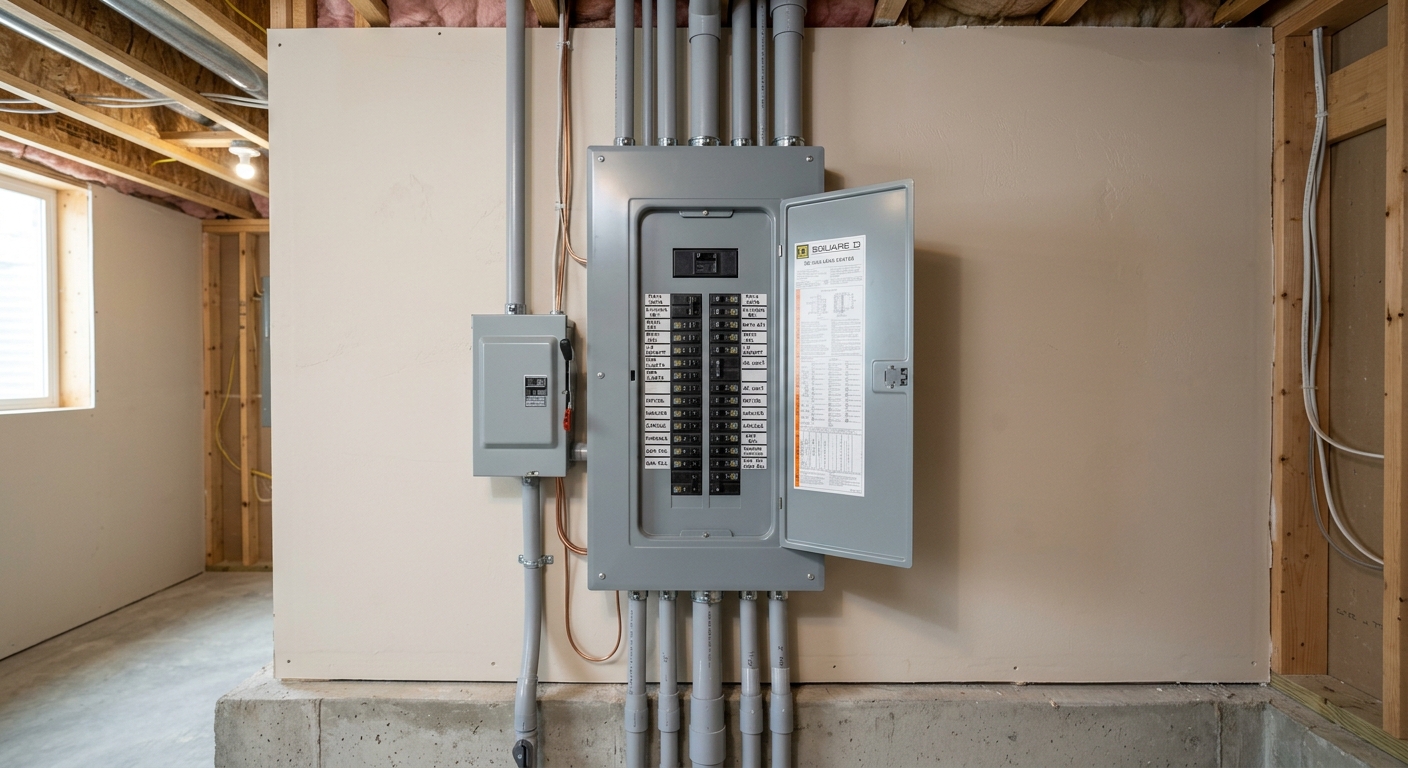
On top of that, Toronto’s load profile has changed. Heat pumps, electric cooking, and Level 2 EV charging add continuous and high-demand loads that smaller panels (like older 60A or 100A services) were never designed to carry. Add winter heating backslides, summer humidity spikes, and the common decision to finish basements or add a rental suite, and it’s easy to see why many projects combine a 100A-to-200A panel upgrade with new circuit additions.
In Mount Dennis—particularly around the older pockets near the Keele Street corridor—electrical trade demand is especially high when homeowners upgrade from older wiring systems, add EV charging, or modernize kitchen and laundry loads. If you’re comparing contractors, use the table below as a realistic starting point for what commonly gets permitted and installed in this area.
| Service |
Why It's Needed |
Permit Required |
Price Range |
| Panel upgrade — 100A to 200A service |
Modern loads (EV charging, heat pumps, electric cooking) often exceed older panel capacity; improves safety and future-proofing. |
Yes (service upgrade and panel change) |
$2,500–$6,000 |
| EV charger installation (Level 2, 40–50A) |
Supports overnight charging with a dedicated circuit; reduces overload risk versus shared receptacles. |
Yes (new circuit and charger connection) |
$900–$2,500 |
| Knob-and-tube wiring removal and replacement |
Outdated wiring with aged insulation; remediation is often needed for safety, code compliance, and insurability. |
Yes (major wiring alteration) |
$3,500–$15,000 |
| Aluminum wiring remediation (CO/ALR connectors) |
Aluminum branch wiring typically requires approved connection methods (CO/ALR) or replacement to reduce heating risks. |
Yes (wiring modification) |
$3,000–$12,000 |
| New dedicated circuit (HVAC, appliance, hot tub) |
Dedicated power improves performance and reduces nuisance tripping; supports high-draw appliances. |
Yes (new circuit) |
$500–$3,500 |
| Whole-home rewire (older home, full replacement) |
When large portions of wiring are aging or incompatible, a full rewire ensures consistent protection and modern safety devices. |
Yes (major wiring replacement) |
$8,000–$20,000 |
Prices are estimates only and vary by project scope, site access and material selection.
What affects the price of electrical work in Mount Dennis
In Mount Dennis and across the Toronto economic region, it’s common to see quotes for the “same” electrical job vary by 30–50%. Two reasons drive that spread: first, Toronto homes often sit on older wiring and service equipment, which means discovery work can quickly add time and materials. Second, labour and inspection scheduling in a high-demand market can change the effective cost of completing the scope efficiently. Even when the final hardware ends up similar, the hours needed to access wiring in finished basements, crawl spaces, or behind plaster walls can be very different.
Housing age is the dominant cost driver. Older homes—particularly those with knob-and-tube wiring—may require removal rather than patching, because insulation contact and legacy components can’t be “made modern” safely. Homes from the 1960s–70s may have 60A or 100A panels that feel adequate until you add today’s loads like EV chargers, heat pumps, and induction stoves. Aluminum wiring, seen frequently in that mid-century window, typically calls for licensed remediation using approved CO/ALR connectors or full replacement where the wiring condition is poor.
EV adoption is also changing the equation. More Level 2 charger permit applications means more demand for dedicated circuits and—when service capacity is tight—pairing the charger install with a panel upgrade. For budget planning, a straightforward EV circuit often fits in the $900–$2,500 band, but if it triggers load calculations and a 100A-to-200A service upgrade, you can easily be looking at $2,500–$6,000 just for the service work. In finished neighbourhoods near Keele Street, panel locations and wiring routes can raise labour costs; in contrast, if your panel is already near the desired charger spot, costs can stay closer to the lower end.
| Price Factor |
Why It Matters |
Cost Impact |
| Panel size upgrade — 100A to 200A is the standard minimum today |
More capacity for heat pumps, EV chargers, and modern appliances; reduces future service upgrade risk. |
$2,500–$6,000 |
| Wiring type — copper vs. aluminum remediation vs. K&T removal |
Aluminum requires specific connectors; knob-and-tube often needs removal and replacement rather than partial repairs. |
$3,000–$15,000 |
| Number of new circuits — each adds material and labour time |
New breakers, cables, boxes, and routing time scale with each added circuit. |
$500–$3,500 per circuit (typical) |
| Permit + ESA/TSBC inspection fee — mandatory for all major work |
Major work requires permits and inspection; you pay for compliance steps, not just hardware. |
$200–$500 (typical) |
| Labour rate for licensed electricians — journeyman rates in Toronto-area |
In this region, licensed contractors commonly bill about 90–120 per hour; complex access increases hours. |
$1,000–$4,000 shift depending on hours |
| EV charger amperage — 40A vs. 50A circuit affects cable and breaker cost |
Higher amperage may require heavier conductors and different breaker/parts selections. |
$900–$2,500 for a typical install |
| Emergency or after-hours premium |
Urgent callouts cost more because crews and scheduling are prioritized. |
$300–$1,500 extra (scope dependent) |
| Load calculation required for service upgrade |
Service upgrades typically require a proper load calculation to prove the panel size and circuit design are safe. |
$0–$600 (usually included or minor add-on) |
Permits & regulations in Ontario
In Ontario, ALL electrical work beyond changing a light bulb must be performed by a licensed electrician. That includes panel upgrades, new circuits, rewiring, service upgrades, and installing an EV charger or dedicated outlet/connection—anything that alters a home’s wiring, protection, or service capacity. Most homeowners can do simple, non-electrical tasks (like changing a fixture shade or swapping a non-wired bulb), but once you open a panel, run new cable, replace breakers, or connect a new circuit, you’re in licensed-work territory.
Permits are required for major work such as panel changes and service upgrades, additions of circuits (including HVAC, appliance, and EV charging), and any rewiring that changes the existing system. Permitted work must pass inspection by the Electrical Safety Authority (ESA) or via the local building process under ESA requirements. This is why a reputable contractor will ask for details and schedule inspection steps early—especially in the Toronto area where inspection lead times can affect completion dates.
Step-by-step, verify your contractor before they start: (1) confirm their Ontario electrical licence using the provincial registry search; (2) request a certificate of insurance showing liability coverage; (3) confirm they carry WSIB/WCB clearance for workers; and (4) ask whether they will obtain the ESA permit and schedule inspections under your address. If they can’t provide licence and clearance proof up front, that’s a strong warning sign.
When your Mount Dennis home needs an electrical upgrade
Electrical upgrades in Mount Dennis are usually about safety and code compliance, not aesthetics. Here are the warning signs I see most often in older Toronto neighbourhoods, where housing stock can include knob-and-tube remnants and aging service equipment.
(1) Breakers that trip regularly: this is often the first clue of overloaded circuits, undersized wiring, or a panel that can’t handle modern loads. If tripping is frequent, treat it as immediate—stop using the circuits and call a licensed electrician. (2) Knob-and-tube wiring: the key concern isn’t just “age,” it’s aged insulation and deteriorated connections that can contact nearby materials. If you’re planning a renovation, adding a suite, or changing loads, planned upgrade often turns into a safety-and-insurability requirement. (3) A 60A or 100A panel: combined loads—EV charger, heat pump, and electric stove—can push an older service beyond safe operating margins. In practice, moving to a 200A upgrade is the standard solution when you’re adding new high-demand equipment.
(4) Aluminum wiring (commonly pre-1976): it may not be “instant danger,” but it must be handled by professionals, often with approved CO/ALR remediation or replacement depending on condition. (5) Insufficient outlets and extension cords: this is a misuse signal and a fire-risk pattern. (6) No AFCI/GFCI protection where required: it can become a sale-issue and a safety gap.
Dollar-wise, it’s not unusual to see a dedicated circuit plan cost a few hundred to a couple thousand, but once you’re doing proper load calculations and upgrading to 200A, the service portion typically lands in the $2,500–$6,000 band—money well spent when your goal includes EV charging and heat-pump readiness.
| Warning Sign |
What It Means |
Recommended Action |
Urgency |
| Breakers trip frequently |
Overload, failing breakers, or undersized/incorrect circuit wiring. |
Inspection, troubleshooting, and circuit load review; may require new circuits. |
Immediate |
| Knob-and-tube wiring present |
Aged wiring with insulation/contact risks and outdated protection. |
Safety assessment and plan for removal/replacement in affected areas. |
Planned upgrade / prioritize |
| 60A or 100A panel (inadequate load capacity) |
Not enough capacity for modern appliances and EV/heat-pump loads. |
Load calculation and usually 100A-to-200A service upgrade. |
Planned upgrade (often before adding EV) |
| Aluminum wiring (pre-1976 construction) |
Connection and heating risks if not remediated correctly. |
CO/ALR connector remediation or replacement where needed. |
Planned upgrade (schedule promptly) |
| Insufficient outlets — extension cords everywhere |
Temporary power use increases heat build-up risk. |
Add outlets via new circuits where appropriate; remove reliance on cords. |
Planned upgrade (address soon) |
| No AFCI or GFCI protection where required |
Missing required shock/fire prevention devices. |
Upgrade breakers/receptacles to code-compliant protection. |
Planned upgrade / before sale |
How to choose a electrical work contractor in Mount Dennis
Choosing the right electrical contractor in Mount Dennis starts with verification. First, confirm their Ontario licence before work begins (ask for the licence details and cross-check the registry). Second, request proof of liability insurance so you’re protected if there’s property damage. Third, ask for WSIB/WCB coverage information—this matters for worker safety and avoids headaches if an incident occurs on site.
Next, get 2–3 itemised written quotes, not just a lump sum. An itemised quote should list labour hours, materials (breakers, panels, cable, connectors), and any required testing, plus which circuits are included. Pay attention to scope exclusions: ask whether the permit pull is included, whether disposal/demolition is covered, and whether patching/finishing drywall is part of the offer or handled separately. For workmanship, ask for the warranty length and whether it’s in writing; confirm how it’s handled if you sell the home (transferability matters to some buyers). For payment, keep it practical: never pay more than 10–15% upfront, and hold back a portion until the job is complete and inspected. Finally, get a clear start date and estimated completion timeline in writing, including inspection scheduling realities for the GTA.
- Provide Ontario electrical licence details before signing anything.
- Show a certificate of liability insurance (and confirm it’s current).
- Confirm WSIB/WCB coverage for workers.
- Get an itemised quote with labour + materials line items.
- Ask who applies for the ESA permit and who schedules the inspection.
- Clarify what’s included for panel relocation, conduit, and cable runs.
- Confirm disposal of old breakers/cable and any debris removal.
- Ask whether load calculations are included for service upgrades.
- Confirm which protection devices (AFCI/GFCI) are included and where.
- Ask about product brands/series and whether substitutions are allowed.
- Review warranty: workmanship length and documentation provided.
- Agree on a payment schedule: 10–15% max upfront; remainder after completion.
Red flags in Mount Dennis include: quoting a service upgrade “without” discussing load calculations, refusing to provide licence/insurance/WSIB proof, vague scopes like “wiring as needed” with no itemised breakdown, asking for a large upfront deposit (beyond 10–15%), or starting work before the permit/inspection steps are clearly planned.
Frequently asked questions — electrical work in Mount Dennis
Can I add a subpanel to my Mount Dennis home?
Yes, adding a subpanel is often a practical way to expand circuit capacity—especially if your main panel is older or crowded. In Mount Dennis and the wider Toronto area, a subpanel may be paired with a load calculation to confirm the existing service can support the additional breakers. If you currently have a 60A or 100A service, adding a subpanel alone may not be the safest long-term fix; many homes end up needing a 100A-to-200A service upgrade before adding meaningful new loads like heat pumps or EV charging. Subpanel work typically involves permits and ESA inspection because it changes distribution and protection. Costs vary by wiring distance and panel location, but in many cases homeowners plan their project around the same budget bands as other panel upgrades (often $2,500–$6,000 when a service change is required).
How much does an electrician cost in Mount Dennis?
In Mount Dennis, licensed electricians commonly charge labour around 90–120 per hour in this region, with the final total depending on access complexity and how much troubleshooting is needed. If the job is straightforward—like adding a dedicated outlet or replacing a failing component—you’ll usually see a lower total labour requirement. If the electrician needs to open walls, trace circuits in older wiring types, or address aluminum/K&T conditions, hours can increase quickly. Permits and inspections also add a required cost for major work, often in the general $200–$500 range depending on scope. When you compare quotes, ask for an itemised breakdown so you can see whether the “cheaper” quote is actually excluding permits, testing, or required devices like AFCI/GFCI.
How much does a panel upgrade cost in Mount Dennis?
A panel upgrade in Mount Dennis commonly refers to upgrading from 100A to 200A service capacity, which is often the minimum practical choice for modern load growth (EV charging, heat pumps, induction cooking). In the Toronto market, typical pricing for this service upgrade generally falls in the $2,500–$6,000 range, assuming standard site access and no major remediation. If the panel needs relocation, if significant wiring rework is required, or if there are knob-and-tube/aluminum complications that must be corrected to complete the upgrade, the upper end of the band (or more) can apply. In all cases, expect permits and ESA inspection for service changes. A good contractor will also include load calculations to justify the new panel size rather than just quoting hardware.
Do I need to upgrade to a 200A panel?
You don’t automatically need 200A, but in Mount Dennis you often do when you’re adding modern high-demand equipment. A 200A service is commonly chosen because it provides headroom for Level 2 EV charging, heat pumps/efficient heating systems, and kitchen/laundry loads—especially if you have a 60A or 100A panel today. Before recommending a change, electricians typically perform load calculations and review your existing circuits to confirm whether the current service can safely support additions. If you already have many circuits in use, you’re finishing a basement, or you plan an EV charger soon, upgrading to 200A usually prevents repeat work. For planning, remember that when a 200A upgrade is triggered, homeowners usually budget in the $2,500–$6,000 panel upgrade band, and then you can layer in charger and circuit work on top.
How much does an EV charger installation cost in Mount Dennis?
For Mount Dennis homeowners installing a Level 2 charger (typically on a 40–50A dedicated circuit), pricing in this region often lands in the $900–$2,500 range when wiring and permitting are straightforward. Your total can be higher if the electrician must run longer cable distances, upgrade older protection devices, or perform extra work to make the charger circuit compliant and safe. If your existing service is undersized or you have older wiring issues (like aluminum connections that need remediation), the electrician may require additional scope—sometimes including a service upgrade. In that scenario, you’d add the panel/service budget (often $2,500–$6,000) to the charger installation cost. Also expect permits and ESA inspection for the new circuit and charger connection.
What is knob-and-tube wiring and should I replace it?
Knob-and-tube wiring is an older wiring method used in many pre-mid-20th-century homes. It typically uses ceramic knobs/tubes to route conductors, and—more importantly today—its insulation and installation method don’t meet modern safety expectations for today’s loads and living conditions. In Ontario, if knob-and-tube wiring is present, a licensed electrician should assess the exact areas affected and determine what can be safely retained versus what must be removed and replaced. For many Mount Dennis homeowners, replacement is recommended when the system is connected to unsafe conditions, when you’re adding new circuits, or when insurance requirements are becoming stricter. Treat K&T as a safety-and-compliance priority, not a DIY project. Costs vary widely; whole-home rewires or significant removal often align with wiring remediation bands that can start around $3,500–$15,000 depending on how much needs replacement.