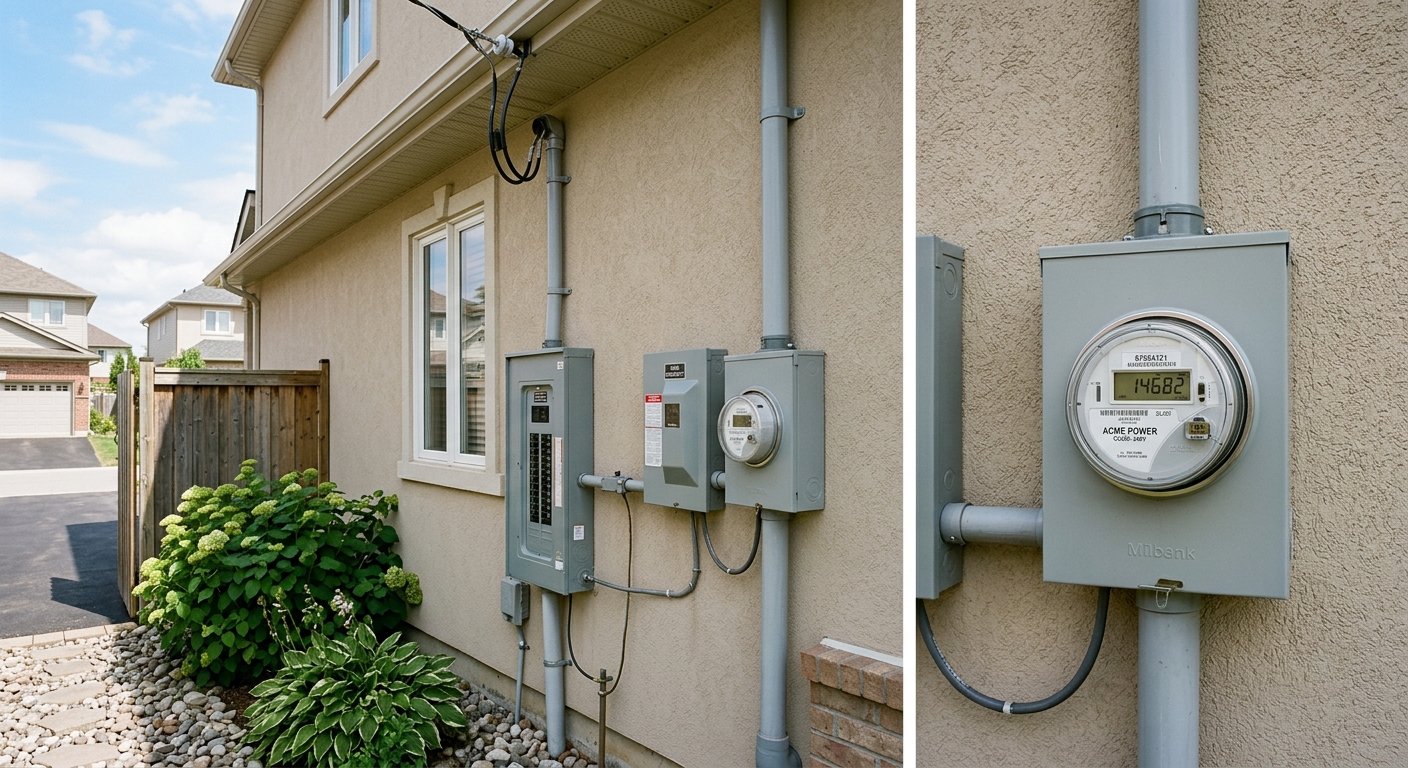
Electrical services and costs in Markland Wood
Electrical service needs in Markland Wood are shaped by the area’s mix of long-established streets and ongoing infill, and that shows up in the most common upgrades we see: panel increases, reworks of older wiring, and added circuits for modern loads. Markland Wood’s population is relatively small—10,554 people (Statistics Canada, 2021 Census)—but the homes are often mature, and many were built decades before today’s appliance and vehicle-charging expectations. In Toronto’s older neighbourhood fabric, it’s also common to find knob-and-tube or older branch wiring conditions that don’t keep up with today’s load profiles, especially once homeowners add heat pumps, finished basements, induction cooking, and Level 2 EV charging.
Toronto-area labour availability and site complexity are major cost drivers. In the GTA, dense lots, narrow driveways, and mature tree lines can add time for access, material staging, and cable routing. Weather matters too: during winter, colder working conditions can slow troubleshooting and make it harder to manage attic or crawlspace work safely, particularly where wiring must be re-run to reach serviceable locations. For families along the busier corridors in Markland Wood—where renovations are frequent and contractors can have tighter scheduling—pricing often reflects both demand and the time required to coordinate permits and inspection windows.
Below is a practical comparison of typical service types and the permits that usually go with them, so you can benchmark what a fair quote looks like for your situation.
| Service |
Why It's Needed |
Permit Required |
Price Range |
| Panel upgrade — 100A to 200A service |
Adds capacity for EV charging, heat pumps, modern kitchen loads, and basement renovations; improves safety margins and code compliance. |
Yes (panel/service work requires permits and inspection in Ontario). |
$2,500 – $6,000 |
| EV charger installation (Level 2, 40–50A) |
Enables faster home charging with proper breaker, wiring, and GFCI/AFCI coordination where required. |
Yes (new circuit/charger installation requires permit and inspection). |
$900 – $2,200 |
| Knob-and-tube wiring removal and replacement |
Reduces fire risk from deteriorating insulation/contact issues and brings the home up to modern wiring expectations. |
Yes (rewiring and removal typically require permits and inspection). |
$3,000 – $12,000 |
| Aluminum wiring remediation (CO/ALR connectors) |
Improves connection reliability for older aluminum branch wiring using approved methods to address oxidation and improper terminations. |
Often yes (remediation/removal of unsafe conditions usually requires a permit). |
$3,500 – $10,500 |
| New dedicated circuit (HVAC, appliance, hot tub) |
Prevents nuisance tripping and voltage drop by dedicating circuits for high-demand equipment. |
Yes (new circuits typically require permit/inspection). |
$400 – $2,800 |
| Whole-home rewire (older home, full replacement) |
Replaces obsolete wiring throughout to safely support today’s electronics, electric heating/heat pumps, and EV loads. |
Yes (major rewiring requires permits and inspection). |
$8,000 – $15,000 |
Prices are estimates only and vary by project scope, site access and material selection.
What affects the price of electrical work in Markland Wood
In Toronto and the surrounding market, you can see the same “type” of electrical job quoted 30–50% apart, even when homeowners believe the scope is identical. That’s because the price is driven by hidden variables: how much existing wiring needs to be opened, whether the panelboard is obsolete, what rewiring paths are feasible through insulation and finished walls, and how quickly permits and ESA inspections can be scheduled. The dominant cost driver is the age and condition of the housing stock. Homes built before 1950 are the most likely to have knob-and-tube wiring issues that insurance companies may not want to cover, and they can require extensive replacement rather than patchwork. Meanwhile, many homes from the 1960s–70s have 60A or 100A service capacity that struggles with modern loads—especially once you add EV chargers, heat pumps, and high-demand kitchen appliances. Aluminum wiring is also common in houses built roughly in the 1965–1976 window, and that typically calls for licensed remediation using approved CO/ALR connector methods or full replacement.
EV adoption is also pushing up demand for Level 2 charger installs. In practice, a new 40A or 50A circuit can affect cable size, breaker selection, and how much additional panel capacity is needed; if your panel is already near its limit, a service upgrade can move the job from a smaller “add-on” into the $2,500–$6,000 panel upgrade tier, sometimes higher when significant remediation is required. In Markland Wood specifically, cost often rises with difficult routing (finished basements, older plaster walls, tight crawlspaces) and falls when you already have accessible cable pathways and a modern panel. Winter conditions can add time for attic/crawlspace work, which matters when labour runs around 90–120 per hour in this region.
| Price Factor |
Why It Matters |
Cost Impact |
| Panel size upgrade — 100A to 200A is the standard minimum today |
More breakers/capacity for EV, heat pumps, and modern appliance loads; improves safety and code compliance. |
Typically shifts the job into about $2,500 – $6,000 |
| Wiring type — copper vs. aluminum remediation vs. K&T removal |
Aluminum and knob-and-tube require special handling; K&T often triggers broader rewiring. |
Can add thousands; K&T removal commonly starts around $3,000 – $12,000 |
| Number of new circuits — each adds material and labour time |
Each circuit means new cable, breakers, terminations, and testing time. |
Often increases totals proportionally; dedicated circuits can range into $400 – $2,800 each |
| Permit + ESA/TSBC inspection fee — mandatory for all major work |
Permits and inspections are required in Ontario for major work (service/panel changes, rewiring, new circuits). |
Usually adds roughly a few hundred dollars depending on scope |
| Labour rate for licensed electricians — journeyman rates in Toronto |
Labour is a primary component: troubleshooting, wall openings, and proper terminations take time. |
Hourly rates commonly in the $90 – $120/hour range affects final totals |
| EV charger amperage — 40A vs. 50A circuit affects cable and breaker cost |
Higher amperage can require larger conductors, breakers, and more careful load management. |
Can move EV installs within $900 – $2,500 |
| Emergency or after-hours premium |
Utilities and ESA scheduling constraints can create rush-work costs. |
Often adds a measurable premium (commonly 20%+ for urgent scheduling) |
| Load calculation required for service upgrade |
If your panel is near limits, a load calculation may be needed and can influence the required service size. |
May add billable time, but prevents costly under-sizing later |
Permits & regulations in Ontario
In Ontario, ALL electrical work beyond changing a light bulb must be done by a licensed electrician, and most homeowners should assume a permit will be required for anything that changes your system’s capacity or introduces new conductors. Permits are typically required for panel upgrades (including 100A-to-200A service), new circuits (including an EV charger circuit), rewiring projects, and service upgrades. Work like installing additional receptacles or switching devices may or may not require a permit depending on how it affects circuits, but in practice, contractors usually pull permits to keep the job compliant and properly inspected.
Permitted work must pass inspection by the electrical safety authority—ESA in Ontario—before it’s considered compliant. DIY electrical is prohibited for most tasks; the only narrow homeowner allowances are generally limited to very basic, low-risk activities that do not involve altering wiring or electrical components that require inspection. To protect yourself, ask your electrician to provide the ESA permit number (or documentation of the permit being pulled) and the inspection clearance details after completion.
How to verify before work starts: (1) Confirm the electrician/company licence and number through the Ontario licence registry (use the company name and individual licence), (2) request a current Certificate of Insurance showing liability coverage, and (3) confirm WSIB/WCB coverage for workers who will be on-site. You want those documents before the first drill bit goes in—especially in Markland Wood where older wiring conditions can expand scope quickly.
If a contractor won’t provide licence/insurance proof or won’t discuss permitting and inspection steps, treat it as a warning sign.
When your Markland Wood home needs an electrical upgrade
Electrical upgrades in Markland Wood aren’t just about convenience—they’re about preventing unsafe conditions and avoiding costly failures during winter peaks. Start with the most visible warning sign: (1) breakers that trip regularly. Frequent tripping usually indicates an overloaded circuit, a failing breaker, or wiring issues; if it happens alongside specific appliances, plan corrective work soon, and stop using the equipment that triggers it.
(2) Knob-and-tube wiring is a key concern even if “it still works.” The issue is aging insulation, contact quality, and the increased risk profile—plus potential insurance problems. If knob-and-tube is present, you’re typically looking at partial or whole-home replacement strategies, not “minor repairs.”
(3) A 60A or 100A panel can be inadequate for a modern household, especially in Ontario where heat pumps and electric cooking are common. When you add an EV charger plus an electric stove and a heat pump, many homes need a 200A upgrade for safe capacity and code alignment. (4) Aluminum wiring in pre-1976 homes may not be immediately dangerous if it’s in good condition, but it does require licensed remediation—commonly CO/ALR connectors or replacement of failed/heat-damaged sections—because connection reliability is the weak point.
(5) Insufficient outlets and (6) missing AFCI/GFCI protection are often discovered during home sales or renovations. These are not always emergency situations, but they are code-compliance and safety upgrades that should be planned.
For example, if you’re considering EV charging and your panel is at the limit, a charger-only install may be wasted money. In that scenario, a $900–$2,500 charger install can be paired with a $2,500 – $6,000 service upgrade to avoid future rework—often the cheaper overall path.
| Warning Sign |
What It Means |
Recommended Action |
Urgency |
Price Band |
| Breakers trip frequently |
Likely overload, shorted component, or undersized/aging circuit protection. |
Troubleshoot the specific circuit(s), measure load, and upgrade/dedicate circuits as needed. |
Immediate to planned (depends on frequency and cause) |
$400 – $2,800 |
| Knob-and-tube wiring present |
Obsolete wiring with aging insulation/contact risks; often incompatible with modern load expectations. |
Remove/relabel and replace with modern cable; scope is typically partial-to-whole-home. |
Planned with a safety priority |
$3,000 – $12,000 |
| 60A or 100A panel (inadequate load capacity) |
May not safely support EV charging, heat pumps, and kitchen/appliance loads together. |
Load calculation and upgrade to 200A service where required. |
Planned (with timelines before new high loads) |
$2,500 – $6,000 |
| Aluminum wiring (pre-1976 construction) |
Connection issues can develop over time; requires approved remediation methods. |
Inspect connections; repair using CO/ALR-approved techniques or replace compromised sections. |
Planned |
$3,500 – $10,500 |
| Insufficient outlets — extension cords everywhere |
Over-reliance on temporary wiring increases risk and often indicates missing circuits. |
Add receptacles and/or dedicated circuits; improve GFCI/AFCI coverage where required. |
Planned |
$400 – $2,800 |
| No AFCI or GFCI protection where required |
Outdated protection increases shock and arc-fault risk. |
Upgrade protection devices and add/modify circuits to meet Ontario Electrical Code requirements. |
Planned with safety priority |
$200 – $3,500 |
How to choose a electrical work contractor in Markland Wood
Choosing the right contractor in Markland Wood starts with proof, not promises. First, verify Ontario licensing: the electrician/company should provide their licence number(s), and you can cross-check it through the Ontario electrical licensing registry. Next, confirm liability insurance—request a Certificate of Insurance and ensure it covers the work being performed. Also confirm WSIB/WCB coverage for workers on-site; if a contractor can’t provide it, you can be the one who absorbs the cost if there’s an incident.
For pricing, get 2–3 written itemised quotes rather than lump sums. Look for a breakdown of labour hours, materials (cable, breakers, panel components, connectors), permits, and inspection fees. Ask whether the quote includes permit pulling, ESA/inspection coordination, and disposal of removed materials. Scope clarity matters: exclusions like wall patching, drywall repairs, landscaping restoration, or upgrading service mast/utility connections can dramatically change the final cost.
Warranty is equally important. Ask for the workmanship warranty length, whether manufacturer warranties apply to panel/charger components, and if warranties are transferable to the homeowner. Payment schedule should be conservative: never pay more than 10–15% upfront; hold back the remainder until the job is completed and tested. Finally, require a start date and completion estimate in writing so you can plan around winter scheduling and inspection windows.
- Verify Ontario licence number and company name match the quote.
- Request Certificate of Insurance and confirm the coverage limits.
- Confirm WSIB/WCB clearance before work begins.
- Insist on itemised labour + materials (not a single total).
- Check whether permits and ESA inspection fees are included.
- Ask what’s excluded: drywall repairs, landscaping restoration, debris hauling.
- Confirm circuit testing, label updates, and final documentation.
- Ask the contractor to perform/confirm a load calculation for service upgrades.
- For aluminum/K&T work, confirm what remediation method they’ll use (approved connectors vs. replacement).
- Review warranty terms for both workmanship and equipment.
- Use a payment schedule with a holdback until everything passes test and inspection.
- Get the timeline and inspection scheduling plan in writing.
Red flags in Markland Wood include: a contractor who won’t pull permits for panel/service or EV charger circuits, vague scope wording (no circuit counts or cable/breaker specifics), refusing to provide licence/insurance/WSIB details, pushing for large upfront deposits, or quoting “same price no matter what” without assessing your panel capacity and existing wiring condition.
Frequently asked questions — electrical work in Markland Wood
How much does an EV charger installation cost in Markland Wood?
In Markland Wood, a typical Level 2 EV charger installation (about a 40–50A circuit) is commonly in the $900 – $2,500 range when your electrical service has enough capacity and the routing is straightforward. Pricing moves up when cable runs are longer, when the panel needs labeling/updates, or when the charger install requires a service or panel upgrade to safely support EV loads alongside existing household demand. In the GTA, demand for charger permits is high, so scheduling and inspection timing can also affect labour time. If you’re starting from a marginal 60A or 100A panel, it’s often smarter to plan for the $2,500 – $6,000 panel upgrade tier so you don’t pay twice. (Ontario Electrical Code compliance + ESA inspection apply.)
What is knob-and-tube wiring and should I replace it?
Knob-and-tube wiring is an older wiring method using porcelain “knobs and tubes” to route insulated conductors through spaces without modern cable sheathing. Even when it appears to work, the insulation and connection practices are outdated, and that’s why it carries higher risk and often causes insurance or sale-transaction issues in Ontario homes, including in Markland Wood. Replacement is usually recommended when you’re doing major upgrades, adding new circuits, or when parts of the system are deteriorated. The practical approach is often partial replacement in limited areas, but many homeowners choose broader rewiring once they start because hidden sections can have similar aging. Expect permitting and ESA inspection because rewiring and circuit additions are major work.
Is aluminum wiring safe in older Markland Wood homes?
Aluminum wiring isn’t automatically “unsafe,” but it does require careful handling and inspection. In older Markland Wood homes built with aluminum branch wiring (commonly around the 1960s–1970s), the concern is typically the quality of terminations over time—oxidation and loose connections can increase heat at contact points. The safe route is a licensed inspection of affected connections and remediation using approved methods (often CO/ALR connectors) or replacement where damage is found. If your system is already showing signs of heat discoloration, nuisance breaker issues, or you’re planning major loads like an EV charger, the correct time to address aluminum wiring is before you add demand. Depending on scope, remediation is frequently in the $3,500 – $10,500 range.
Do I need a permit for electrical work in Ontario?
Yes, in Ontario you generally need permits for electrical work that alters your circuits, adds wiring, or changes your service/panel. Typical permit-requiring work includes panel upgrades (including service increases), service relocation, rewiring, and new dedicated circuits—especially EV charger installations, which require a permit because they introduce new conductors, breakers, and safety protections. Ontario also requires inspection of permitted work by the ESA (Electrical Safety Authority) to confirm code compliance. Simple tasks like replacing an identical light fixture can be exempt depending on exact circumstances, but you should not assume exemptions—ask your electrician what requires a permit before they start. Always request proof of the permit being pulled and the inspection completion documents before final payment.
What are signs of an overloaded electrical panel?
An overloaded panel often shows up as breakers that trip repeatedly, especially when running multiple appliances at once, or when a “single” event triggers tripping—like using the hair dryer while the oven and microwave are running, or starting laundry and a dehumidifier simultaneously. Another clue is frequent nuisance tripping after adding a new high-demand item (electric range, heat pump equipment, A/C, or an EV charger). In homes where the panel is undersized for modern loads, you may also see warm breaker faces, discoloured wiring at terminations, or a pattern of older breakers being replaced repeatedly. If you’re planning to add a Level 2 charger or upgrade heating, the safest path is a load calculation and—if needed—a 200A upgrade typically in the $2,500 – $6,000 band. Cold Ontario weather can increase heating load and makes these problems show up sooner.
Can I do my own electrical work in Ontario?
In Ontario, DIY electrical is restricted and is not allowed for most work, even if you’re experienced. The practical rule for homeowners is: if the work involves opening walls, altering wiring, adding circuits, changing the panel, installing a new breaker, or connecting wiring beyond simple fixture swaps, it must be done by a licensed electrician and typically requires permits and ESA inspection. Narrow homeowner allowances generally don’t cover major wiring changes, service work, or adding EV charger circuits. If you try to cut corners, you can end up with failed inspections, insurance complications, or unsafe conditions. In Markland Wood, where older homes may already have knob-and-tube or aluminum wiring, the compliance and safety risks are even higher. The best approach is to hire a licensed contractor, request itemised quotes, and confirm permitting/inspection steps before any work starts.