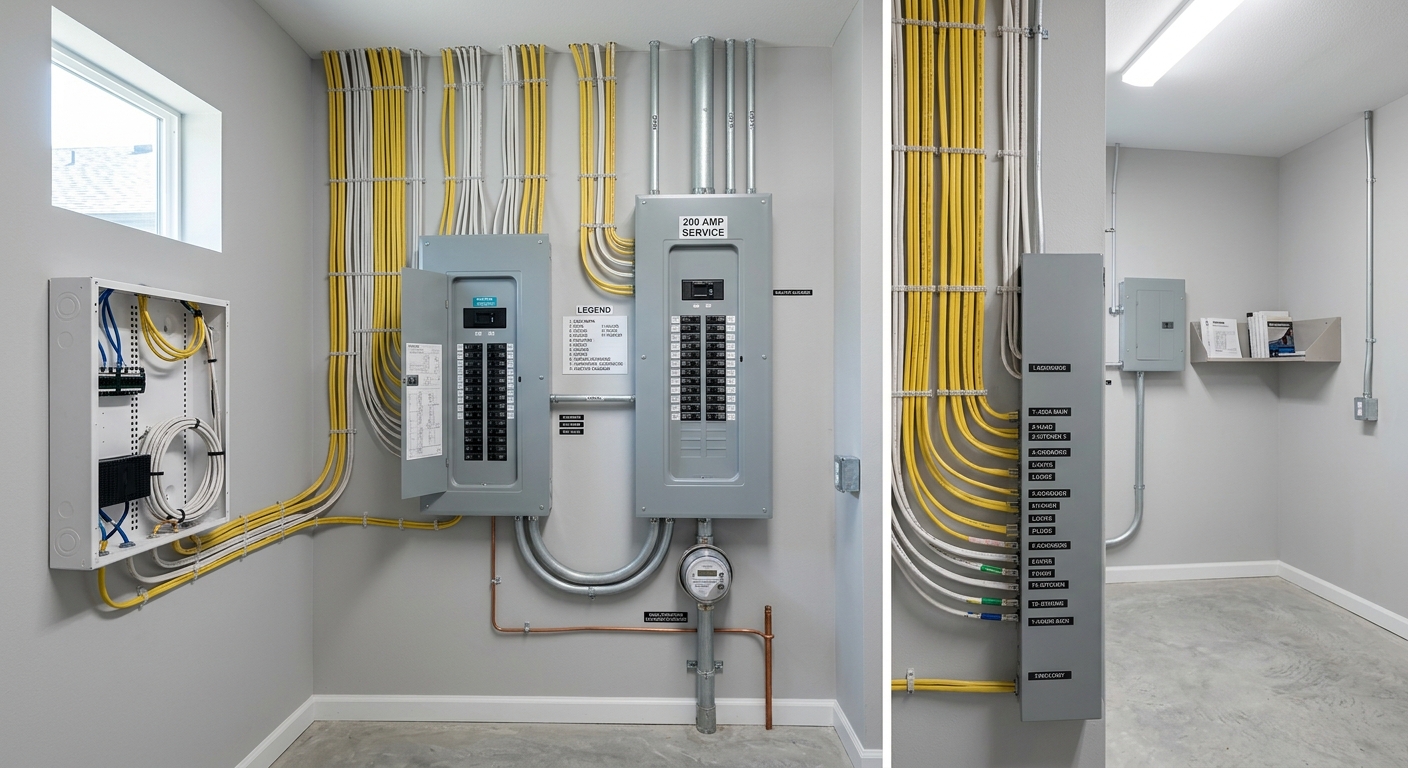
Electrical services and costs in Grimsby
Grimsby homeowners often face electrical costs that feel higher than expected—not because labour is inflated, but because the local housing stock drives the scope. In 2021, Grimsby had 28,883 residents, and 42.2% of dwellings were built before 1981 (Statistics Canada, 2021 Census). That matters: older wiring styles and smaller services are common, so electricians frequently pair panel upgrades with rewiring work rather than doing a single, “clean” change-out. It’s also common to see older 60–100A services that can’t reliably support modern loads like electric heating, heat pumps, induction cooking, EV chargers, and future renovation needs.
The Hamilton–Niagara Peninsula market has a lot of pre‑1970 homes, especially around older residential pockets and infill areas where homeowners are finishing basements and adding bedrooms. In a colder-than-average seasonal swing—winter cold and indoor demand spike—breakers and under-sized wiring become more noticeable, and contractors plan around peak load safety and ESA inspection timelines. Availability can also affect pricing: when multiple projects are hitting permits at once, electricians may schedule work in tighter windows, which can add mobilization and “rush” planning time.
We typically see steady demand in the Grimsby Beach/Harbourfront and surrounding residential streets, where many homes are older and owners are modernizing for comfort and resale readiness. If you’re comparing options, the table below is a practical starting point for budgeting before we confirm your load needs and site conditions.
| Service |
Why It's Needed |
Permit Required |
Price Range |
| Panel upgrade — 100A to 200A service |
Increases capacity for modern appliances, EV charging, heat pumps, and electric heating while improving safety clearances and protection. |
Yes (ESA permit + inspection) |
$1,800–$4,500 |
| EV charger installation (Level 2, 40–50A) |
Dedicated circuit reduces overload risk and supports consistent charging for today’s vehicles. |
Yes (ESA permit + inspection) |
$1,000–$3,500 |
| Knob-and-tube wiring removal and replacement |
Knob-and-tube is outdated and often triggers insurance issues; replacement restores safer insulation systems and compliant circuits. |
Yes (ESA permit + inspection) |
$8,000–$20,000 |
| Aluminum wiring remediation (CO/ALR connectors) |
Approved remediation (e.g., CO/ALR connectors) reduces overheating at terminations and improves connection integrity. |
Yes (ESA permit + inspection) |
$6,500–$15,000 |
| New dedicated circuit (HVAC, appliance, hot tub) |
Dedicated wiring supports high-draw equipment and reduces nuisance trips and voltage drop. |
Yes (new circuit generally requires ESA permit) |
$750–$2,500 |
| Whole-home rewire (older home, full replacement) |
Full replacement is chosen when wiring, outlets, and circuit paths need complete modernization or when older wiring is widespread. |
Yes (ESA permit + inspection) |
$12,000–$28,000 |
Prices are estimates only and vary by project scope, site access and material selection.
What affects the price of electrical work in Grimsby
In Grimsby and across the Hamilton–Niagara Peninsula, you can see quoted prices vary by roughly 30–50% for what looks like the same job. The biggest driver is the condition and age of the wiring and service: with 42.2% of homes built before 1981 (Statistics Canada, 2021 Census), many projects start as “a simple upgrade” and quickly turn into service sizing, wiring remediation, and code-compliance changes. Another common reason is load growth. In this region, EV adoption and electric-heat add-ons push peak demand, so electricians often have to expand capacity and add dedicated circuits before installing new equipment.
Housing age changes the job in a dollar way. Homes built before 1950 may have knob‑and‑tube wiring, which is a safety and insurance problem—not just an aesthetic issue—so removing and replacing it can push rewiring work into the higher end of the $8,000–$20,000 range. Homes from the mid‑60s to mid‑70s often have 60A or 100A panels and aluminum wiring; those combinations typically require both panel assessment and licensed remediation. If you’re adding an EV charger, the most common outcome is either (a) dedicated 40A/50A circuits within a properly sized panel, or (b) an upgrade first—often in the $1,800–$4,500 service range—followed by charger installation.
Concrete examples from Grimsby: a house with straightforward basement access may keep a panel upgrade closer to the lower band, while a crawlspace or difficult service location increases labour and cable runs. Similarly, a connector-only aluminum remediation job is usually less expensive than full rewiring, but if the wiring is damaged or workmanship is inconsistent, we’ll recommend replacement to avoid repeat callbacks. Finally, if a load calculation shows you’re near capacity, the “cheaper now” option (small circuit changes) can cost more later when additional equipment forces another panel review.
| Price Factor |
Why It Matters |
Cost Impact |
| Panel size upgrade — 100A to 200A is the standard minimum today |
Modern loads require capacity, correct breakers, and safe routing space. |
Often moves the project into the $1,800–$4,500 band |
| Wiring type — copper vs. aluminum remediation vs. K&T removal |
Aluminum and knob-and-tube require licensed remediation or replacement to meet safety and inspection expectations. |
Can shift total cost by thousands, e.g., $8,000–$20,000 for K&T scenarios |
| Number of new circuits — each adds material and labour time |
Each circuit requires breakers, cable, terminations, and testing. |
Incremental increases (often hundreds to a few thousand per circuit) |
| Permit + ESA/TSBC inspection fee — mandatory for all major work |
Major changes must be permitted and inspected before the utility finalizes any service change. |
Typically adds a fixed compliance cost plus scheduling time |
| Labour rate for licensed electricians — journeyman rates in Hamilton–Niagara area |
Licensing and experience affect troubleshooting, terminations, and code compliance. |
Higher complexity can add hours and raise the labour portion |
| EV charger amperage — 40A vs. 50A circuit affects cable and breaker cost |
Higher amperage may mean larger cable/breaker materials. |
Can move an EV job within the $1,000–$3,500 band |
| Emergency or after-hours premium |
Nights/weekends increase mobilization and scheduling overhead. |
Commonly adds a noticeable premium |
| Load calculation required for service upgrade |
ESA/utility requirements often rely on documented capacity planning. |
May add engineering/scoping time, especially if evidence is incomplete |
Permits & regulations in Ontario
In Ontario, electrical work that goes beyond changing a light bulb must be done by a licensed electrician. Permits are required for major work such as panel upgrades (including 100A to 200A), adding new circuits, rewiring, and installing equipment like EV chargers. Permitted work must also pass inspection by the Electrical Safety Authority (ESA). While Ontario allows very limited “owner-permitted” tasks, homeowners generally cannot do wiring, panel work, or new circuit connections themselves—those narrow exceptions do not cover the kinds of service and wiring changes that most Grimsby projects require.
Here’s what does require a permit in typical Grimsby residential scenarios: (1) panel or service equipment changes, (2) new breakers and circuits, (3) EV charger installations, (4) knob-and-tube removal/replacement work, and (5) whole-home rewiring or significant rewiring. What typically does not require a permit: like-for-like fixture swaps (for example, replacing a ceiling light with an identical-rated fixture), basic maintenance that does not involve changing wiring conductors, and work restricted to non-electrical tasks.
To verify an Ontario contractor, start with the electrician’s licence (and company registration where applicable) through the ESA/official provincial licence registry. Next, request a current certificate of insurance (liability) and confirm coverage limits. Finally, ask for WSIB/WCB clearance documentation (or the contractor’s confirmation for coverage status) before work begins. If a contractor won’t provide documentation or tries to quote without a permit plan, that’s a major red flag—especially for service upgrades where inspection outcomes affect when the utility will finalize changes.
When your Grimsby home needs an electrical upgrade
Grimsby homes—particularly older housing stock—often show warning signs that aren’t just “inconvenient,” but safety-critical. Frequent breaker trips usually indicate an overloaded circuit, a failing breaker, or wiring that can’t handle the current load. If trips happen during normal use (not only during one exceptional event), plan inspection promptly. Knob-and-tube wiring is the key concern: it’s not only about age; older insulation contact and overheating risk can trigger both insurance problems and ESA/inspection concerns. If knob-and-tube is still present, treat it as an urgent modernization task, not a cosmetic fix.
Service size is another common issue. Many pre-modern homes are on 60A or 100A panels, which can be inadequate when you add an EV charger, heat pump, electric stove, and new basement upgrades. In those cases, a 200A upgrade is often the standard solution to avoid nuisance trips and keep the system compliant and future-proof.
Aluminum wiring (often seen in pre‑1976 builds) may not fail immediately, but it requires licensed remediation—typically with approved connectors—to reduce loose/overheating terminations. Finally, insufficient outlets or missing AFCI/GFCI protection is frequently discovered during home sales or renovations; if required protection is missing, it’s a compliance issue that should be addressed during the upgrade, not postponed indefinitely.
On the cost side, upgrading from 100A to 200A often aligns with the $1,800–$4,500 band, which can prevent much larger issues later. If you’re adding an EV charger without a capacity plan, the “cheaper circuit now” approach can cost more once you realize you need the service upgrade anyway—especially during winter when loads peak.
| Warning Sign |
What It Means |
Recommended Action |
Urgency |
Price Band |
| Breakers trip frequently |
Overload, loose connections, or undersized/failed circuit components. |
Load check, breaker/cable inspection, add circuits or upgrade panel if needed. |
Immediate to short-term (schedule soon) |
$750–$2,500 |
| Knob-and-tube wiring present |
Outdated insulation and connection risk; often a coverage and inspection concern. |
Plan removal and rewiring of affected circuits. |
Urgent (safety/compliance) |
$8,000–$20,000 |
| 60A or 100A panel (inadequate load capacity) |
Not enough capacity for modern appliances and added EV/heat loads. |
Load calculation and 200A service upgrade as required. |
Planned (before adding major loads) |
$1,800–$4,500 |
| Aluminum wiring (pre-1976 construction) |
May have overheating risk at connections if not properly remediated. |
Licensed CO/ALR connector remediation or selective replacement. |
Planned (but don’t ignore) |
$6,500–$15,000 |
| Insufficient outlets — extension cords everywhere |
Temporary/unsafe usage patterns and likely circuit stretching. |
Add outlets and (if needed) new dedicated circuits. |
Planned (address before winter) |
$750–$2,500 |
| No AFCI or GFCI protection where required |
Potential shock/fire risk and code non-compliance discovered at inspection or sale. |
Upgrade receptacles/breakers as required and verify protection strategy. |
Planned (prioritize before sale/renovation) |
$150–$1,600 |
How to choose a electrical work contractor in Grimsby
Start by verifying licensing, insurance, and coverage—because service upgrades, rewiring, and EV charger circuits are permit-driven work under Ontario’s ESA system. Ask for the electrician’s licence details (and confirm the company’s ability to obtain ESA permits). Next, request a certificate of insurance showing liability coverage; if they can’t produce it, that’s a serious problem. For WSIB/WCB, ask for clearance or proof of registration/status for the contractor and any subcontractors; don’t rely on verbal assurances.
When you request quotes, insist on itemization rather than a single lump sum. At minimum, get a breakdown of labour and materials (panel, breakers, cable, connectors, disposal/loading if applicable) and what’s included in testing and ESA inspection prep. Confirm whether permit pull/handling is included in the quote, whether disposal (old panel/material removal) is covered, and whether any utility requirements are discussed—especially for panel and service changes. A good electrician will also explain exclusions clearly (for example, patching drywall, trenching, or upgrades required by hidden wiring conditions).
Warranty matters too: confirm the workmanship warranty length and whether it covers follow-up visits. Product warranties are typically manufacturer-based; ask if the warranty is transferable to you as the homeowner. For payment, keep deposits conservative—generally no more than 10–15% upfront—and use a holdback until the job is complete and any ESA paperwork is delivered. Finally, get the start date and an estimated completion timeline in writing so you can plan around inspections and winter scheduling realities.
- Ask for ESA permit responsibility in writing.
- Request a licence/registration number and confirm it matches the company on the quote.
- Get certificate of liability insurance before any work starts.
- Confirm WSIB/WCB clearance or coverage status for the contractor.
- Require an itemized quote: labour vs. materials vs. allowances.
- Verify what’s included for testing, labeling, and final inspection prep.
- Confirm disposal and haul-away of old equipment (panel, breakers, wiring scrap).
- Ask who handles any utility/ESA scheduling steps for service changes.
- Check warranty terms: workmanship coverage and how it’s claimed.
- Use a payment schedule with a holdback until completion and documentation.
- Get a realistic timeline that accounts for permits and inspection booking.
- Request photos of completed work and a description of any changes from original scope.
Red flags in Grimsby include: (1) quoting without discussing load calculations when you’re adding EV charging or heat pumps, (2) no mention of ESA permitting for new circuits or service upgrades, (3) “we don’t do itemized quotes” responses, (4) refusing to show insurance/WSIB/WCB documentation, and (5) asking for large upfront payments (well beyond 10–15%) before any verified work begins.
Frequently asked questions — electrical work in Grimsby
How much does an electrician cost in Grimsby?
In Grimsby, electricians typically price residential work using flat-rate quotes for common upgrades, but the final number depends on wiring condition and permit scope. For budgeting, many panel and service-related projects land in the $1,800–$4,500 range when you’re moving up to a safer capacity like 200A. If the work involves older wiring like knob-and-tube removal or substantial rewiring, costs commonly move into the $8,000–$20,000 band because labour hours and materials rise quickly. The region’s older housing stock is a big reason: 42.2% of dwellings were built before 1981 (Statistics Canada, 2021 Census), so contractors often encounter outdated insulation or undersized services more frequently than in newer suburbs.
How much does a panel upgrade cost in Grimsby?
A panel upgrade in Grimsby usually falls into the $1,800–$4,500 range for a typical residential change such as upgrading from 100A to 200A, assuming wiring access is straightforward and there’s no major hidden rewiring required. If your home has older wiring types, aluminum terminations, or conditions that require additional circuit modifications, the job can cost more because electricians must keep everything inspection-ready. Panel work also requires an ESA permit and inspection, and for service changes the utility process needs to be coordinated. For context, Grimsby’s housing age profile means many owners are modernizing for EV charging and heat pump loads, which is exactly when a 200A service upgrade becomes the most practical long-term fix (Statistics Canada, 2021 Census).
Do I need to upgrade to a 200A panel?
You don’t always need 200A, but it’s often the standard minimum in Grimsby when you’re adding modern loads. A qualified electrician will start with a load calculation and review your current panel capacity, breaker spaces, and any known wiring limitations. Many homes in the area were built long before today’s EV chargers and heat equipment, and with more households owning homes (82.6% of households own, Statistics Canada, 2021 Census), upgrades are common during renovations and basement finishing. If your current panel is 60A or 100A and you’re planning an EV charger, heat pump, and electric cooking, a 200A upgrade is frequently the safest way to avoid repeated nuisance trips and keep the system compliant for ESA inspection requirements.
How much does an EV charger installation cost in Grimsby?
For a typical Level 2 EV charger installation in Grimsby, many projects land in the $1,000–$3,500 range, depending on the distance to the panel, whether you already have spare breaker space, and what circuit size is required. If the charger is on a 40–50A circuit, the breaker and cable sizing changes the material cost. ESA permits are mandatory for the electrical work and inspection must be passed before the installation is considered complete from a compliance standpoint. In older Grimsby homes, the hidden variable is often whether your panel needs to be upgraded first; if you’re already near capacity due to electric heating or other large loads, an EV charger can push you into the $1,800–$4,500 panel upgrade band before the charger goes in.
What is knob-and-tube wiring and should I replace it?
Knob-and-tube wiring is an older wiring method commonly found in pre-modern homes. It uses ceramic knobs/tubes to support conductors and insulation practices that are not comparable to modern standards. In Ontario, knob-and-tube presence often becomes a safety and inspection issue, and it can also create insurance complications—so even if it seems to “still work,” it may be difficult to insure and may not pass inspection for certain upgrades without remediation. In Grimsby, replacement decisions are often driven by project timing: when homeowners renovate, finish basements, or add EV charging/heat equipment, the upgrade scope makes complete circuit replacement more practical than piecemeal changes. Budget-wise, knob-and-tube removal and replacement commonly sits in the $8,000–$20,000 band because it’s labour-intensive and requires proper circuit redesign and testing for ESA sign-off.
Is aluminum wiring safe in older Grimsby homes?
Aluminum wiring isn’t automatically “unsafe,” but it does require the right installation approach and licensed remediation where needed—especially at connection points. In many older Grimsby homes (often from the pre‑1976 era), aluminum wiring can develop issues at terminations, which is why approved CO/ALR connectors and proper connection methods matter. A licensed electrician should evaluate the wiring condition, identify where remediation is required, and then perform work that will pass ESA inspection. If the aluminum is in good shape and only connection remediation is needed, costs can be lower than a full rewire; however, if there’s damage, corrosion, or widespread replacement is necessary, the project can climb significantly. The safest path is a targeted assessment before you add major new loads like a Level 2 EV charger.