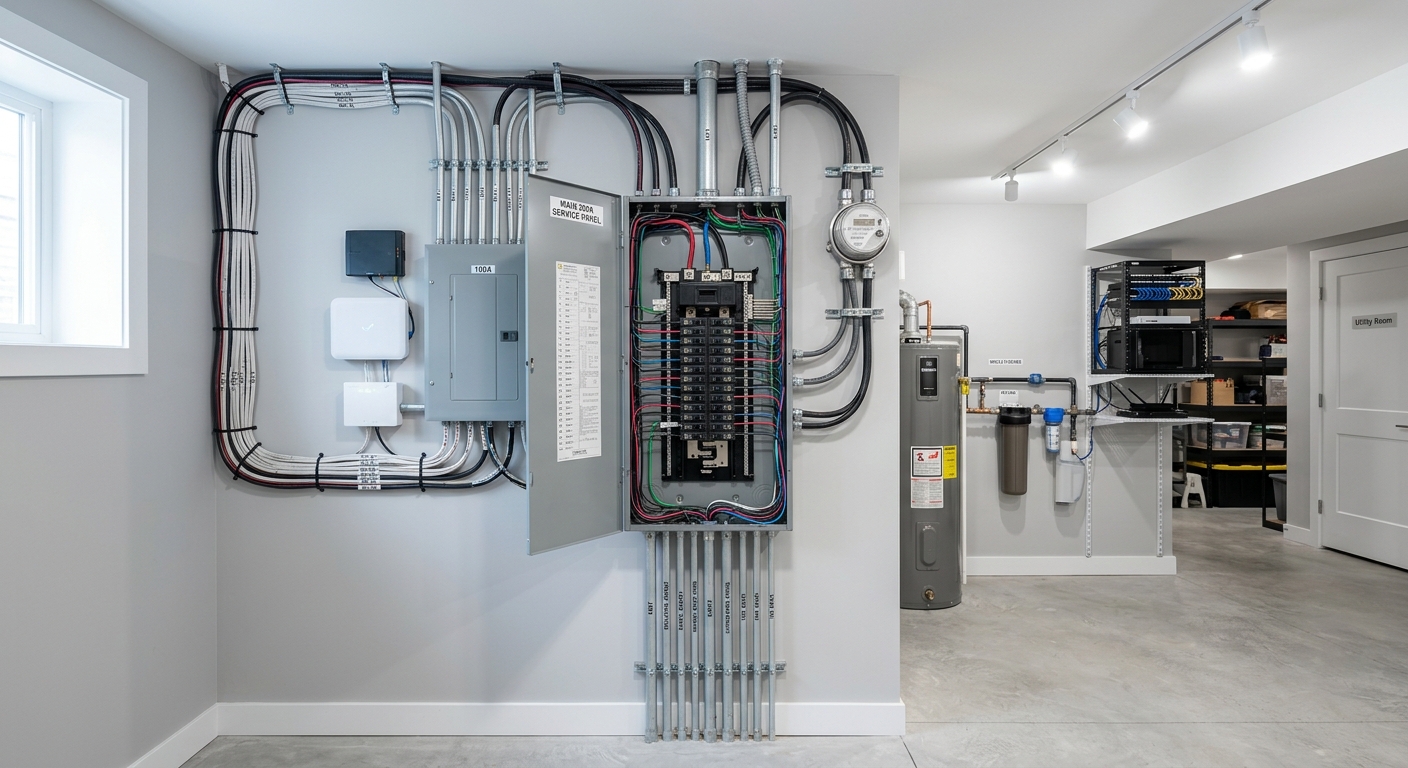
Electrical services and costs in Wasaga Beach
Wasaga Beach, Ontario has a steady mix of retirement-time renovations and family upgrades, and that’s exactly why electrical work demand stays strong along the waterfront and through established neighbourhoods near Main Street. With 23.6% of homes built before 1981, many projects start with panel upgrades, safety-centred rewiring, and removal or replacement of older wiring types before adding new loads. Regionally, (Statistics Canada, 2021 Census) reports the area’s homeowner base is large—there are 9,235 homeowner households—so upgrades like EV-ready services and basement finishing are common discussion points.
In the Kitchener–Waterloo–Barrie economic region, costs are shaped by older housing stock (often 60–100A services), a growing need for modern protection (AFCI/GFCI), and high winter and shoulder-season electrical demands. Even though Wasaga Beach is coastal-facing, Ontario’s freeze–thaw cycles and the way homes are heated (baseboards, heat pumps, and mixed systems) can increase the likelihood of service capacity issues, especially when adding a Level 2 EV charger. Contractors who can pull permits and pass ESA inspections are also busier in this market, which supports pricing in the mid-to-high Ontario range—particularly for heritage or heavily renovated homes, where access and upgrade complexity are higher.
In practice, you’ll see the most scheduling pressure for panel and wiring work in areas like the south end near the quieter residential streets between Mosley Street and Mosley Woods, where older cottages-to-homes conversions and basement projects are frequent. With that in mind, here’s a practical cost comparison to anchor your next quote before we break down the biggest price drivers.
| Service |
Why It's Needed |
Permit Required |
Price Range |
| Panel upgrade — 100A to 200A service |
Modern breakers, grounding improvements, and additional capacity for EV charging, heat pumps, and kitchen loads. |
Yes (service upgrade and panel replacement require an ESA permit and inspection in Ontario). |
$2,500 – $7,000 |
| EV charger installation (Level 2, 40–50A) |
Reduces charging time and supports safer dedicated circuit protection rather than shared or overloaded circuits. |
Yes (new EV circuit typically requires a permit and inspection). |
$800 – $2,500 |
| Knob-and-tube wiring removal and replacement |
Legacy insulation condition and compatibility with current code and insurance requirements; reduces fire risk. |
Yes (rewiring and significant changes require permitting/inspection). |
$4,000 – $15,000 |
| Aluminum wiring remediation (CO/ALR connectors) |
Homes with aluminum branch wiring often need approved connectors or circuit replacement to meet modern safety expectations. |
Yes (significant wiring remediation typically requires permitting and inspection). |
$4,000 – $15,000 |
| New dedicated circuit (HVAC, appliance, hot tub) |
Prevents nuisance trips and supports high continuous loads with correct cable sizing and breaker selection. |
Yes (new circuits generally require a permit/inspection). |
$800 – $3,500 |
| Whole-home rewire (older home, full replacement) |
When wiring layout is unsafe, outdated, or no longer practical to remediate piece-by-piece; enables full code upgrades. |
Yes (full rewiring requires permits/ESA inspection). |
$7,000 – $30,000 |
Prices are estimates only and vary by project scope, site access and material selection.
What affects the price of electrical work in Wasaga Beach
In the Kitchener–Waterloo–Barrie region, two quotes for the “same” electrical job can differ by 30–50% because the scope details change: how much wiring must be replaced, whether the service must be upgraded, how far new cable must run, and what safety devices must be added for code compliance. Labour and permitting workload also varies with contractor availability during busy renovation seasons, and that pushes day rates and scheduling premiums.
In our area, the age of the housing stock is the dominant cost driver. Homes built before 1950 can include knob-and-tube systems where remediation is labour-intensive, and insurance scrutiny tends to be higher. Homes from the 1960s–70s frequently have 60A or 100A panels, which are often inadequate for today’s loads—especially once you add EV charging, heat pumps, and modern electric ranges at the same time. Aluminum wiring, commonly seen in homes built roughly 1965–1976, typically requires approved connector-based remediation (CO/ALR) or partial/full replacement, which is more expensive than “standard” rewiring because it’s more meticulous.
EV adoption is also a visible surge driver here. With more permit applications for Level 2 chargers, installers need to handle load calculations and ensure the breaker, cable size, and grounding match the service capacity. As a practical example in Wasaga Beach: upgrading from a tight 100A to a properly loaded 200A service can be a prudent step—often in the $2,500 – $7,000 band—if your plan also includes adding a $800 – $2,500 Level 2 charger. Conversely, if you already have adequate panel capacity and modern protection, the charger-only route can avoid the larger service work and keep costs nearer the lower end.
Local site conditions move the number too. Short cable runs through an accessible unfinished basement often keep rework closer to the bottom of the $4,000 – $15,000 wiring band; tight crawl spaces, finished walls, or corroded service equipment push the job toward the higher end, because labour time increases and restoration work may be needed for safe wiring routes.
| Price Factor |
Why It Matters |
Cost Impact |
| Panel size upgrade — 100A to 200A is the standard minimum today |
Modern load demands require more capacity, space for breakers, and better grounding. |
Typically shifts work into the $2,500 – $7,000 service/panel band. |
| Wiring type — copper vs. aluminum remediation vs. K&T removal |
Legacy wiring needs approved remediation or replacement, which is slower and more detailed. |
Can move from “routine rewiring” toward the $4,000 – $15,000 range or higher for full replacement. |
| Number of new circuits — each adds material and labour time |
Each circuit needs load assessment, correct cable, breakers, and usually AFCI/GFCI where required. |
Commonly adds hundreds to thousands per circuit depending on routing and protection. |
| Permit + ESA/TSBC inspection fee — mandatory for all major work |
ESA requires permits for service changes and most new circuit/wiring work; inspections are non-optional. |
Adds cost that’s built into professional quotes; typically not optional. |
| Labour rate for licensed electricians — journeyman rates in {region} |
Licensed, insured crews with proper tools and code compliance carry higher overhead. |
Labour time is often the biggest component, affecting the final total meaningfully. |
| EV charger amperage — 40A vs. 50A circuit affects cable and breaker cost |
Higher amperage generally means heavier cable and breaker selection. |
May nudge charger projects toward the upper end of the $800 – $2,500 band. |
| Emergency or after-hours premium |
Urgent troubleshooting and after-hours attendance cost more. |
Can add a notable premium on top of standard labour. |
| Load calculation required for service upgrade |
Accurate load calculations determine whether 200A is sufficient or whether additional upgrades are needed. |
Can add hours of engineering/verification time, but prevents rework and unsafe setups. |
Permits & regulations in Ontario
In Ontario, electrical work beyond changing a light bulb must be completed by a licensed electrician. Permits are required for panel upgrades, service upgrades, new circuits (including EV charger circuits), rewiring, and most work that changes the electrical distribution or safety protection. Once the work is permitted, it must pass inspection by the provincial electrical safety authority—the Electrical Safety Authority (ESA) in Ontario.
DIY electrical is generally prohibited for most homeowner tasks that involve connecting to wiring, altering circuits, or working inside panels. Homeowner electrical exemptions are narrow and still typically require permits and inspection if you’re doing anything that affects the fixed wiring. As a practical rule for Wasaga Beach homeowners: if the job involves the panel, running new cable to a new breaker, replacing feeders, adding a receptacle in a way that requires opening walls for new cable, or installing an EV charger circuit—assume you’ll need permits and an ESA inspection.
To verify a contractor in Ontario, start by checking the electrician’s licence in the Ontario registry (available online through the provincial electrical safety framework). Next, ask for a certificate of insurance showing liability coverage and confirm WSIB/WCB coverage (or the contractor’s applicable clearance documentation). Finally, request the permit number (once issued) and confirm who is listed as the installer on the ESA paperwork; a legitimate contractor can provide this quickly. If any step is missing or vague, that’s a red flag—especially for panel and service work.
When your Wasaga Beach home needs an electrical upgrade
Wasaga Beach homes often need upgrades not because homeowners “want” modernization, but because safety and capacity stop matching the way people live today—especially with older wiring and heating patterns. Start with the warning signs that point to real risk: (1) Breakers that trip frequently can mean an overloaded panel, undersized circuits, or a fault in a circuit—not just “a nuisance.” If it’s happening repeatedly, treat it as urgent troubleshooting.
(2) Knob-and-tube wiring present is the big concern. It’s not simply “old”; the insulation condition and wiring method can become a problem, and insurance coverage can be affected. (3) 60A or 100A service is often inadequate once you add an EV charger, heat pump, and electric stove at the same time. In this situation, a 200A service upgrade is usually the standard solution because it supports modern breaker space and safer load management.
(4) Aluminum wiring (pre-1976 construction) isn’t always instantly dangerous if it’s been maintained, but it does require licensed remediation—commonly CO/ALR connectors where appropriate—or replacement of affected sections. (5) Insufficient outlets or extension cords everywhere is an electrical code and safety issue that often masks overloaded receptacles. (6) No AFCI or GFCI protection where required is also a code-compliance concern that can surface during home sale or when you upgrade rooms.
Climate and seasonality matter too: winter baseboard and shoulder-season use can increase continuous load. For example, if your panel upgrade cost falls in the $2,500 – $7,000 band, but you already know you’re installing a Level 2 charger, that service work can prevent repeated rewiring later. If you do a charger-only install on an undersized service, you may pay again when capacity limits show up.
| Warning Sign |
What It Means |
Recommended Action |
Urgency |
| Breakers trip frequently |
Overloaded circuits, undersized wiring, or a developing fault. |
Electrical diagnostic + load assessment; identify circuit(s) and fix underlying cause. |
Immediate troubleshooting |
$150 – $400 diagnostic visit often precedes work |
| Knob-and-tube wiring present |
Legacy wiring methods with aging insulation and higher safety/insurance concerns. |
Plan targeted removal and rewiring, prioritizing high-risk areas and junction points. |
High priority |
$4,000 – $15,000 depending on scope |
| 60A or 100A panel (inadequate load capacity) |
Modern loads (EV, heat pumps, electric appliances) can exceed safe capacity. |
Service/panel upgrade to 200A with modern breakers and required protections. |
Planned upgrade (soon) |
$2,500 – $7,000 |
| Aluminum wiring (pre-1976 construction) |
Branch circuit connections may need approved remediation. |
Licensed remediation using CO/ALR connectors or replacement of affected runs. |
High priority |
$4,000 – $15,000 for meaningful remediation |
| Insufficient outlets — extension cords everywhere |
People are compensating for too few receptacles, increasing overload risk. |
Add receptacles and/or dedicated circuits; remove the need for extension cords. |
Safety concern (plan quickly) |
$800 – $3,500 depending on routing/circuit work |
| No AFCI or GFCI protection where required |
Higher risk of arc-fault or shock hazards; can affect resale compliance. |
Update protection devices during panel/circuit upgrades; add GFCI/AFCI as needed. |
Planned upgrade |
$150 – $800 for fixtures/protection parts up to larger service work if needed |
How to choose a electrical work contractor in Wasaga Beach
Choosing the right contractor for electrical work in Wasaga Beach comes down to proof of licensing, coverage, and clarity in the quote. In Ontario, verify the electrician’s licensing through the provincial registry and ask whether the company is properly registered for the work you need. Request a certificate of liability insurance and confirm whether the contractor carries WSIB/WCB coverage (or provides clearance documentation, where applicable). If they cannot provide these promptly, don’t move forward—panel and service work is not where you want guesswork.
Next, get 2–3 itemised written quotes that separate labour and materials rather than a single lump sum. Itemised quotes help you see whether the price is mostly cable and breakers, or mostly troubleshooting and wiring removal. Read the scope carefully: are permits included, who pulls them, and are ESA inspection costs covered? Ask about disposal, patching/restoration if walls must be opened, and whether old materials are removed or left in place.
For warranty, confirm the workmanship warranty length and whether it covers the full installation, and note the manufacturer warranty on breakers, panels, and devices. A good contractor will also be able to explain whether warranties are transferable if you sell the home. For payment, avoid paying more than 10–15% upfront; use a milestone schedule and hold back a portion until completion and inspection documentation are provided. Finally, get a start date and completion estimate in writing.
- Check the licence/registration before signing anything.
- Confirm liability insurance and WSIB/WCB coverage documentation.
- Ask for an ESA permit handling plan (who applies, when it’s pulled).
- Request an itemised quote with labour hours and material line items.
- Verify protection devices included (AFCI/GFCI where required).
- Confirm cable type/rating and breaker sizing assumptions.
- Ask what’s included for site protection, cleanup, and debris disposal.
- Clarify whether patching/drywall touch-ups are part of the scope.
- Request a timeline with key milestones (rough-in, inspection, finish).
- Make sure the quote states who is responsible for passing inspection.
- Review warranty terms for both workmanship and installed products.
- Use a payment schedule with a holdback after successful completion.
Common red flags in Wasaga Beach include: refusing to provide a licence number or insurance certificate, quoting without a permit plan for panel/service/EV work, vague scope language like “electrical as required” with no itemisation, asking for large upfront deposits (beyond 10–15%), and failing to explain AFCI/GFCI or load calculations when upgrading circuits.
Frequently asked questions — electrical work in Wasaga Beach
How do I compare electrical quotes?
Start by comparing like-for-like scope. In Wasaga Beach, the same headline—like a “panel upgrade”—can mean very different work if one quote includes load calculation, grounding updates, required AFCI/GFCI devices, and a properly permitted service change while another doesn’t. Look for itemised labour and materials, confirm what wiring type is being replaced (for example, aluminum remediation versus full rewiring), and verify which permits and ESA inspection fees are included. If an EV charger is part of the plan, ask whether the quote assumes a 40A or 50A circuit and whether a 200A service upgrade is included or treated as optional. As a benchmark, service/panel upgrades often land in the $2,500 – $7,000 range, and Level 2 charger installs commonly fall in the $800 – $2,500 band when the electrical path and capacity are straightforward.
How long does a panel upgrade take in Wasaga Beach?
Most 100A to 200A panel upgrades in Wasaga Beach take about 1 day of electrical labour, but the overall project timeline is usually longer because of permits and inspections. The electrician has to schedule ESA permit submission, coordinate for any required service shut-down, complete the panel/service change, and then wait for inspection before the job is considered finished. If your home needs additional preparatory work—like rewiring portions for grounding, repairing corroded service components, or creating safe pathways for new feeders—the job can extend. Finished basements or tight wiring routes can also add time. A realistic homeowner plan is to expect the install day plus at least one inspection scheduling window. Ask the contractor for a written sequence: permit pulled, rough-completed, ESA inspection booked, then final clearance and cleanup.
What is a GFCI outlet and where is it required in Ontario?
A GFCI (Ground Fault Circuit Interrupter) outlet is a protective device that detects current leakage (like when electricity takes an unintended path). In Ontario, GFCI protection is required in specific areas where shock risk is higher, such as bathrooms, kitchens depending on layout, garages, outdoor receptacles, basements and crawl spaces in many cases, and other locations covered under the Ontario Electrical Code requirements. Practically, if you’re updating circuits during a panel upgrade or adding new outlets, the electrician should include GFCI/AFCI where the code calls for it—especially when circuits are added or changed. If your home sale inspection flags missing protection, it’s typically handled during the next permitted electrical scope, not with ad-hoc retrofits. For budgeting, the cost often depends on whether you’re adding protection devices as part of a larger job; lighting or fixture-related items can be smaller line items, but protection upgrades can be part of a service/circuit package.
How do I know if my Wasaga Beach home has aluminum wiring?
The quickest way is to have a licensed electrician inspect the panel and accessible junction points. Aluminum branch wiring often shows up as wiring with an “AL” marking on conductors or at terminations. Sometimes the panel is labeled for aluminum, and you may see specific types of connectors used where copper and aluminum meet. Homes built during the common aluminum period (roughly mid-1960s through the 1970s) are especially likely, and Wasaga Beach has plenty of housing from that era. Still, don’t rely on age alone—renovations sometimes replace portions of wiring. If aluminum is present, ask the contractor whether remediation using approved CO/ALR connectors is possible in your situation, or whether full replacement is safer. This matters for resale and safety: aluminum connections need to be correct and tightened to approved standards to reduce overheating risk.
What is the cost of rewiring a house in Wasaga Beach?
Rewiring cost varies widely based on how much of the home needs new wiring and how accessible the walls and ceilings are. In Wasaga Beach and the broader Kitchener–Waterloo–Barrie region, many rewiring projects are partial-but-deep: removing knob-and-tube in key areas, remediating aluminum branch runs, or replacing outdated wiring tied to unsafe junctions. For meaningful wiring work, your budget often falls in the $4,000 – $15,000 band for wiring and rewiring scope, and it can be higher for whole-home replacement. If the project also includes a panel or service upgrade, that often adds another $2,500 – $7,000 depending on what’s required for ESA compliance. The biggest variables are number of circuits, wiring type, the route length, and whether finished walls require additional patching beyond basic electrical work.
What electrical upgrades are required when selling a home in Ontario?
Ontario doesn’t require a “mandatory list” of electrical upgrades for every sale, but electrical issues can still become deal-breakers when they violate code or create safety concerns. Typically, the most common seller-facing items are missing required protection devices (like GFCI and AFCI where the Ontario Electrical Code requires them), overloaded circuits, unsafe or outdated wiring methods (including knob-and-tube), and service equipment that can’t safely support modern loads. If your home has a small service (like older 60A or 100A setups) and the electrical system is near capacity, buyers may request upgrades, especially when the home is heated with electric baseboards or if there’s an EV-ready expectation. For budgeting, many sellers handle repairs in smaller steps like adding required protection, or—when necessary—plan a service/panel upgrade in the $2,500 – $7,000 range to address capacity and code compliance. If ESA permits and inspections are involved, those documents are usually part of the smoother transition for buyers and inspectors.