Electrical services and costs in Orangeville
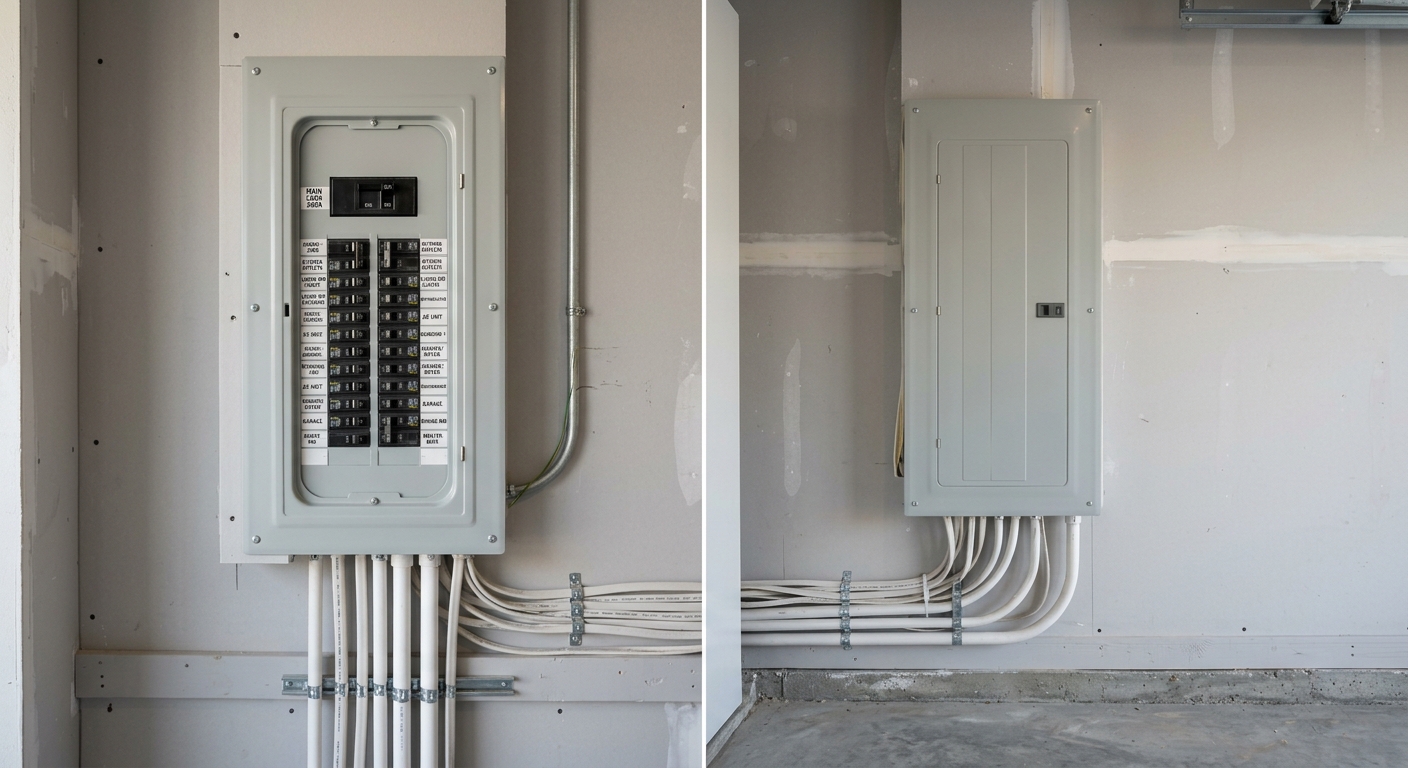
Orangeville homeowners often face electrical upgrades because many local houses were built when electrical loads were far lighter than they are today. With 41.7% of Ontario homes built before 1981 in your area’s housing stock profile (Statistics Canada, 2021 Census), it’s common to see original or aging components—especially panels that can’t comfortably support modern appliances, finishing basements, or a Level 2 EV charger. Orangeville is also home to a high share of owner-occupied households (75.7%), which typically means longer-term “update-and-live” renovations rather than quick fixes (Statistics Canada, 2021 Census).
In the Kitchener–Waterloo–Barrie region, pricing is shaped by a steady mix of panel upgrades, knob-and-tube removals, and aluminum wiring remediation work. Labour availability can tighten during peak renovation seasons, and service upgrades often require coordinated scheduling for ESA inspections, utility coordination, and sometimes temporary outages. Climate matters too: longer winter heating demands push usage up, and families adding heat pumps, electric stoves, or multiple electric baseboard zones during cold months can tip an older 60A or 100A setup into overload territory.
Work is especially in demand in established neighbourhoods like downtown Orangeville and the surrounding older residential blocks, where many homes have original wiring or undersized services. For that reason, the most accurate way to compare quotes is to line up the scope: service/panel work, rewiring, and any required permits and protections. Next, you’ll see typical cost ranges for the upgrades Orangeville homeowners request most often.
| Service |
Why It's Needed |
Permit Required |
Price Range |
| Panel upgrade — 100A to 200A service |
Modern load capacity for EV charging, heat pumps/electric heat, kitchen circuits and basement renovations; improves safety and breaker compatibility. |
Yes (service change and panel replacement require permits and ESA inspection in Ontario). |
$2,500–$7,000 |
| EV charger installation (Level 2, 40–50A) |
Adds a dedicated, protected circuit to charge safely and avoid overloading existing wiring. |
Yes (new EV circuit in Ontario typically requires a permit and inspection). |
$800–$2,500 |
| Knob-and-tube wiring removal and replacement |
Legacy wiring can be a safety and insurance risk due to insulation condition and aged conductors. |
Yes (rewiring/major alteration requires permits and ESA inspection). |
$4,000–$15,000 |
| Aluminum wiring remediation (CO/ALR connectors) |
Licensed splicing/termination with approved CO/ALR methods (or full replacement) to reduce overheating risk. |
Yes (major wiring remediation generally requires permitting and inspection). |
$4,000–$15,000 |
| New dedicated circuit (HVAC, appliance, hot tub) |
Supports higher inrush and continuous loads with proper cable sizing and breakers. |
Often yes (new circuits typically require a permit and ESA inspection). |
$800–$2,500 |
| Whole-home rewire (older home, full replacement) |
Replaces failed or non-compliant wiring, modernizes grounding/bonding and protection (AFCI/GFCI where required). |
Yes (full rewiring requires permits and ESA inspection). |
$4,000–$15,000 |
Prices are estimates only and vary by project scope, site access and material selection.
What affects the price of electrical work in Orangeville
In the Kitchener–Waterloo–Barrie region, two contractors can quote different totals for the same-looking job—often by 30–50%—because the price isn’t just the labour time. It’s what’s hidden behind walls (old wiring condition), how much new cable and breaker work is needed, and whether the service requires a load calculation to reach code-compliant breaker space and conductor sizing. Permits and ESA inspection requirements are mandatory for major work, so the biggest swing in price usually comes from wiring type, panel capacity, and how extensive the remediation becomes.
The dominant cost driver locally is housing age. Many homes built before 1950 may still have knob-and-tube wiring, which is often expensive to remove properly because every circuit must be traced and replaced to keep the system safe and code-compliant. Homes from the 1960s–70s frequently have 60A or 100A panels that were never designed for today’s loads—EV chargers, heat pumps, induction stoves, and multiple electric baseboard zones. For aluminum wiring (commonly seen in homes built roughly 1965–1976), remediation typically needs licensed work with approved CO/ALR connectors or full replacement, and that’s why an “in-room fix” can become a house-wide job once the extent is confirmed.
EV adoption is also driving higher demand for permits and scheduling. A Level 2 charger installation can sit around $800–$2,500 when the panel has capacity and routing is straightforward, but if you must move from 100A to 200A, panel upgrade pricing in the $2,500–$7,000 band becomes the prudent baseline. In Orangeville, costs can be raised by difficult basement access (low clearance, finished ceilings, or long cable runs) and lowered when a home already has modern grounding, spare breaker space, and accessible service equipment.
| Price Factor |
Why It Matters |
Cost Impact |
| Panel size upgrade — 100A to 200A is the standard minimum today |
More breaker space and safer capacity for EV charging and modern heating loads. |
$2,500–$7,000 |
| Wiring type — copper vs. aluminum remediation vs. K&T removal |
Legacy wiring takes longer to trace, and aluminum/K&T work requires careful, code-compliant replacement methods. |
$4,000–$15,000 |
| Number of new circuits — each adds material and labour time |
Extra cable, breakers, box work, and termination time add up quickly. |
$800–$2,500 (per major circuit) |
| Permit + ESA/TSBC inspection fee — mandatory for all major work |
Inspection scheduling and paperwork are required; costs are built into reputable quotes. |
$200–$700 (varies by scope) |
| Labour rate for licensed electricians — journeyman rates in the region |
Licensed, insured contractors charge for guaranteed compliance, testing, and cleanup. |
$500–$3,000 (scope-dependent) |
| EV charger amperage — 40A vs. 50A circuit affects cable and breaker cost |
Higher amperage can require different cable sizing and breaker selection. |
$100–$600 |
| Emergency or after-hours premium |
After-hours callout and expedited parts/logistics increase labour costs. |
$250–$1,000 |
| Load calculation required for service upgrade |
Confirms the service size and breaker/circuit plan meets Ontario Electrical Code requirements. |
$150–$600 |
Permits & regulations in Ontario
In Ontario, electrical work beyond changing a light bulb must be performed by a licensed electrician. For homeowners around Orangeville, the key point is that major work—like panel upgrades, service changes, new circuits, rewiring, and EV charger installations—requires a permit and must be inspected by the Electrical Safety Authority (ESA). ESA is also where inspection compliance matters: permitted work has to pass electrical testing and code review before it’s considered complete.
What typically DOES require a permit in Ontario includes: replacing or upgrading your service/panel (for example, 100A to 200A), adding new breaker circuits (including a Level 2 EV charger circuit), removing and replacing unsafe wiring methods (such as knob-and-tube), and installing new dedicated high-load equipment circuits (hot tubs, large HVAC units, electric vehicle chargers). What typically DOES NOT require a permit is very minor fixture work that doesn’t alter wiring or circuits (for example, swapping a ceiling light fixture in a way that uses existing wiring terminations and doesn’t involve opening new splices behind walls). Because boundaries can be misunderstood, the safest approach is to ask your electrician whether a permit is needed before they start.
To verify your contractor, first confirm their Ontario licence through the provincial licence lookup tools and ensure the licence matches the work being performed. Ask for a current certificate of insurance (liability) and a WSIB clearance where applicable. For service changes and major permitted work, request the job plan and inspection timing in writing, and make sure you receive the appropriate ESA permit documentation and closeout paperwork after inspection.
When your Orangeville home needs an electrical upgrade
Electrical upgrades in Orangeville aren’t just about adding convenience—they’re often about preventing overloads and correcting wiring that no longer matches modern safety expectations. Start with the most common warning sign: breakers that trip regularly. If a breaker fails the “reset and forget” test—especially during winter appliance use—it usually indicates an overloaded panel, a circuit that’s stretched beyond its design, or connections that are failing under load.
Next, look for knob-and-tube wiring. The main concern isn’t only age; it’s insulation contact quality, splicing integrity, and how it behaves under long service life. Many insurance providers become reluctant when knob-and-tube remains active, so this often becomes an “upgrade before you lose coverage” situation. If you have a 60A or 100A service, modern household loads can outgrow it quickly. With EV charging and electric heating usage during Ontario winters, the standard solution is typically a 200A upgrade paired with new protective devices and properly sized circuits.
For aluminum wiring (often seen in pre-1976 construction), it may not be immediately dangerous if it has been properly maintained, but it does require licensed remediation, commonly with CO/ALR connectors or full replacement in worst-case areas. Finally, if your home has insufficient outlets or no AFCI/GFCI protection where required, you can end up relying on extension cords or outdated protection—an ongoing code and safety concern that often becomes obvious at resale.
As for urgency: frequent tripping and hot/charred outlets are immediate “stop using and call” issues. Knob-and-tube and undersized services are usually planned upgrades, but they’re time-sensitive if you’re planning an EV charger, a basement finish, or a sale. For example, adding a Level 2 charger around $800–$2,500 may look affordable, but if you need to move from a 100A panel to 200A, the extra capacity in the $2,500–$7,000 band is exactly what prevents repeated overloading.
| Warning Sign |
What It Means |
Recommended Action |
Urgency |
Price Band |
| Breakers trip frequently |
Possible overload, failing connections, or undersized/incorrectly installed circuits. |
Electrical troubleshooting and panel/circuit capacity review; fix the overloaded circuit(s) and connections. |
Immediate |
$800–$2,500 |
| Knob-and-tube wiring present |
Legacy wiring with aged insulation and increased risk; often a compliance/insurance concern. |
Plan phased removal or whole-home rewire based on extent; replace circuits to match current code. |
Planned (but time-sensitive) |
$4,000–$15,000 |
| 60A or 100A panel (inadequate load capacity) |
Doesn’t meet today’s household loads when adding EV charging, heat pumps, or electric cooking. |
Load calculation and panel/service upgrade to 200A with modern breakers and protections. |
Planned |
$2,500–$7,000 |
| Aluminum wiring (pre-1976 construction) |
Termination/splicing risk if not remediated with approved CO/ALR methods or replacement. |
Licensed aluminum inspection and remediation, or targeted/full replacement if extensive. |
Planned (prioritise high-risk areas) |
$4,000–$15,000 |
| Insufficient outlets — extension cords everywhere |
Overreliance increases overheating risk and can indicate missing circuits. |
Add new outlets and (if needed) dedicated circuits; plan outlet placement to remove extension cord use. |
Planned |
$800–$2,500 |
| No AFCI or GFCI protection where required |
Higher risk from arc faults and shock hazards; code-compliance issue and common during sale inspections. |
Add/upgrade protection devices and modernize circuit protection as required by code. |
Planned (often before selling) |
$800–$2,500 |
How to choose a electrical work contractor in Orangeville
Choosing the right electrician around Orangeville comes down to proof, process and clarity. Start with licensing: confirm the contractor holds an Ontario licence for the work described. Next, request a certificate of liability insurance and confirm they provide WSIB/WCB coverage where required—this matters if something goes wrong on site. A reputable contractor will answer quickly and provide documentation without pressure.
Then get 2–3 itemised written quotes. You want line items for labour and materials, not a single lump sum. A strong quote also explains what’s excluded (for example, drywall patching, disposal fees, long conduit runs, or bringing finishes back to match existing). Ask whether the permit is included and who pulls it—major work should have an ESA permit tied to the scope. Also confirm disposal is included if they remove old panel components or wiring.
Warranty matters too. Ask for the workmanship warranty length and whether manufacturer warranties on breakers/chargers are included and how they’re handled if you sell the home (transferability is a common concern for homeowners). Payment schedule should be conservative: typically no more than 10–15% upfront, with the remainder paid after key milestones and a final clean, tested completion. Finally, insist on a written timeline: start date, estimated duration, and when inspection is expected.
- Ask for the Ontario licence number and confirm it before any work starts.
- Request a certificate of insurance (liability) and confirm coverage limits.
- Confirm WSIB/WCB clearance where applicable and get it in writing.
- Use itemised quotes: separate labour, materials, breakers/connectors, and permits.
- Confirm whether ESA permit fees are included in the quoted total.
- Clarify exclusions: drywall patching, flooring protection, disposal, and cabinet modifications.
- Confirm who handles inspection scheduling and the sequence (rough-in vs. final).
- Ask what testing is included (continuity/insulation/functional checks as applicable).
- Get exact model numbers for products (EV charger, AFCI/GFCI devices, breakers, panel components).
- Ask about workmanship warranty length and what it covers.
- Agree on a payment schedule with a small deposit and holdback until completion.
- Request a start/completion estimate and what happens if an ESA inspection is delayed.
Red flags I commonly see include: quotes that avoid specifying materials (no brand/model), promises to do service/panel work without mentioning ESA permitting, asking for large upfront payments (well beyond 10–15%), “no need for load calculation” statements on service upgrades, and missing insurance/WSIB paperwork. If any of those show up, slow down and get clarification or choose another contractor.
Frequently asked questions — electrical work in Orangeville
How long does a panel upgrade take in Orangeville?
A typical 100A to 200A panel upgrade in Orangeville is often a one-day electrical install for the main work, but your overall timeline depends on ESA inspection scheduling and any utility coordination that may be required. If the existing service location is easy to access (clearances, not buried behind finishing), the rough-in, breaker/panel install and testing can usually be completed in a single mobilization. The next step is inspection, so your “complete” date may stretch a few days. For many homeowners planning EV charging, the faster path is to confirm circuit count and do any wiring plan upfront—because additional cable routing or rework after inspection is what commonly adds days. Cost-wise, panel upgrades generally fall around $2,500–$7,000 depending on complexity and materials.
What is a GFCI outlet and where is it required in Ontario?
A GFCI (Ground-Fault Circuit Interrupter) outlet is designed to quickly shut off power when it detects dangerous current leakage—commonly related to shock hazards near water or damp locations. In Ontario, GFCI protection is required in specific locations where shock risk is higher, such as bathrooms, kitchens (where applicable by circuit arrangement), garages, unfinished basements, outdoors, and other wet/damp areas. In practice, electricians verify which circuits serve these areas and then install GFCI devices (or GFCI breakers) as code requires. If you’re seeing nuisance tripping or you notice older outlets without protection in high-risk spots, it’s usually not just cosmetic: it’s a safety and code-compliance improvement. For many homeowners, adding or upgrading protection as part of a small circuit or breaker update can align with work in the $800–$2,500 range.
How do I know if my Orangeville home has aluminum wiring?
You can’t always spot aluminum by appearance alone, but there are a few practical checks. First, look at visible conductors at the panel and junction points: some aluminum wiring shows a duller, smoother finish than typical copper, and the sheathing and markings may indicate aluminum conductors. Second, search for printed markings on cables (often embedded in the outer jacket) that may reference AL or aluminum. Third, note the age of the home: aluminum wiring was more common in certain construction periods (many homeowners associate it with homes roughly from the mid-1960s through the mid-1970s). The most reliable method is a licensed electrician’s verification using documentation and conductor identification techniques during inspection. If aluminum is present, remediation is not “DIY connector roulette”—it requires approved CO/ALR methods or replacement, and that’s typically priced in the $4,000–$15,000 band depending on extent.
What is the cost of rewiring a house in Orangeville?
Rewiring costs in Orangeville depend heavily on the wiring condition and how much of the home needs replacement, not just the number of rooms. Many local projects fall into the range of $4,000–$15,000 when rewiring includes opening walls/ceilings, removing legacy methods, and upgrading to current Ontario Electrical Code expectations for protection and grounding. If your home has knob-and-tube wiring, the cost can trend higher because the work often requires tracing circuits and replacing multiple runs. If the issue is mainly localized aluminum terminations, remediation with approved connectors may cost less than a full replacement, but it still can expand once the wiring extent is measured. Your electrician should provide an itemised plan (circuits, removal scope, new cable routes) and a clear explanation of what’s included—especially if you have finished basements where access is limited.
What electrical upgrades are required when selling a home in Ontario?
Ontario doesn’t generally require a homeowner to upgrade everything “just because you’re selling,” but electrical issues that are unsafe or not code-compliant can cause delays, failed inspections, or buyer renegotiations. Common upgrades we see requested in Orangeville include adding or improving GFCI protection in required areas, ensuring AFCI protection where required by code, and addressing obvious safety hazards like overloaded circuits or old wiring methods that are difficult to insure. Homes with outdated protection devices or insufficient outlets sometimes trigger concerns from home inspectors or during insurance underwriting. If you have a service that’s undersized for modern loads (especially where EV charging or added electric heating is planned), upgrading the panel can prevent future risk. If you’re making electrical changes, expect permits and ESA inspection for major work. As a budgeting reference, a typical panel/service upgrade often lands around $2,500–$7,000, while targeted protection or circuit additions may fit within $800–$2,500.
What is a load calculation and why does my electrician need one?
A load calculation is a method electricians use to estimate the electrical demand your home requires now and with typical future usage patterns, based on Ontario code rules. For service upgrades—like going from 100A to 200A—your electrician needs this calculation to confirm the service size and to plan breakers/circuits correctly so the system isn’t overloaded. This is especially important in Orangeville homes because older services can struggle once residents add EV chargers, electric stoves, heat pumps and multiple electric-heat zones during winter. The calculation helps justify why an upgrade is “the prudent route” instead of making questionable changes that might still fall short. It also supports safer breaker and conductor sizing and can prevent costly rework. When you’re planning an EV charger, the load calculation often ties directly into whether a $800–$2,500 charger install can be done without upgrading—or whether you should budget for the $2,500–$7,000 panel/service upgrade first.