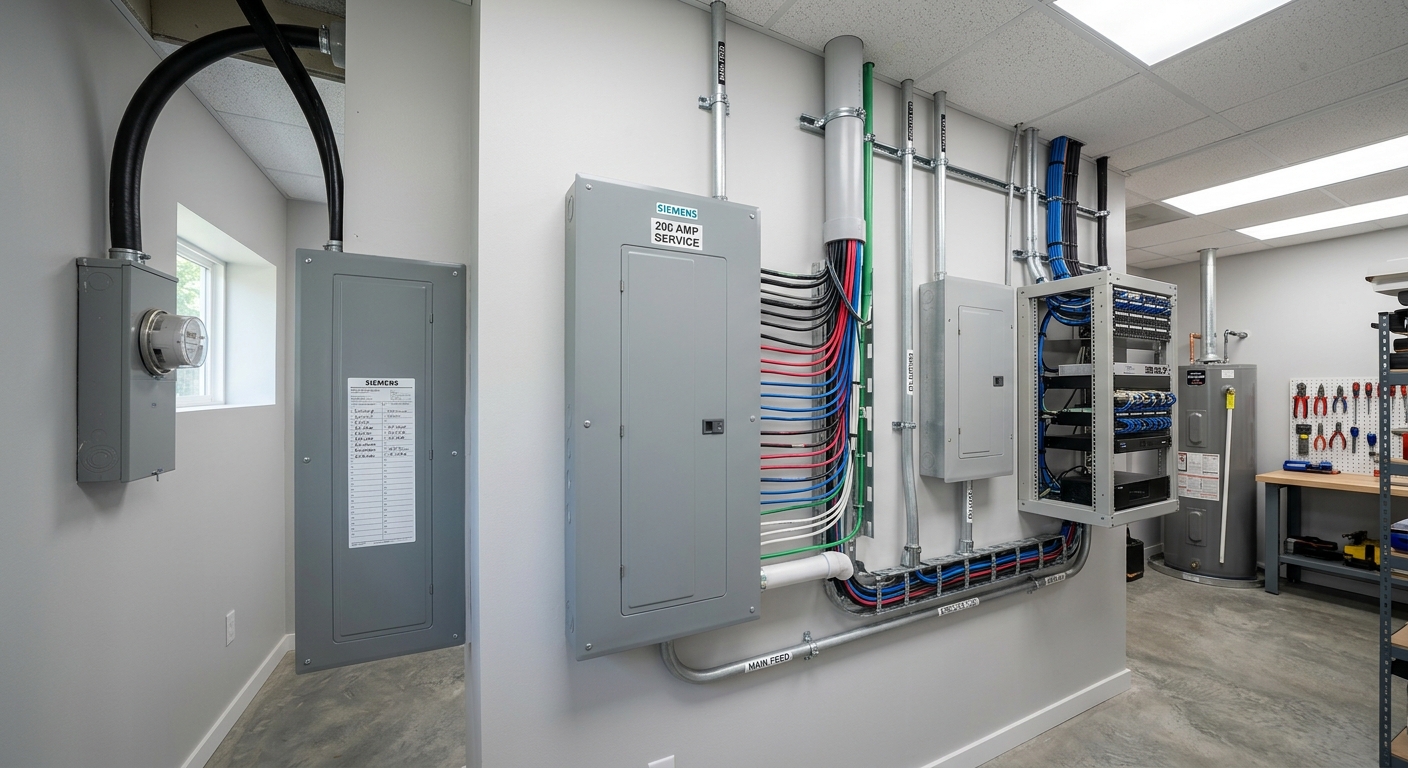
Electrical services and costs in Simcoe
Electrical work in Simcoe often costs more than homeowners expect at first, mostly because the housing stock here includes a lot of older wiring and older service capacity. With a population of 13,922 (Statistics Canada, 2021 Census), Simcoe is small enough that contractors can get booked quickly during renovation season, but large enough that you still have multiple licensed crews competing for work in the Hamilton–Niagara Peninsula market. Just as importantly, the region has a high concentration of pre-1970 homes, so many projects start with the same safety questions: is the home still relying on knob-and-tube, or does it have aluminum wiring or a 60A/100A service that can’t support modern loads?
Our local climate also plays a role in demand and scheduling. Winters in Simcoe mean heavier baseline loads from heat sources, and when homeowners add heat pumps, EV chargers, or electric appliances, the electrical system is stressed sooner and more often. That combination—older wiring plus rising peak demand—drives both permit activity and labour time. In neighbourhoods around areas like the south end near downtown and the older residential pockets closer to the lake and creek corridors, finished basements and service upgrades are especially common. Homeowners planning an EV charger or a heat-pump change often end up needing either a dedicated circuit or a panel/service upgrade before the new equipment can be safely energized. Use the ranges below as a realistic starting point for comparing quotes, then tailor it to your exact wiring condition and load plan.
| Service |
Why It's Needed |
Permit Required |
Price Range |
| Panel upgrade — 100A to 200A service |
Supports modern loads (EV chargers, heat pumps, induction stoves) and improves safety margins for nuisance trips and overheating risks. |
Yes (ESA permit and inspection) |
$1,800 – $4,500 |
| EV charger installation (Level 2, 40–50A) |
Dedicated, code-compliant circuit with appropriate breaker, cable sizing, and grounding to charge safely. |
Yes (ESA permit and inspection) |
$1,000 – $3,500 |
| Knob-and-tube wiring removal and replacement |
Eliminates obsolete wiring conditions where insulation condition and contact points can create safety and insurance issues. |
Yes (rewiring permit and inspection) |
$8,000 – $20,000 |
| Aluminum wiring remediation (CO/ALR connectors) |
Stabilizes terminations and improves reliability where aluminum conductor terminations need approved remediation. |
Yes (major wiring work permit and inspection) |
$8,000 – $20,000 |
| New dedicated circuit (HVAC, appliance, hot tub) |
Reduces overload on existing circuits and adds properly protected, dedicated power for high-demand equipment. |
Yes (new circuit permit and inspection) |
$1,200 – $3,800 |
| Whole-home rewire (older home, full replacement) |
Replaces undersized/obsolete wiring, upgrades receptacle and protection requirements, and prepares the home for modern appliances. |
Yes (rewiring permit and inspection) |
$8,000 – $20,000 |
Prices are estimates only and vary by project scope, site access and material selection.
What affects the price of electrical work in Simcoe
Across the Hamilton–Niagara Peninsula and Ontario, it’s common to see quotes for the “same” electrical job differ by 30–50%. The driver is almost always the actual condition behind the walls and panel—especially in Simcoe, where pre-1950 wiring issues and older service sizes show up frequently during renovations. Housing age is the dominant cost driver. Homes built before about 1950 are more likely to have knob-and-tube wiring, and those systems can trigger insurance refusals or coverage limits when contractors or insurers want complete safety upgrades. Homes from the 1960s–70s often have 60A or 100A services, and once you add EV charging, heat pumps, and modern cooking loads, the existing service can be the limiting factor.
Aluminum wiring—frequently seen in homes from roughly 1965–1976—typically requires licensed remediation with approved CO/ALR connectors, and in some cases partial or full replacement if terminations or conductor conditions can’t be brought up to standard. Meanwhile, EV adoption is pushing permit applications in the region, because Level 2 chargers (often 40–50A circuits) need dedicated wiring, breaker sizing, and an updated load picture. In practical terms, a simple panel-only upgrade might sit nearer the low end of the $1,800 – $4,500 band, but once we’re opening walls for wiring routes, upgrading grounding, and doing load calculations, projects can move toward the middle and upper ends of the $8,000 – $20,000 wiring band.
Two local examples that raise cost in Simcoe: (1) long cable runs through older framing with limited access in finished basements near downtown, and (2) service upgrades timed with HVAC/heat-pump installations that increase total circuit work in one mobilization. Cost can drop when the panel location is already accessible, knob-and-tube is limited to a small area, and the EV charger can use a nearby route without extensive drywall removal.
| Price Factor |
Why It Matters |
Cost Impact |
| Panel size upgrade — 100A to 200A is the standard minimum today |
Increases capacity for modern loads and reduces the risk of nuisance trips. |
$1,800 – $4,500 |
| Wiring type — copper vs. aluminum remediation vs. K&T removal |
Aluminum terminations and knob-and-tube conditions require compliant methods, testing, and/or replacement. |
$8,000 – $20,000 |
| Number of new circuits — each adds material and labour time |
More circuits means breakers, wire, supports, labour time, and often additional drilling/patching. |
$500 – $2,000 per circuit |
| Permit + ESA/TSBC inspection fee — mandatory for all major work |
ESA (Ontario) requires permits and inspection sign-off for panel/service upgrades, rewiring, and new circuits. |
$200 – $650 |
| Labour rate for licensed electricians — journeyman rates in region |
Labour is the largest portion once access is difficult and wiring changes are extensive. |
$90 – $140 per hour (typical, varies) |
| EV charger amperage — 40A vs. 50A circuit affects cable and breaker cost |
Higher amperage can require larger cable/breaker components and more demanding load planning. |
$150 – $650 difference |
| Emergency or after-hours premium |
Weekend/evening scheduling and rushed material sourcing typically increase labour rates. |
$250 – $1,000 |
| Load calculation required for service upgrade |
Verifies the panel size and circuit plan are safe and code-compliant under expected operating loads. |
$250 – $600 |
Permits & regulations in Ontario
In Ontario, ALL electrical work beyond changing a light bulb must be completed by a licensed electrician. That includes panel upgrades, new circuits, service upgrades, and rewiring—work that changes how electricity is supplied or how circuits are protected. Permits are required for major electrical jobs, including EV charger installations (new dedicated circuit or changes to the service), knob-and-tube removal and replacement, aluminum wiring remediation, and any work that requires you to energize equipment after modifications. Permitted work must pass inspection by the Electrical Safety Authority (ESA) before the utility will finalize certain service changes.
DIY is prohibited for most electrical tasks. Homeowners typically can do non-electrical work like painting after rough-in, installing approved exterior fixtures if wiring is already complete, or swapping a cover plate—without touching wiring, breakers, or conductors. If you’re planning to add an outlet, relocate a switch, install a new breaker, or run cable, assume a permit and ESA inspection are required.
To verify an Ontario contractor for work in Simcoe, start with the electrician’s licence details through the provincial licensing registry, then request a certificate of insurance naming you as the interested party and confirm WSIB coverage (or the appropriate WCB status). Ask for their ESA permit number for the job and confirm they will schedule the inspection and provide documentation after the work is completed. This is the fastest way to protect yourself if something goes wrong.
When your Simcoe home needs an electrical upgrade
Homeowners in Simcoe usually notice electrical problems because the system doesn’t “look right” anymore—but the real issue is safety-critical performance: protection, wiring condition, and available capacity for modern loads. Here are the common warning signs to take seriously. (1) Breakers that trip regularly can mean overloaded circuits, failing breakers, or poor circuit design—plan to investigate before a fault causes damage. (2) Knob-and-tube wiring is a key concern because aging insulation and termination conditions can create overheating risk; the point is not just how old it is, but whether it can be safely and insurably maintained. (3) A 60A or 100A service is often inadequate in today’s Simcoe homes when you run heating demands and add EV charging, heat pumps, and electric appliances at the same time. A 200A upgrade is the standard solution in these cases.
(4) Aluminum wiring in pre-1976 construction isn’t automatically dangerous if it has been maintained, but it does require licensed remediation so terminations are reliable—CO/ALR connectors or replacement where appropriate. (5) Insufficient outlets and extension cords everywhere usually indicates a circuit capacity and layout problem, not a “convenience” problem, and it can lead to overheating. (6) Missing AFCI/GFCI protection where required is a code-compliance and shock/arc-fault risk issue that becomes especially important for resale; it can surface during home sale electrical reviews.
Climate matters here: Simcoe winters increase baseline load, so a system that seems “fine in summer” may fail under peak heating. For a dollar example, upgrading from a 100A panel to 200A typically falls within the $1,800 – $4,500 band, but if the upgrade is paired with whole-home rewiring due to knob-and-tube or extensive aluminum issues, the project shifts toward the $8,000 – $20,000 wiring band. That difference is justified when access is already opened and the safety scope is expanded.
| Warning Sign |
What It Means |
Recommended Action |
Urgency |
Price Band |
| Breakers trip frequently |
Possible overload, short/ground fault, failing breaker, or undersized circuit design. |
Request a diagnostic visit and load/circuit review; plan corrections based on findings. |
Immediate to investigate |
$300 – $2,500 |
| Knob-and-tube wiring present |
Obsolete wiring with aging insulation/termination risk; insurance and safety concerns. |
Assess scope and plan removal/replacement; isolate any remaining unsafe sections. |
Planned upgrade (often high priority) |
$8,000 – $20,000 |
| 60A or 100A panel (inadequate load capacity) |
Can’t reliably support modern simultaneous loads (EV, heat pump, electric stove, etc.). |
Upgrade to 200A and complete load calculation/circuit plan. |
Planned upgrade before adding new equipment |
$1,800 – $4,500 |
| Aluminum wiring (pre-1976 construction) |
Termination and connection reliability issues can arise without proper remediation. |
Have licensed remediation done with approved CO/ALR methods or replace affected runs. |
Planned upgrade with priority |
$8,000 – $20,000 |
| Insufficient outlets — extension cords everywhere |
Risk of overloading circuits and poor temporary connections. |
Add receptacles and, where needed, new dedicated circuits. |
Planned upgrade (safety first) |
$1,200 – $3,800 |
| No AFCI or GFCI protection where required |
Higher risk of shock and arc-fault hazards; may fail safety or inspection expectations. |
Add required protection devices for relevant circuits and locations. |
Planned upgrade (often before sale/renos) |
$500 – $2,200 |
How to choose a electrical work contractor in Simcoe
Choosing the right licensed contractor in Simcoe is mostly about verifying three things: licensing, liability coverage, and worker protection coverage. Ask for the contractor’s Ontario electrical licence details (and confirm it matches the individuals performing the work), then request a certificate of insurance and ensure the policy amount is appropriate for residential service work. Next, confirm WSIB/WCB coverage (ask directly—reputable contractors will provide documentation without hesitation). This is especially important for service upgrades and whole-home rewires, where there’s more chance of damage to finishes and more time in active work zones.
Get 2–3 itemised written quotes, not “lump sum” estimates. A good quote clearly separates labour and materials, lists the exact scope (panel components, breakers, cable size, protection devices, grounding changes), and identifies what’s excluded. Clarify whether the quote includes the permit pull, inspection scheduling, drywall patch/paint (usually not), and debris/disposal. For warranties, confirm both workmanship warranty length and whether product warranties are provided and transferred to you where applicable.
Payment schedule matters: never agree to pay more than about 10–15% upfront. Hold back the remainder until the job is complete and ESA documentation is provided. Finally, insist on a start date and completion estimate in writing. Delays are common when materials are backordered or inspections are pushed—so a clear timeline protects you.
- Confirm Ontario licence details for the electrician and the company performing the work.
- Request a certificate of insurance and verify you are listed as an interested party where applicable.
- Confirm WSIB/WCB coverage in writing.
- Get itemised labour + materials breakdown, including breaker/panel model numbers.
- Ask whether the ESA permit is included in the price (or separately quoted).
- Confirm inspection responsibility and who will schedule/coordinate the ESA inspection.
- Ask what drywall patching, caulking, or cleanup is included.
- Require clarification on cable routing, access expectations, and estimated drywall openings.
- Ask for disposal/hauling of old breakers or wiring where applicable.
- Confirm workmanship warranty length and how claims are handled.
- Set a payment schedule with no more than 10–15% upfront and progress-based holds.
- Get start date, estimated duration, and after-inspection energization timing in writing.
Red flags in Simcoe: vague scopes that don’t mention permits or ESA inspections, refusal to provide insurance/WSIB documentation, “too good to be true” pricing that omits panel components or required circuit upgrades, pressure to pay a large deposit before any rough-in, and contractors who won’t provide a written warranty or a clear completion timeline.
Frequently asked questions — electrical work in Simcoe
How long does a rewiring job take?
In Simcoe, rewiring timelines depend heavily on whether the work is limited to certain areas or it’s a full whole-home rewire. A partial rewiring (for example, replacing knob-and-tube in a limited footprint) can take days to a couple of weeks, while whole-home rewire projects commonly take longer because we have to open walls/ceilings, replace wiring runs, update protection and receptacle requirements, and then have ESA inspect before power is fully restored. If a project includes service work at the same time (like a 100A to 200A upgrade), scheduling can add complexity but may reduce total disruption. In terms of cost, wiring-heavy projects typically align with the $8,000 – $20,000 band, and timelines usually track scope and accessibility rather than just house size. (Statistics Canada, 2021 Census)
Why do my breakers keep tripping?
Breakers that trip regularly in Ontario are a safety signal, not a nuisance inconvenience. In Simcoe, the winter season can increase baseline load, so an overloaded circuit may trip more often during cold snaps when heating appliances run alongside other loads. Common causes include overloaded circuits (too many devices on one circuit), a failing breaker, loose or failing connections—especially in older panels or aluminum wiring terminations—or a wiring issue such as a damaged conductor. If knob-and-tube is present, tripping can reflect degraded insulation conditions and termination problems. The right next step is a diagnostic review and load/circuit assessment before you replace breakers “blind.” Repairs and upgrades can range from a small fix near the lower end of the bands to more extensive work if wiring or service capacity is the root cause, sometimes shifting you into the $1,800 – $4,500 service-upgrade range or beyond.
How do I compare electrical quotes?
To compare quotes fairly in Simcoe, insist on itemised estimates and consistent scope. Ask each contractor to list exactly what’s included: panel/service components (and panel model), number and type of breakers, cable size, grounding changes, protection devices, permit pull responsibilities, inspection scheduling, and disposal/cleanup expectations. One quote might say “panel upgrade” while another includes load calculations, ESA permit work, and additional grounding—those differences alone can explain why prices vary substantially across the Hamilton–Niagara Peninsula. Use the local bands as a checkpoint: a typical 100A to 200A upgrade often lands around the $1,800 – $4,500 range, and wiring-heavy work often falls in the $8,000 – $20,000 range depending on whether it’s partial remediation or a full rewire. If a quote is missing permits/inspection references, it’s usually not truly comparable.
How long does a panel upgrade take in Simcoe?
In Simcoe, a panel upgrade (commonly a 100A to 200A service) often takes about a full workday for the electrical changes once materials are on site, but the overall timeline includes scheduling and ESA inspection. If the panel location is accessible and the existing wiring routes are straightforward, the “active work” part is usually faster. If additional grounding, service conductor work, or circuit reconfiguration is required, it can extend beyond a single day. After rough work, the contractor schedules ESA inspection before power is fully finalized, especially where the utility requires sign-off. If your panel upgrade is bundled with adding circuits (like for an EV charger) or dealing with older wiring, total time increases because more openings and testing are needed. Costs commonly fall within the $1,800 – $4,500 band for typical service upgrades, with schedule changes driven more by access and inspection timing than by the panel itself.
What is a GFCI outlet and where is it required in Ontario?
A GFCI (Ground-Fault Circuit Interrupter) outlet protects people by quickly shutting off power when it senses an imbalance that could indicate a dangerous shock. In Ontario, GFCI protection is required for specified locations—commonly where there’s a higher risk of shock from moisture and outdoor conditions. Typical examples include kitchen/sink areas (per code requirements and circuit rules), bathrooms, garages/workshops, basements in many cases depending on circuit use and location, laundry areas, and outdoor receptacles. Many homes also benefit from GFCI for sump pump and other wet-area circuits. The key is that requirements depend on where the receptacle is located and what circuit it belongs to. If your Simcoe home is older and has none, it’s often best to update during renovations or when you upgrade circuits. Depending on scope, GFCI/AFCI updates can push small projects above minor electrical tweaks, though major service work generally fits the $1,800 – $4,500 service-upgrade band when paired with other capacity improvements.
How do I know if my Simcoe home has aluminum wiring?
The surest way is inspection: an electrician can check the conductor markings inside the panel and at receptacle/switch boxes. Aluminum wiring is usually identified by conductor markings and by physical characteristics at terminations. Common clues include older construction dating and evidence of “CO/ALR” style installation requirements at certain outlets or connections. In Simcoe and the surrounding Hamilton–Niagara Peninsula, aluminum wiring is more commonly encountered in homes built around the mid-1960s through the 1970s. Even if wiring looks intact, aluminum requires licensed remediation at terminations—approved connectors and proper methods—because older connections can loosen over time or fail to make reliable contact. If you’re planning a panel upgrade or EV charger installation, confirm wiring type early, because aluminum remediation can change the scope and cost direction. Wiring-heavy remediation projects often align with the $8,000 – $20,000 band depending on how extensive the aluminum wiring is and whether replacement is required.