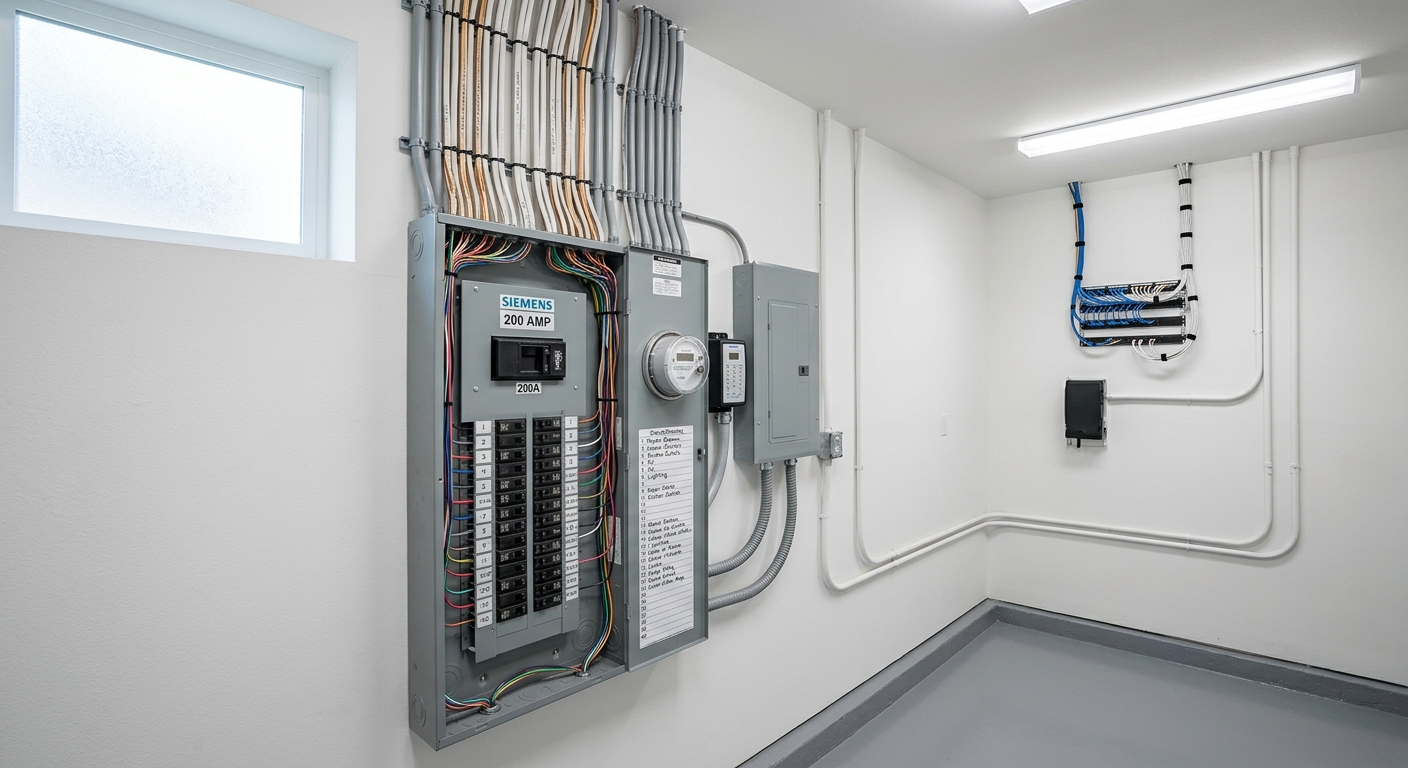
Electrical services and costs in Bancroft
Bancroft’s electrical work tends to be busier—and a bit more involved—because a large share of local housing stock is older. In fact, about 60.0% of homes in the area were built before 1981 (Statistics Canada, 2021 Census), which often means knob-and-tube wiring, aluminum branch wiring, and panel sizes that were never designed for today’s loads. With about 65.6% of households owning their homes (Statistics Canada, 2021 Census), many residents are planning long-term upgrades rather than only addressing one failing component.
In the Kingston–Pembroke region, the climate also matters. Cold winters mean heavy baseline demand from heat (including electric baseboard in some homes) and greater use of ventilation, de-icing, and shop equipment—so electricians often see higher panel-load stress when homeowners add an EV charger or upgrade major appliances. Availability can also tighten during peak renovation seasons, especially in smaller communities where crews may have longer travel time to sites in town and around Bancroft’s surrounding roads.
One area where we commonly see demand is around downtown and the older residential pockets near Moira Lake Road, where many homes are close to original service equipment and older wiring types. If you’re planning to replace knob-and-tube or bring a service from a typical older capacity up to today’s requirements, the next step is to understand the cost ranges you’ll see for common projects in Bancroft—so you can compare quotes consistently.
| Service |
Why It's Needed |
Permit Required |
Price Range |
| Panel upgrade — 100A to 200A service |
Provides capacity for modern loads like electric heat, EV charging, and upgraded kitchen/laundry appliances; improves safety and code compliance. |
Yes (service change requires ESA permit and inspection) |
$2,500–$4,500 |
| EV charger installation (Level 2, 40–50A) |
Dedicated circuit reduces load sharing issues and supports safe, reliable overnight charging; may trigger a panel or load review. |
Yes (new circuit/charger installation requires ESA permit and inspection) |
$1,200–$2,800 |
| Knob-and-tube wiring removal and replacement |
Knob-and-tube is outdated and often has degraded insulation; replacement reduces risk and supports insurability and code compliance. |
Yes (rewiring/removal requires ESA permit and inspection) |
$6,000–$20,000 |
| Aluminum wiring remediation (CO/ALR connectors) |
Aluminum branch wiring can require approved connector methods (CO/ALR) or targeted replacement at terminations to meet safety standards. |
Yes (major wiring remediation typically requires ESA permit and inspection) |
$2,500–$8,500 |
| New dedicated circuit (HVAC, appliance, hot tub) |
Improves performance and safety by preventing overloads; supports equipment that requires stable, dedicated power. |
Yes (new circuit requires ESA permit and inspection) |
$900–$2,500 |
| Whole-home rewire (older home, full replacement) |
Replaces end-to-end wiring for full safety and modernization (including grounding, device upgrades, and AFCI/GFCI where required). |
Yes (full rewiring requires ESA permit and inspection) |
$12,000–$35,000 |
Prices are estimates only and vary by project scope, site access and material selection.
What affects the price of electrical work in Bancroft
In Bancroft and across the Kingston–Pembroke region, it’s common to see the same electrical job quoted 30–50% apart. The difference usually comes down to how much wiring has to be opened, whether panel capacity needs upgrading, and whether the electrical contractor includes the required permit administration and inspections. Even when two quotes list the same “panel upgrade” line item, one may plan for only a like-for-like swap while another includes a full load review and updated protection devices.
Age of the housing stock is the dominant driver. Homes built before 1950 may still have knob-and-tube wiring; beyond the age factor, the condition of insulation and past repairs can make safe remediation slower and more expensive. Homes from the 1960s–70s often include 60A or 100A panels that become inadequate for today’s loads—especially when homeowners add an EV charger, heat pump systems, and modern kitchen appliances. In addition, aluminum wiring is common in houses from roughly the mid-1960s through the 1970s; remediation with approved CO/ALR connectors can be labour-intensive, and in some cases full replacement is the most reliable path. With EV adoption rising throughout Ontario, permit applications for dedicated 40–60A Level 2 circuits are also increasing, which can push material scheduling and labour planning.
Local conditions that raise cost in Bancroft include long runs from the panel to the garage, finishing work after opening walls, and service equipment that’s dated and needs upgrades to modern standards. Costs can be lower when the work is localized—for example, an aluminum termination fix at specific junctions may cost less than a whole-home rewire. As a reference point, a typical panel/service upgrade is often in the $2,500–$4,500 band, while whole-home rewiring commonly moves into the $6,000–$20,000 band depending on scope, number of rooms opened, and device upgrades required.
| Price Factor |
Why It Matters |
Cost Impact |
| Panel size upgrade — 100A to 200A is the standard minimum today |
Modern protection, spacing, and capacity for EV/heat loads; reduces nuisance overloads. |
Often shifts work into the $2,500–$4,500 range |
| Wiring type — copper vs. aluminum remediation vs. K&T removal |
Different repair methods, connector requirements, and time to verify safe terminations or replace aged wiring. |
Aluminum/K&T work can add hours and materials; can double project time on older homes |
| Number of new circuits — each adds material and labour time |
Each circuit requires cable, breakers, test/commissioning, and often device upgrades. |
Expect incremental increases rather than linear “per circuit” pricing |
| Permit + ESA/TSBC inspection fee — mandatory for all major work |
Major electrical changes require permits and inspections before energizing. |
Typically built into quotes; omission usually makes the job non-comparable |
| Labour rate for licensed electricians — journeyman rates in Kingston–Pembroke |
Regional rates commonly sit around $90–$130/hour depending on complexity and scheduling. |
Labour-hours are the main swing factor for older wiring access and troubleshooting |
| EV charger amperage — 40A vs. 50A circuit affects cable and breaker cost |
Higher amperage can require larger conductor, different breaker/circuit design details, and more staging time. |
May move EV installs within the $1,200–$2,800 band |
| Emergency or after-hours premium |
Scheduling changes, priority response, and time pressure can increase labour cost. |
Can add a noticeable premium versus planned daytime work |
| Load calculation required for service upgrade |
A proper capacity review avoids undersizing and reduces rework. |
Often adds planning time, but prevents expensive “fix it later” scenarios |
Permits & regulations in Ontario
In Ontario, electrical work beyond changing a light bulb must be performed by a licensed electrician. Permits are required for the kind of work homeowners most commonly request in Bancroft: panel upgrades and service changes, rewiring, adding new circuits (including dedicated EV charger circuits), and other major modifications to fixed electrical systems. After the work is permitted, it must pass inspection by the Electrical Safety Authority (ESA). DIY electrical is prohibited for most tasks; while there are narrow homeowner exceptions in certain minor circumstances, work that changes circuits, alters the service, or affects safety-critical components generally requires both a permit and an inspection.
To verify your electrician is properly licensed in Ontario, start with their licence number and confirm it through the provincial licence registry. Next, request a certificate of insurance showing liability coverage and ask whether they carry WSIB/WCB coverage as applicable (so you’re not left responsible for workplace injury claims). Before any work begins, ensure the contractor confirms they will pull the ESA permit, schedule the inspection, and provide the inspection results or clearance documentation after the job.
Typical “requires a permit” examples include: replacing or upgrading a breaker panel, adding a new circuit for a hot tub or HVAC, relocating fixtures with new wiring, and any service work. “Usually does not require a permit” examples include: replacing a single existing fixture with a similar model where no new wiring is added, or swapping a standard bulb—provided wiring stays untouched and the work is done safely and in compliance with Ontario requirements.
When your Bancroft home needs an electrical upgrade
If you live in Bancroft, don’t wait for a failure—look for safety-critical warning signs. Frequent breaker trips are usually your first clue that the panel or circuit design can’t handle current usage, or that a connection is loose and overheating. If you have knob-and-tube wiring, the key issue isn’t just age; it’s the condition of insulation and the way older wiring has been repaired over time. In practice, insurance and safety concerns often escalate when knob-and-tube is discovered during underwriting, renovation, or home sales.
Another common driver is service capacity. Many older homes still have 60A or 100A panels, which may be inadequate once you run electric heat alongside a heat pump, kitchen loads, and a Level 2 EV charger. In these situations, a 200A upgrade is typically the standard solution because it provides headroom for modern appliances and future additions. Aluminum wiring in pre-1976 construction also needs attention: it may not be “immediately dangerous” when well maintained, but it does require licensed remediation at terminations and approved connector methods—or targeted replacement—to meet modern safety expectations.
Finally, insufficient outlets and the overuse of extension cords is a code and safety problem that often reveals wiring constraints. And if your home lacks AFCI/GFCI protection where required, that can be a sale-time or inspection-time issue and a practical risk for certain fault types. In Bancroft’s freeze–thaw climate, moisture and temperature cycling can further aggravate connection issues, so planned upgrades are often cheaper than emergency repairs.
For example, choosing a planned panel capacity review plus a $2,500–$4,500 service upgrade can prevent a repeat visit later when an EV charger forces load changes. Waiting until after installation sometimes turns a single EV job into a larger reconfiguration—more labour, more parts, and longer disruption.
| Warning Sign |
What It Means |
Recommended Action |
Urgency |
Price Band |
| Breakers trip frequently |
Often indicates overload, failing breaker, loose connections, or undersized/incorrect circuit design. |
Have a load and fault inspection; test circuits and check for overheating or improper connections. |
Immediate |
$900–$2,500 |
| Knob-and-tube wiring present |
Outdated wiring method with degraded insulation risk and compliance/insurance concerns. |
Plan removal and replacement (often room-by-room or full rewire depending on condition). |
High (plan soon) |
$6,000–$20,000 |
| 60A or 100A panel (inadequate load capacity) |
May not support today’s combined loads; can cause nuisance trips and limit EV/heating upgrades. |
Service capacity review and upgrade to 200A as required. |
High (plan before adding loads) |
$2,500–$4,500 |
| Aluminum wiring (pre-1976 construction) |
Terminations may oxidize or loosen without proper remediation; requires approved safety methods. |
Licensed aluminum assessment and remediation with CO/ALR connectors or partial replacement. |
Planned (unless faults are present) |
$2,500–$8,500 |
| Insufficient outlets — extension cords everywhere |
Under-provisioned circuits leading to overload risk, tripping, and worn cord hazards. |
Add new dedicated circuits/outlets; evaluate overall capacity. |
Planned (but address promptly) |
$900–$2,500 |
| No AFCI or GFCI protection where required |
Higher risk of electrical faults not being interrupted and reduced code compliance at sale/permit time. |
Upgrade devices/breakers to required protection based on wiring type and areas. |
Planned |
$200–$800 |
How to choose a electrical work contractor in Bancroft
Start by verifying that your electrician holds the correct Ontario licence and is insured. To check Ontario licensing, ask for their licence number and look it up through the provincial registry; don’t rely on “we’re licensed” claims alone. For liability insurance, request a current certificate of insurance and confirm it covers electrical contracting work. Also ask about WSIB/WCB coverage (where applicable) so you’re not left exposed if a worker is injured on your property. If they can’t provide documentation promptly, that’s your first signal to move on.
Next, get 2–3 itemised written quotes. You want a labour and materials breakdown (not just a lump sum), including cable size, breakers, devices, disposal/cleanup, and any travel/service call assumptions. Make sure the scope is explicit: does the quote include pulling the ESA permit, scheduling inspection, replacing damaged drywall/insulation, and reinstating finish materials? If any part is excluded—like moving furniture, restoring baseboards, or hauling away old equipment—get that in writing so the final bill doesn’t drift.
For payment, never pay more than 10–15% upfront. Use a holdback until the job is complete and tested. Ask about the workmanship warranty length and whether the product/manufacturer warranty is included and transferable to your ownership. Finally, get the start date and estimated completion timeline in writing.
- Licence number provided and confirmed on the Ontario registry
- Certificate of insurance current (request it before work starts)
- WSIB/WCB coverage documentation (where applicable)
- ESA permit and inspection included in the scope (not “we’ll do it if needed”)
- Itemised quote: labour hours, materials, breakers, devices, and cable/conduit details
- Clear exclusions (drywall patching, disposal, vehicle/travel, engineering/load calc)
- Workmanship warranty stated in writing
- Product warranty described (and whether you keep the warranty paperwork)
- Payment schedule with holdback after testing and commissioning
- Start date and completion estimate in writing
- Residential safety checklist included (testing, verification, labeling, cleanup)
- Wiring/access plan for older homes with pre-1981 structures
In Bancroft, red flags include: contractors who won’t pull an ESA permit for a service or EV charger circuit, quotes that treat a panel upgrade as “just swapping parts” without a load review, vague scopes with no breakdown of materials/devices, demanding large deposits, or refusing to provide written warranty terms.
Frequently asked questions — electrical work in Bancroft
Do I need a permit for electrical work in Ontario?
Yes—if the work goes beyond simple like-for-like fixture or bulb replacement, permits are typically required in Ontario and must be inspected by the Electrical Safety Authority (ESA). In Bancroft, the permit requirement comes up most often with panel upgrades and service changes, rewiring, and adding new circuits—especially dedicated EV charger circuits. Even if you’re only moving a receptacle or adding a breaker for a new appliance, that’s usually considered new work that needs ESA involvement. Your licensed electrician should confirm what will be permitted in advance and provide the permit/inspection process in the quote. If you’re quoted a flat price for a service change but they don’t mention ESA permits, ask questions—because the inspection is a mandatory part of the job.
What are signs of an overloaded electrical panel?
Common signs include breakers that trip regularly, lights that dim when appliances start, warm/humming breaker panels, and repeated overloads in the same circuits. In older Bancroft homes—especially those with 60A or 100A services—these symptoms often appear after homeowners add electric heat, an EV charger, a heat pump, or new kitchen/laundry appliances. Another clue is that everyone resorts to extension cords because outlets and circuits are limited. If you’re seeing nuisance tripping or performance issues, it’s not something to “live with.” A licensed electrician can do a load assessment and recommend whether a panel/service upgrade is needed. For many homes, that recommendation leads into the typical $2,500–$4,500 panel/service upgrade band, but the scope and service rating determine the final number.
Can I do my own electrical work in Ontario?
For most electrical work in Ontario, DIY is not allowed. The rules are strict because the electrical safety risk isn’t limited to shock—it includes fire risk from poor connections, overheating, and improper protection. In Bancroft, homeowners often ask about replacing a fixture, but as soon as you’re adding circuits, changing breaker/panel components, performing rewiring, or making service changes, a licensed electrician and a permit are typically required. Even minor work should be done safely and in compliance with the Ontario Electrical Safety Code, and many tasks still need an ESA permit depending on what changes. The safest approach is to have a licensed electrician quote and perform the work, then you can handle non-electrical tasks like moving belongings, clearing access, or repainting after they’re done.
How long does a rewiring job take?
Rewiring timelines vary a lot based on the home size, whether you’re doing a room-by-room approach versus a full whole-home rewire, and how accessible the walls/basement/crawlspace are. In older Bancroft homes (many built before 1981), open-up work can take longer because of older construction methods and the need to remove unsafe wiring like knob-and-tube or remediate aluminum terminations. As a rough planning guide, localized rewires can be a few days, while whole-home rewires can take several weeks when including testing, labeling, device upgrades, and restoring finishes. Your electrician should provide a written schedule and specify what “done” means—testing/commissioning, final inspections, and cleanup. If your scope is in the $6,000–$20,000 range, you may still be surprised by the timeline differences when demolition and access conditions change.
Why do my breakers keep tripping?
Breakers that trip can be caused by overload (too much current on a circuit), a failing breaker, loose or damaged connections, or wiring issues such as undersized wiring for the load. In Bancroft, cold-weather usage patterns can reveal problems—space heaters, de-icing tools, or older electric heating loads can push circuits past what they were designed to handle. If you’re using an EV charger, hot tub, or shop equipment, trips can also point to incorrect circuit design or inadequate panel capacity. Another possibility is fault conditions that trigger protective devices. Because the correct fix depends on the root cause, the best next step is a licensed electrician inspection: check the breaker and connections, verify the loads, and consider whether you need protection upgrades (AFCI/GFCI) and/or a service upgrade. If you’re seeing repeat nuisance trips, treat it as urgent rather than waiting.
How do I compare electrical quotes?
To compare quotes in Bancroft, insist on itemised written scopes: labour hours, materials (panel type, breakers, conductors), disposal, and any restoration allowances. Confirm whether the quote includes the ESA permit and inspection steps for panel/service changes and new circuits—missing that makes the quotes impossible to compare. Ask whether they performed a load calculation before recommending an upgrade, and whether they addressed older wiring safety needs like knob-and-tube removal or aluminum CO/ALR remediation. Also compare warranties and payment schedules: workmanship warranty length, product warranty documentation, and whether they hold back until testing is complete. Finally, look at the price against typical bands: for example, a panel/service upgrade is commonly in the $2,500–$4,500 band, while EV charger installs often fall in the $1,200–$2,800 band depending on cable run and amperage. If one quote is dramatically lower without explanation, ask what’s excluded.