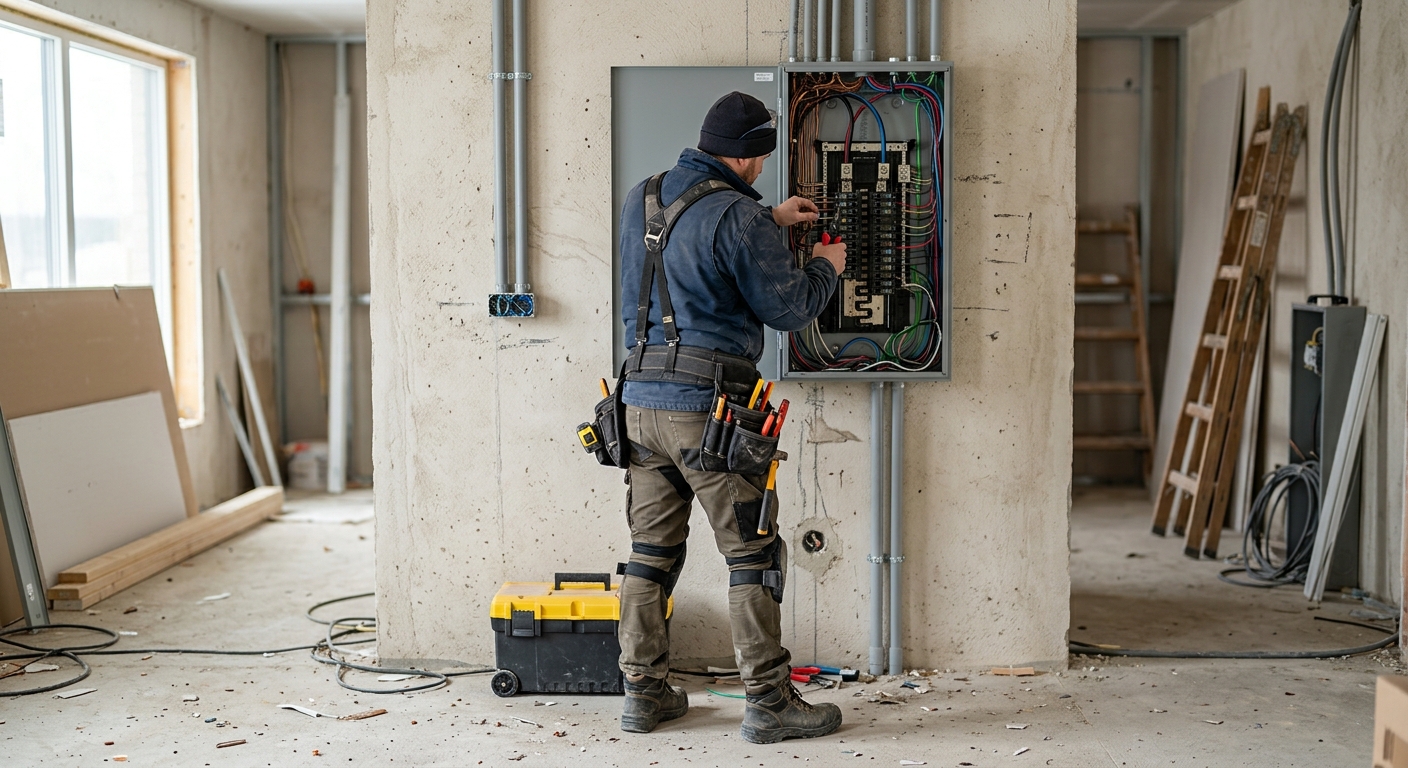
Electrical services and costs in Brantford
Brantford homeowners often find that electrical costs are tightly linked to what’s already in the home—especially because many houses here were built long before today’s electrical standards. In the 2021 Census, 62.8% of homes in the area were built before 1981, and that older housing stock is a prime driver of panel upgrades, knob-and-tube removal, and aluminum wiring remediation. Another reason electrical work tends to show up quickly during renovations is that many Brantford households are owner-occupied (27,505 homeowner households, 66.0% of households own), so projects like finished basements, adding heat pumps, or upgrading kitchens happen with regularity rather than “someday” planning (Statistics Canada, 2021 Census).
Across the Hamilton–Niagara Peninsula, winters can be hard on peak electrical demand, particularly where homes rely on electric baseboard or have multiple high-draw appliances running at once. That market pressure means contractors frequently schedule work around permit capacity with the Electrical Safety Authority (ESA) and utility timelines, which can affect how quickly an upgrade can start. In areas like the north end around West Brant, as well as older pockets closer to the downtown core, it’s common to see service sizes running at 60–100A that need to be increased to support modern loads such as EV chargers, heat pumps, and hot tubs.
When you compare quotes, use the ranges below as a realistic baseline for Brantford scope planning—then confirm the details during the site visit and load calculation.
| Service |
Why It's Needed |
Permit Required |
Price Range |
| Panel upgrade — 100A to 200A service |
Provides capacity for modern loads (EV charging, heat pumps, induction ranges) and improves safety by bringing the home closer to current requirements. |
Yes (ESA permit + inspection) |
$1,800 – $4,500 |
| EV charger installation (Level 2, 40–50A) |
Adds dedicated power for faster charging and reduces nuisance loads on existing circuits. |
Yes (ESA permit + inspection) |
$1,000 – $3,500 |
| Knob-and-tube wiring removal and replacement |
Older K&T wiring can be difficult to safely extend and is a common reason insurance coverage is limited; replacement reduces fault risk. |
Yes (typically full permit for rewiring) |
$8,000 – $20,000 |
| Aluminum wiring remediation (CO/ALR connectors) |
Restores safe terminations where aluminum conductors are present and properly addressed with approved methods. |
Yes (as major work; ESA inspection) |
$8,000 – $16,500 |
| New dedicated circuit (HVAC, appliance, hot tub) |
Dedicated circuits keep high-draw equipment from overloading shared wiring and improve reliability. |
Yes (new circuit/branch work) |
$700 – $2,800 |
| Whole-home rewire (older home, full replacement) |
Best option when wiring is aged, mixed, inaccessible, or when safety and code compliance require full modernization. |
Yes (major permitted rewiring) |
$14,000 – $28,000 |
Prices are estimates only and vary by project scope, site access and material selection.
What affects the price of electrical work in Brantford
In Brantford and the broader Hamilton–Niagara Peninsula, quotes for the same electrical upgrade can swing by about 30–50% because older wiring conditions and access issues aren’t visible until the electrician opens walls, measures conductor sizes, and confirms panel capacity. The biggest cost driver here is the region’s housing age: when homes were built before modern standards, you’re more likely to run into knob-and-tube sections, mixed materials, or early aluminum installations that require specific remedial methods. In homes from the 1960s to mid-1970s, aluminum wiring is often present and may need licensed remediation with approved connectors (or, in some cases, full replacement).
At the same time, newer loads are arriving faster than older panels can handle. EV chargers are a good example: Level 2 installs commonly require a 40–50A circuit, and when paired with existing electric heat or heat pumps, a 60–100A panel can become inadequate. That’s why many homeowners see service upgrades in the $1,800 – $4,500 band for typical 100A-to-200A work, while more complex rewires fall into the $8,000 – $20,000 range depending on how many rooms and circuits need replacement.
Concrete Brantford factors that raise costs include tight crawlspaces, knob-and-tube hidden behind plaster, aluminum terminations that require extensive verification at splices and outlets, and utility coordination for service changes. Costs can be lower when the home already has copper wiring, panel space is available, and the electrician can reuse existing cable routes. Finally, EV adoption is pushing more ESA permits through for charging circuits, which can make scheduling and labour availability a little tighter during peak renovation months.
| Price Factor |
Why It Matters |
Cost Impact |
| Panel size upgrade — 100A to 200A is the standard minimum today |
Increases available capacity for modern household loads and improves safety margins. |
$1,800 – $4,500 typical range |
| Wiring type — copper vs. aluminum remediation vs. K&T removal |
Different materials require different labour methods, approved terminations, and verification work. |
$8,000 – $20,000 for major remediation/removal |
| Number of new circuits — each adds material and labour time |
More circuits typically mean more cable runs, breakers, boxes, and terminations. |
Often adds several hundred to a few thousand per circuit |
| Permit + ESA/TSBC inspection fee — mandatory for all major work |
Major electrical changes require permits and inspections before energization or service finalization. |
Can add noticeable fixed overhead to the quote |
| Labour rate for licensed electricians — journeyman rates in {region} |
Complex troubleshooting and wall access time are billed labour-intensive. |
Labour differences can swing the total by 15–30% |
| EV charger amperage — 40A vs. 50A circuit affects cable and breaker cost |
Higher amperage can require heavier cable, different breaker sizing, and sometimes more panel capacity. |
Often a few hundred dollars difference within the install band |
| Emergency or after-hours premium |
Urgent call-outs include scheduling costs and faster turnaround labour. |
Frequently adds a premium (commonly 25–50% on labour) |
| Load calculation required for service upgrade |
ESA- and utility-facing scope depends on documented load; underestimating can force rework. |
May add analysis time but prevents costly changes later |
Permits & regulations in Ontario
In Ontario, ALL electrical work beyond changing a light bulb must be done by a licensed electrician. That includes panel upgrades (like 100A to 200A), adding new circuits, rewiring work, and EV charger installations. For many residential projects, a permit is required and the Electrical Safety Authority (ESA) must inspect the completed work before the utility finalizes a service change. DIY electrical is prohibited for most work, and homeowner “exceptions” are narrow; even when you can do non-electrical preparation, the permitted electrical portion still requires a licensed contractor, permits, and inspection sign-off.
What typically DOES require a permit in Brantford: any new branch circuit, replacing or upgrading the main panel, disconnecting/reconnecting service equipment, rewiring (including significant replacement of conductors), installing an EV Level 2 circuit, and correcting safety-critical defects found during inspection. What typically does NOT require a permit: swapping a fixture or bulb where the wiring is unchanged, replacing a receptacle with an identical type where permitted by local practice and not involving new circuits, and basic non-electrical accessories (subject to the existing installation being safe and intact).
To verify a contractor in Brantford, start by checking the Ontario electrician’s licence through the ESA’s online resources or relevant provincial listing, then ask for a current certificate of insurance showing liability coverage. Next, request proof of WSIB/WCB coverage (or an exemption letter if applicable). Finally, ensure you get a clearance letter/permit reference tied to ESA inspection—your paperwork should match your address and scope before the utility energizes anything new.
When your Brantford home needs an electrical upgrade
Brantford homes often give clear warning signs long before there’s a failure. The first is breakers that trip regularly—especially when the trips happen during normal household use—because that usually points to overloaded circuits, failing breakers, or wiring that can’t safely handle modern load patterns. The second red flag is knob-and-tube wiring. This isn’t just “old”: the concern is insulation condition and the way K&T connections can fail over time, which can trigger insurance issues and inspection concerns. The third is an undersized service, commonly 60A or 100A. With EV chargers, heat pumps, and even electric stoves running together, a 200A upgrade is often the standard solution rather than chasing endless smaller fixes.
Fourth, aluminum wiring in pre-1976 homes may not be immediately dangerous if it was installed and maintained well, but it does require licensed remediation and correct terminations (CO/ALR connectors where appropriate). Fifth, insufficient outlets and reliance on extension cords are a reliability/safety issue and often reveal code non-compliance; you may need new circuits and properly located receptacles. Sixth, missing AFCI/GFCI protection where required can surface during home sales or inspections—so planning the upgrade can prevent delays and unexpected costs.
Because winters in Brantford can push continuous-use heating, load calculations and capacity planning matter. If you’re choosing between a limited “fix” and a properly designed upgrade, the dollar difference can be justified: for example, a typical 100A to 200A service upgrade can land in the $1,800 – $4,500 band, and that investment often prevents repeat panel/circuit work when you add an EV charger later.
| Warning Sign |
What It Means |
Recommended Action |
Urgency |
Price Band |
| Breakers trip frequently |
May indicate overload, failing breakers, or wiring with inadequate capacity. |
Schedule an electrical inspection and load evaluation; replace/repair the fault and consider circuit/panel upgrades. |
Immediate to urgent |
$700 – $4,500 |
| Knob-and-tube wiring present |
Aged wiring with insulation concerns; insurance/inspection challenges are common. |
Plan removal/replacement of K&T sections and rewire affected areas to modern standards. |
Urgent/plan soon |
$8,000 – $20,000 |
| 60A or 100A panel (inadequate load capacity) |
Likely can’t support modern peak loads safely (EV charging, heat pumps, electric range). |
Perform load calculation and upgrade service—commonly to 200A. |
Urgent for upgrades |
$1,800 – $4,500 |
| Aluminum wiring (pre-1976 construction) |
Can be safe when properly installed, but terminations/splices may need remediation. |
Have a licensed electrician assess and remediate with approved methods, or rewire sections if required. |
Planned/soon |
$8,000 – $16,500 |
| Insufficient outlets — extension cords everywhere |
Often indicates overloaded circuits and poor outlet distribution. |
Add receptacles and dedicated circuits as needed; tidy up wiring to eliminate extension cord dependence. |
Planned but not ignored |
$700 – $2,800 |
| No AFCI or GFCI protection where required |
Higher shock/fire risk and potential compliance issues during sales/inspections. |
Install required devices/breakers and correct unsafe wiring paths. |
Planned soon |
$150 – $2,500 |
How to choose a electrical work contractor in Brantford
Choosing the right contractor in Brantford is about verification and clarity, not just the lowest number. First, confirm Ontario licensing: ask for the contractor’s licence number and verify it through the Electrical Safety Authority (ESA) resources. Next, request proof of liability insurance and check that it’s current and covers the type of residential work being quoted. Then ask for WSIB/WCB coverage details—either proof of coverage or an exemption letter if the contractor is legitimately exempt.
Get 2–3 itemised written quotes rather than a single lump sum. A good quote breaks labour and materials out clearly: panel equipment, breakers, cable types, permit handling, and disposal/cleanup. Read the scope carefully for what’s excluded. For example: is the ESA permit pull included, is drywall repair included (or specifically excluded), and is any old equipment disposal part of the price? Scope clarity matters because the real cost drivers in Brantford—like hidden wiring issues in pre-1981 homes—can turn a “simple” panel upgrade into rework if the electrician didn’t allow for inspection findings.
On payment, never agree to more than 10–15% upfront. Use a holdback until the job is complete, inspected, and handed over with documents. Timeline matters too—get a start date and completion estimate in writing so you’re not stuck waiting on inspections or utility coordination.
- Verify ESA-related licensing information before any work starts.
- Confirm liability insurance is active and request a copy of the certificate.
- Check WSIB/WCB coverage (or a proper exemption letter).
- Require itemised pricing: labour, materials, permits, and any required load calculations.
- Ask whether permit pull and ESA inspection fees are included or billed separately.
- Confirm cable type, breaker sizes, and panel model allowances in writing.
- State what the electrician will do if they find knob-and-tube or aluminum issues.
- Clarify drywall patching, painting, and disposal/hauling responsibilities.
- Get workmanship warranty terms in writing and understand what voids it.
- Confirm manufacturer warranty coverage for chargers/panels and whether it transfers.
- Use a payment schedule with no large upfront deposits; keep a holdback.
- Request a written start date, work hours, and estimated completion timeline.
Red flags in Brantford include: refusing to provide licensing/insurance proof, quoting a “flat” price without visiting the panel/wiring first, not discussing ESA permitting and inspection steps, asking for most payment upfront, and failing to produce an itemised scope (especially for service upgrades or EV circuits).
Frequently asked questions — electrical work in Brantford
How much does a panel upgrade cost in Brantford?
In Brantford, a typical panel upgrade for a service increase from 100A to 200A usually falls within the $1,800 – $4,500 range, depending on access, panel location, required conduit/wiring updates, and whether the upgrade is part of a larger project like rewiring. Because a lot of homes here were built before 1981 (62.8% built before 1981) and many are in the owner-occupied market (66.0% own), it’s common to find older wiring conditions during inspection. In the Hamilton–Niagara Peninsula, winter peak demand can also mean load calculations are taken seriously when you’re adding EV charging or high-draw heating. A proper quote should include ESA permit handling and an inspection pass, plus any utility coordination items if the service is being changed.
Do I need to upgrade to a 200A panel?
You may not always need 200A, but in Brantford it’s a very common “safe minimum” when you’re adding modern loads. If you already have a 60–100A service and plan for an EV charger, heat pump equipment, a new electric range, or a hot tub, a load calculation often shows the panel will be too tight for safe operation. That’s especially likely in older housing stock where circuit layouts may not align well with today’s consumption patterns. If you’re staying with modest updates and your existing panel has adequate capacity and spare breaker spaces, you might avoid a full service upgrade. Still, electricians usually recommend doing the math first. As a budgeting baseline, many homeowners plan for the $1,800 – $4,500 band when a 100A-to-200A upgrade is required and permitted through ESA.
How much does an EV charger installation cost in Brantford?
For a Level 2 EV charger installation in Brantford, many residential projects price in the $1,000 – $3,500 band. Final cost depends on charger amperage (commonly 40A or 50A), breaker and cable sizing, mounting location, panel capacity, and whether new conduit/cabling runs are needed. Older homes may also need additional upgrades if the panel can’t support the load, which can shift the job toward a service upgrade budget. ESA permits are mandatory for new charger circuits, and the inspection must pass before the change is finalized. If you’re in an older neighbourhood and the wiring path is tight, expect more labour time for safe routing. The best way to keep the quote accurate is to ask for an itemised breakdown and confirm what amperage you’re purchasing and installing.
What is knob-and-tube wiring and should I replace it?
Knob-and-tube (K&T) wiring is an older wiring system that uses ceramic knobs and tubes to route and support conductors. In Brantford homes, it’s often encountered in older pre-standard houses, and it’s a safety and compliance concern—not just because it’s old. The insulation condition, the way connections age, and how it handles today’s load expectations can lead to insurance and inspection issues. If K&T is present, replacement is usually the recommended path, especially when you’re planning renovations or adding new circuits (like EV charging). Replacement can be a larger budget item: major rewiring and K&T removal/replacement often falls into the $8,000 – $20,000 range depending on the number of rooms and how much wiring must be replaced. An electrician should assess what’s in place, recommend a scope that’s safe and insurable, and route everything through the ESA-permitted inspection process.
Is aluminum wiring safe in older Brantford homes?
Aluminum wiring can be safe when it was installed correctly and, crucially, when connections and terminations are properly handled. In older Brantford homes, aluminum wiring is more likely in certain construction eras, and over time some terminations can loosen or overheat if they weren’t made with compatible methods. That’s why licensed remediation matters: the electrician should inspect junctions and outlets, then address issues with approved connector methods (commonly CO/ALR techniques) or recommend rewiring in sections when remediation isn’t sufficient. Even when it’s not immediately dangerous, it’s often a “time-bomb” risk at the terminations rather than the wire itself. Budget-wise, aluminum remediation commonly lands in the $8,000 – $16,500 band depending on how extensive it is. The ESA inspection requirement is part of what keeps these projects safe and properly documented.
Do I need a permit for electrical work in Ontario?
In Ontario, permits are required for most electrical work that changes the system—so in Brantford, you should expect a permit when you’re doing panel upgrades, new circuits (including EV charger circuits), rewiring, or service equipment changes. ESA oversees permits and inspections in Ontario, and permitted work must pass inspection before the system is considered compliant and, for service changes, before the utility finalizes. DIY electrical beyond very minor tasks isn’t permitted, and homeowner exceptions are narrow. In practical terms: swapping fixtures and basic like-for-like replacements typically don’t trigger the same permit requirements as a new breaker/circuit or any service/panel alteration. When you meet a contractor, ask what permit is being pulled, who pulls it, and how you’ll receive the permit/inspection documents after completion.