Electrical services and costs in Hespeler
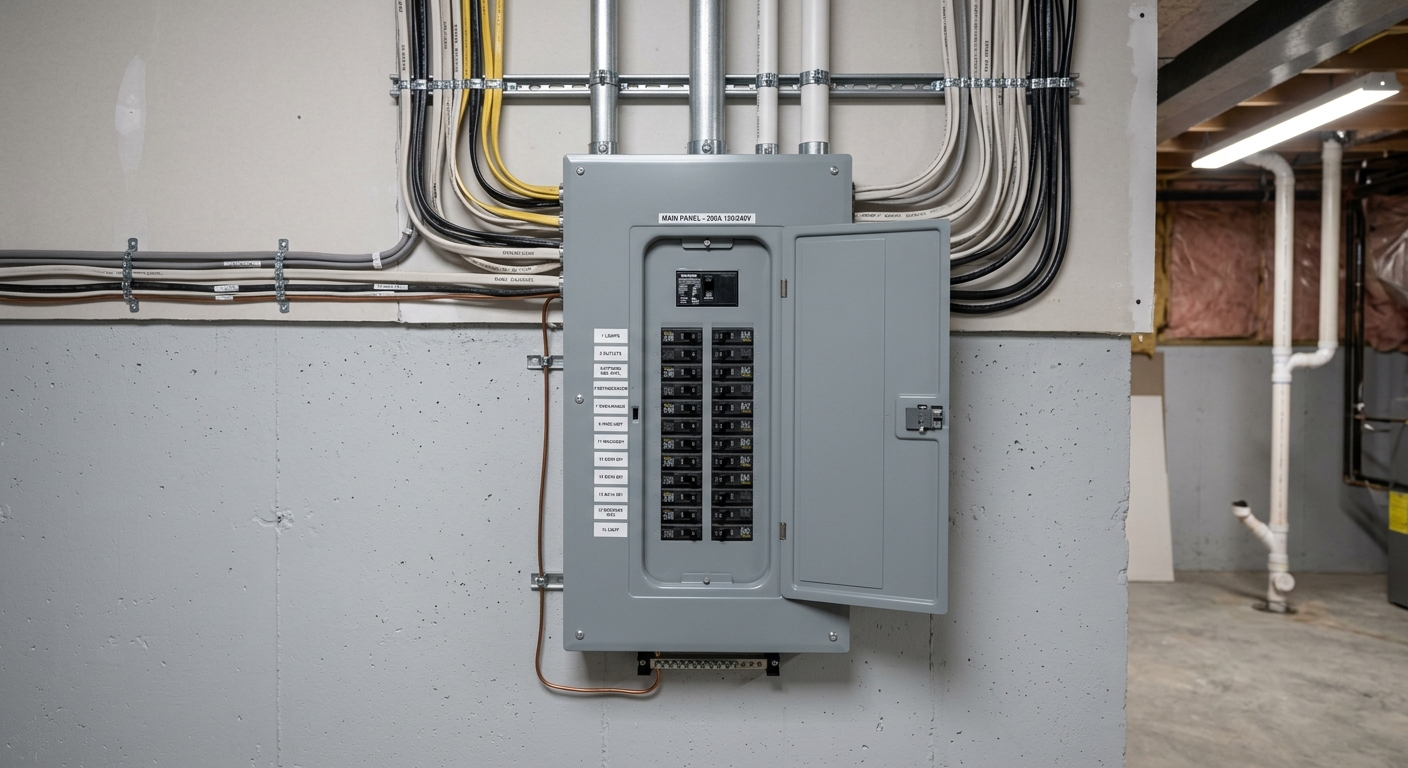
Electrical services in Hespeler often start with the realities of the local housing stock: with a population of 18,445 (Statistics Canada, 2021 Census), the neighbourhood mix includes many older properties where electrical systems were designed for much lower appliance and heating loads. If your home was built before 1950, it’s more likely to have knob-and-tube wiring or early-era components that are difficult to retrofit safely and may trigger insurance concerns. In the 1960s through 1970s, it’s also common to find mid-century 60A or 100A panels and aluminum branch wiring—both of which frequently can’t support today’s combinations of EV charging, heat pumps, electric ranges, and home offices.
In the Toronto economic region, pricing is shaped by contractor demand and job complexity: dense older streets, condo-related labour availability pressures, and frequent infill work all affect scheduling and hourly rates. Winters around Hespeler can also increase on-site time because panel/service work and troubleshooting happen in harsher conditions (warmer-air drying and careful testing take longer). Areas near downtown-style streets and established pockets around Queen Street tend to see steady demand because there are more homes that pre-date modern electrical loads—so turnaround times can vary, especially in spring and summer when renovations spike.
Below is a practical baseline to help you compare estimates, before your electrician confirms the scope (panel condition, wiring type, accessibility, and whether service upgrade is required).
| Service |
Why It's Needed |
Permit Required |
Price Range |
| Panel upgrade — 100A to 200A service |
Modern loads (EV charging, heat pumps, electric cooking, basement finish) often exceed older panel capacity and breaker layouts. |
Yes (permit + inspection) |
$2,500 – $6,000 |
| EV charger installation (Level 2, 40–50A) |
Dedicated circuit and correct breaker/cable sizing so the charger runs safely and reliably. |
Yes (permit + inspection) |
$900 – $2,500 |
| Knob-and-tube wiring removal and replacement |
Eliminates aging insulation risks and brings the home to a safer, serviceable wiring standard. |
Yes (permit + inspection) |
$3,000 – $15,000 |
| Aluminum wiring remediation (CO/ALR connectors) |
Improves connection reliability where aluminum branch wiring exists (typically pre-1976 construction). |
Yes (permit + inspection for remedial work) |
$3,000 – $10,500 |
| New dedicated circuit (HVAC, appliance, hot tub) |
Prevents overloaded existing circuits and supports equipment start-up current demands. |
Usually yes for new circuits and major receptacles |
$650 – $3,500 |
| Whole-home rewire (older home, full replacement) |
For extensive K&T/aluminum issues or when the home needs a complete modernization of outlets, grounding, and panel capacity. |
Yes (permit + inspection) |
$8,000 – $20,000 |
Prices are estimates only and vary by project scope, site access and material selection.
What affects the price of electrical work in Hespeler
In Hespeler and across the Toronto economic region, two homeowners can receive quotes that differ by 30–50% for what sounds like the same electrical task. The usual reason isn’t “different electricians,” it’s different job conditions: wiring accessibility (finished drywall vs. open studs), whether the work triggers a service upgrade, and how much troubleshooting is required to make the system safe and code-compliant under the Ontario Electrical Code. Permit and inspection requirements also add fixed costs, but labour and materials swing most with complexity.
Housing age is the dominant cost driver here. Older homes can have knob-and-tube wiring, early insulating materials, and ungrounded or undersized circuits—so a simple “add a circuit” request can turn into a partial rewire. Homes from the 1960s–70s often have aluminum branch wiring and panels that were adequate for past loads, yet today’s demands include EV chargers and heat pumps plus growing receptacle usage. Aluminum remediation typically requires approved CO/ALR connectors or replacement where conditions demand it, and that takes licensed, careful work.
EV adoption is also moving the market: Level 2 charger permits and the need for load calculations are more common, especially when a home’s panel is already near capacity. For example, if your home needs a 200A upgrade, that standard minimum today can place you in the $2,500–$6,000 panel/service range—while adding a charger circuit separately may still be in the $900–$2,500 band when trenching and cable routing are straightforward. By contrast, an older home with inaccessible wiring pathways can push rewiring into higher bands because labour time grows with each box, chase, and connection.
| Price Factor |
Why It Matters |
Cost Impact |
| Panel size upgrade — 100A to 200A is the standard minimum today |
Ensures breakers, bus capacity, and future expansion for modern loads. |
$2,500 – $6,000 |
| Wiring type — copper vs. aluminum remediation vs. K&T removal |
Aluminum connections and knob-and-tube components require remediation or replacement to meet safe practices. |
$3,000 – $15,000 |
| Number of new circuits — each adds material and labour time |
More boxes, conductors, breaker spaces, and testing increases time. |
$650 – $3,500 |
| Permit + ESA/TSBC inspection fee — mandatory for all major work |
Inspection and permit costs are fixed and required for safety-critical electrical changes. |
$200 – $500 |
| Labour rate for licensed electricians — journeyman rates in {region} |
Toronto-area labour demand affects the effective hourly rate and scheduling. |
$90 – $120/hr |
| EV charger amperage — 40A vs. 50A circuit affects cable and breaker cost |
A higher-amp run generally needs larger conductors and can require additional load provisions. |
$900 – $2,500 |
| Emergency or after-hours premium |
Scheduling priority and extra safety procedures increase labour cost. |
$250 – $800 |
| Load calculation required for service upgrade |
Confirms safe capacity and breaker allocation under modern load assumptions. |
$150 – $600 |
Permits & regulations in Ontario
In Ontario, ALL electrical work beyond changing a light bulb must be done by a licensed electrician. That includes panel upgrades, adding or replacing breakers, new circuits and outlets, rewiring, and anything that changes the service arrangement—plus EV charger installations. Permits are required for most major work, and the permitted work must pass inspection by the Electrical Safety Authority (ESA). In practice, this is why you’ll often see your quote separated into labour/materials plus permitting and inspection handling—those steps aren’t optional.
Work that typically does not need a permit is limited to simple, non-electrical changes like swapping a fixture with the power disconnected by a qualified person, replacing a like-for-like switch or receptacle only when it’s a like-for-like repair and your electrician determines it doesn’t require modifications (your contractor should confirm). If you’re doing anything that involves opening the panel, adding conductors, altering wiring, installing a new breaker/circuit, or relocating outlets/receptacles, assume it requires a permit and inspection.
To verify your contractor in Hespeler step-by-step, ask for (1) their Ontario electrician licence number and confirm it through the provincial licence registry, (2) a current certificate of insurance showing liability coverage and the job location, and (3) evidence of WSIB/WCB coverage (or the appropriate clearance letter/registration details, depending on how the company is set up). Then confirm the ESA permit will be pulled by the licensed company and that they will schedule the inspection after energization.
When your Hespeler home needs an electrical upgrade
Electrical upgrades in Hespeler are usually driven by safety and code compliance—not just convenience. Here are the warning signs that point to a real problem. First, breakers that trip regularly (especially when running heat pumps, hair dryers, or kitchen appliances) can indicate an overloaded panel or undersized/aged circuits. If it’s happening more than occasionally, treat it as immediate—because repeated tripping can mean overheating or loose connections.
Second, if you discover knob-and-tube wiring, the key concern is insulation and connection integrity, not only the age. This is typically a planned upgrade that should be scheduled promptly; many insurers and home buyers will not accept it without remediation. Third, a 60A or 100A panel may work today but can become inadequate as soon as you add an EV charger or electric cooking at the same time as other loads. In modern Hespeler homes, the standard solution is often moving to a 200A upgrade, commonly in the $2,500–$6,000 band depending on whether service relocation or trenching is involved.
Fourth, aluminum wiring in pre-1976 homes isn’t always an emergency, but it must be handled with licensed remediation (CO/ALR connectors or replacement where required). Fifth, insufficient outlets and “extension cord living” is a practical warning: it pushes homeowners into unsafe temporary setups. Finally, missing or inadequate AFCI/GFCI protection can surface during sale inspections—turning a small compliance fix into a bigger circuit and breaker upgrade.
Given Hespeler’s cold-weather demands, electrical capacity matters more than people expect: heat pumps and winter power use can coincide with cooking, laundry, and EV charging patterns. For instance, spending on an electrical load plan and panel work up front may cost more than a “quick new outlet,” but it can prevent repeated service calls and major rewiring later.
| Warning Sign |
What It Means |
Recommended Action |
Urgency |
Price Band |
| Breakers trip frequently |
Overload, failing breaker, loose connections, or undersized circuits. |
Licensed troubleshooting; possible new dedicated circuits and panel/breaker corrections. |
Immediate |
$650 – $3,500 |
| Knob-and-tube wiring present |
Aging components and insulation risks; may affect insurance and sale approvals. |
Partial or full remediation/replacement as required for safe operation. |
Planned (soon) |
$3,000 – $15,000 |
| 60A or 100A panel (inadequate load capacity) |
Limited headroom for modern loads like EV chargers and heat pumps. |
Load calculation, then panel/service upgrade to 200A. |
Planned (before adding load) |
$2,500 – $6,000 |
| Aluminum wiring (pre-1976 construction) |
Connection heating risk if improper terminations exist. |
Remediate using approved CO/ALR connectors or replace affected sections. |
Planned |
$3,000 – $10,500 |
| Insufficient outlets — extension cords everywhere |
Safety risk from temporary loading and poor conductor connections. |
Add receptacles/circuits; check GFCI where required and balance loads. |
Planned |
$650 – $3,500 |
| No AFCI or GFCI protection where required |
Code-compliance gaps that may fail inspections or complicate resale. |
Upgrade breakers and/or install GFCI/AFCI protection to required areas. |
Planned (before sale/inspection) |
$200 – $2,500 |
How to choose a electrical work contractor in Hespeler
Choosing a contractor in Hespeler starts with proof, not promises. Verify the electrician is licensed in Ontario (ask for the licence number and confirm it through the provincial licence registry). Next, request liability insurance documentation showing the company is insured for work performed at your address. Finally, confirm WSIB/WCB coverage—either through clearance documentation or the company’s registration details—so you’re not left responsible if a worker is injured on your property.
Then get 2–3 itemised written quotes. You want a breakdown that separates labour, materials, permits, and any required electrical testing. Ask whether disposal is included (old panels, removed wiring, packaging), whether conduit and cable routing are part of the price, and whether the permit pull and ESA inspection scheduling are handled by the contractor. Avoid “lump sum” quotes that don’t explain what’s included; scope gaps are where cost creep happens.
Warranty should be specific: ask how long they guarantee workmanship and whether the manufacturer warranty on panels/chargers is separate. For payment, never agree to more than 10–15% upfront; use a holdback until the job is complete and inspected. Make sure you receive a start date and a completion window in writing so delays are clear. In busy GTA cycles, electricians who communicate inspection scheduling early tend to finish more predictably.
- Licence number confirmed for Ontario electricians
- Certificate of insurance with your project address listed
- WSIB/WCB coverage evidence before work begins
- Itemised quote (labour, materials, permitting, testing)
- Permit pull responsibility stated in writing
- ESA inspection included and scheduled after energization
- Clear scope exclusions (patching/drywall, trenching, landscaping restoration)
- Workmanship warranty length stated
- Manufacturer warranty details for panel/charger/components
- Payment schedule capped at 10–15% deposit; holdback included
- Estimated start date and completion timeline in writing
- Safety plan for occupied homes (parking, dust control, de-energization)
Red flags in Hespeler include: quoting a panel upgrade without checking your existing wiring type, refusing to itemise materials (especially breakers and conductors), asking for large upfront payments, skipping permit/inspection steps, or giving vague answers about warranty coverage for workmanship.
Frequently asked questions — electrical work in Hespeler
How do I know if my Hespeler home has aluminum wiring?
In Hespeler, aluminum wiring is most common in homes built roughly from the 1960s through the mid-1970s, but age alone isn’t proof. The most reliable approach is an electrician’s inspection of conductor markings. They typically look for “Al” marking on cable jackets, inspect terminations for proper connector usage, and check whether the connections were originally made with correct approved devices. If you’re seeing warm or discoloured breaker/fuse clips or frequent nuisance tripping on specific circuits, that can be a clue worth investigating. If aluminum is confirmed, remediation is often handled with CO/ALR connectors or replacement of affected sections—commonly falling into the $3,000–$10,500 range depending on how much work is accessible. In Ontario, this work should be permitted and inspected when connections or conductors are changed.
What is the cost of rewiring a house in Hespeler?
Rewiring costs in Hespeler depend heavily on whether you’re doing a whole-home replacement versus selective remediation. For many older homes with knob-and-tube wiring or extensive aluminum issues, the practical range can be broad: selective replacement and K&T removal/replacement commonly starts around the $3,000–$15,000 band, while full rewires often land higher when access is difficult (finished basements, limited chaseways, or multiple floors). If you also need a panel/service upgrade to support modern loads, you may add a $2,500–$6,000 panel upgrade component (often 100A to 200A as the standard minimum today). Costs can rise with trenching, service relocation, or when troubleshooting uncovers additional problem runs. Your electrician should itemise how much is “replace-and-restore” wiring versus “remediate connections” work, and confirm permit/inspection handling through ESA.
What electrical upgrades are required when selling a home in Ontario?
Ontario doesn’t require a homeowner to upgrade everything to today’s standards across the board, but sales can trigger requirements through safety and inspection outcomes. Common electrical “sell-side” issues include missing or inadequate GFCI/AFCI protection in areas where Ontario code requires it, problematic aluminum terminations, and outdated wiring that can fail an inspection—especially knob-and-tube wiring. Even if an issue isn’t immediately dangerous, it may block financing or insurance approval. If your home’s panel is undersized for modern loads, a service upgrade may be recommended by inspectors or electricians, particularly if the home already has electric heating or a planned EV charger. Plan for permitting where needed—new circuits, rewiring, and panel work must be done by a licensed electrician and inspected. The good news is that many sales repairs are smaller circuit and protection upgrades, often within the $200–$2,500 lighting/protection-style ranges, but the bigger-ticket items (like service/panel changes) frequently fall into the $2,500–$6,000 band.
What is a load calculation and why does my electrician need one?
A load calculation is an electrical assessment used to determine whether your existing service and panel can safely supply the power you intend to use. In Ontario, this becomes especially important when you’re upgrading a service (commonly from 100A to 200A), adding high-demand equipment, or installing an EV charger. Your electrician uses it to estimate heating, cooking, laundry, lighting, receptacle loads, and any future/known major loads, then designs the breaker layout accordingly so the system meets code requirements and doesn’t run too close to its capacity. In Hespeler, this matters because winter heating patterns and modern upgrades (heat pumps, electric ranges, EV Level 2 charging) tend to coincide in daily use. A proper calculation helps avoid paying for a “simple add-on” that can trigger nuisance trips or a bigger panel/service upgrade later. The result is more predictable costs and fewer surprises during ESA inspection.
How do I find a licensed electrician in Hespeler?
Start by asking the contractor for their Ontario licence details and then verify the licence through the provincial licence registry. Confirm the company is properly insured with a certificate of liability and ask for WSIB/WCB coverage evidence (or the appropriate clearance documentation). For Hespeler homeowners, you’ll also want to ensure they handle ESA permits and inspections for the scope you need—panel upgrades, rewiring, new circuits, and EV charger installations should always be permitted and inspected. Next, request 2–3 itemised written quotes so you can compare labour, materials, and permitting rather than only comparing the final number. A good contractor should explain what they’re including (trenching or cable routing, disposal, and testing) and schedule inspections once work is complete. If a contractor won’t provide licence/insurance/WSIB information up front, or suggests you can skip permits, that’s a strong warning sign in Ontario.
Can I add a subpanel to my Hespeler home?
Yes, a subpanel can be a good solution when you need more breaker space, want to organise loads, or are adding a basement suite, garage circuits, or an EV charging circuit in a neat and code-friendly way. However, whether you should add a subpanel or upgrade your main service depends on your existing panel capacity and wiring condition. If you have a 60A or 100A main panel, a subpanel alone may not solve the underlying load issue—often the recommended path is still a 200A panel/service upgrade first, typically in the $2,500–$6,000 range. A subpanel installation usually requires a permit and ESA inspection because it involves new feeders, breaker sizing, grounding/bonding, and careful circuit design. In older Hespeler homes with aluminum or knob-and-tube wiring, the electrician may also need to remediate portions of wiring before adding downstream panels. Ask your electrician to perform a load calculation and confirm the exact routing, feeder size, and grounding method before pricing.